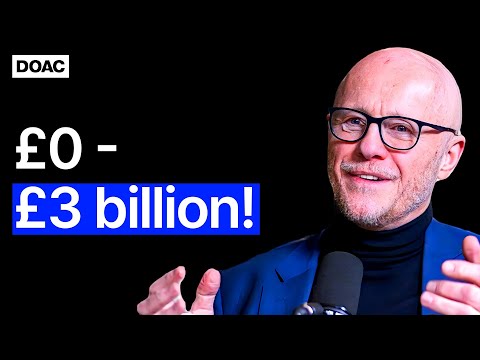
Phones 4u Founder: The Pain Of Becoming A Billionaire: John Caudwell | E124
Steven Bartlett (host), John Caudwell (guest)
In this episode of The Diary of a CEO, featuring Steven Bartlett and John Caudwell, Phones 4u Founder: The Pain Of Becoming A Billionaire: John Caudwell | E124 explores billionaire John Caudwell’s Hidden Costs Of Relentless Entrepreneurial Success John Caudwell, founder of Phones 4u, traces his journey from a tough, emotionally starved childhood in Stoke-on-Trent to building a £2.4 billion turnover empire with 12,000 employees, and the psychological and physical toll that journey took. He explores how early unfairness from his father hard‑wired his obsession with fairness, his extreme resilience, and his unforgiving standards as a leader.
Billionaire John Caudwell’s Hidden Costs Of Relentless Entrepreneurial Success
John Caudwell, founder of Phones 4u, traces his journey from a tough, emotionally starved childhood in Stoke-on-Trent to building a £2.4 billion turnover empire with 12,000 employees, and the psychological and physical toll that journey took. He explores how early unfairness from his father hard‑wired his obsession with fairness, his extreme resilience, and his unforgiving standards as a leader.
Caudwell details repeated near-terminal crises in business, including losing 90% of his revenue overnight when Motorola terminated his distributorship, and the brutal, unglamorous reality of working 22‑hour days under constant existential threat. He argues that true success comes from ruthless self-criticism, intelligent risk, and being “good at everything,” but admits that drive often tips into unfairness and costs relationships and health.
In the second half, he describes the pivot to philanthropy—founding Caudwell Children, pledging most of his wealth to charity, and the deep meaning he derives from transforming children’s lives versus material luxury. The most personal section covers his son Rufus’s devastating struggle with Lyme disease and PANS/PANDAS, and how wealth, persistence, and family support helped him back to a meaningful life.
Across the conversation, Caudwell returns to a few core principles: fairness as the primary virtue, resilience as partly innate, the danger of ego, the inevitability of crisis in entrepreneurship, and the idea that real fulfillment comes from leaving the world better than you found it, not from the money itself.
Key Takeaways
Early unfairness can hard‑wire a lifelong obsession with fairness and love.
Caudwell’s father was strict, emotionally distant, and likely suffering undiagnosed PTSD, enforcing bizarre standards (e. ...
Get the full analysis with uListen AI
Self‑criticism is a powerful engine for improvement—if paired with fairness.
He constantly scrutinized his own reactions and business systems, often realizing within minutes when he’d overreacted or been unfair. ...
Get the full analysis with uListen AI
True resilience blends innate wiring with early conditioning, but it’s not universal.
Caudwell believes he was born unusually resilient and that his tumultuous upbringing likely reinforced it. ...
Get the full analysis with uListen AI
Dependency risk can quietly kill a business; diversify aggressively using the ‘10% rule’.
When Motorola terminated his distributorship—90% of his revenue—he faced instant oblivion. ...
Get the full analysis with uListen AI
High‑performing cultures require a fine balance between motivation and ego control.
Caudwell admits he under‑praised people and was widely criticized for it, but says too much praise inflates ego and increases poaching risk, especially for star performers in a hot sector. ...
Get the full analysis with uListen AI
Extreme entrepreneurial drive is costly: expect health strain, emotional turmoil, and social sacrifice.
At one point he worked 22 hours a day for a week at a time, on tranquilizers, retching from stress while trying to protect his mother’s mortgaged home and keep a fledgling car business alive. ...
Get the full analysis with uListen AI
Lasting fulfillment comes more from impact and love than from wealth or status.
Despite the jets, boats and helicopter, his deepest satisfaction comes from helping over 60,000 children through Caudwell Children and seeing individual stories like Tilly’s journey from severe muscular atrophy to Stanford University. ...
Get the full analysis with uListen AI
Notable Quotes
“Failure or difficulties teach you a lot more than success, because if you're analytical and you look at what went wrong, you can learn so much from it.”
— John Caudwell
“It's not our successes that make us successful. It's our failures and what we get wrong, and putting them right.”
— John Caudwell
“Every challenge in life, whether it's business, personal, or anything, it's just that – it's a challenge, and there's always a solution.”
— John Caudwell
“I was sitting on the edge of my seat nearly every day for 20 years, facing threat after threat after threat after threat.”
— John Caudwell
“I can have all the boats in the world, all the helicopters, all the trappings… but without changing a child's life, they wouldn't mean much to me.”
— John Caudwell
Questions Answered in This Episode
In hindsight, is there a specific decision or deal during the Motorola crisis that you now recognize as the true hinge point between bankruptcy and survival, and would you handle that moment any differently today?
John Caudwell, founder of Phones 4u, traces his journey from a tough, emotionally starved childhood in Stoke-on-Trent to building a £2. ...
Get the full analysis with uListen AI
You argue that fairness is the number-one human quality; can you describe a concrete situation where sticking rigidly to fairness cost you commercially, and whether you’d still make the same call?
Caudwell details repeated near-terminal crises in business, including losing 90% of his revenue overnight when Motorola terminated his distributorship, and the brutal, unglamorous reality of working 22‑hour days under constant existential threat. ...
Get the full analysis with uListen AI
Given how violently the mobile phone industry treated you at times, why did you choose to build such a high-pressure, unforgiving culture internally instead of deliberately designing a softer one as a counterweight?
In the second half, he describes the pivot to philanthropy—founding Caudwell Children, pledging most of his wealth to charity, and the deep meaning he derives from transforming children’s lives versus material luxury. ...
Get the full analysis with uListen AI
If you had to start Caudwell Children from scratch today, armed with what you’ve learned from Rufus’s journey with Lyme and PANS/PANDAS, how would you structure its focus, research agenda, and advocacy differently?
Across the conversation, Caudwell returns to a few core principles: fairness as the primary virtue, resilience as partly innate, the danger of ego, the inevitability of crisis in entrepreneurship, and the idea that real fulfillment comes from leaving the world better than you found it, not from the money itself.
Get the full analysis with uListen AI
You say you felt you had ‘no choice’ but to pursue wealth in order to give it away; what would you say to a talented 20‑year‑old who feels a similar sense of destiny but is already showing signs of burnout?
Get the full analysis with uListen AI
Transcript Preview
Could you do me a quick favor if you're listening to this? Please hit the follow or subscribe button. It helps more than you know, and we invite subscribers in every month to watch the show in person.
I grew from nothing to 12,000 employees, 2.4 billion turnover.
Jon Caudwell, the billionaire founder of Phones 4U. As it relates to his wealth, he has it all, but it's come at a real cost.
I was sitting on the edge of my seat nearly every day for 20 years, facing threat after threat after threat after threat. It did nearly finish me, and I think anybody's would, you know, because you can't work 22 hours a day-
Hmm.
... under immense pressure. It was a monster deal, the biggest that'd ever been done in the marketplace by anybody.
Hmm.
You know, I don't mind fair competition, but it was very unethical. If I didn't find a solution, it was instantly terminal. You know, my turnover was going to drop immediately. My stores were empty. Nothing. I'd have been bankrupt, and I wouldn't be here talking to you today.
Without further ado, I'm Steven Bartlett, and this is The Diary of a CEO. I hope nobody's listening, but if you are, then please keep this to yourself. (upbeat music) "I suppose if I'd had a little bit more love, I would've been happier." Do you remember saying that?
(laughs) I don't actually, but I can understand why I might have said it.
Why do you think you might have said that?
Um, it's, yeah, it- it would certainly be to do with my childhood, um, because my father was, uh, not the kindest to me. Uh, not abusive, but, no... In a way, I, you know, in a way maybe he was abusive, but not abusive in the way normal sense of it. He just wasn't very fair with me, and certainly not very affectionate. And I think my mother was struggling through all those early childhood years. So I understand completely why I might say, "If I'd had a bit more love, I might have been happier." Uh, so it's, it's quite a true point.
When you say your father wasn't so kind to you, was that because he was, he was suffering with something or he was... Did you ever diagnose why he wasn't kind to you?
Not at the time, but in more recent years probably came to understand it. I think, um, I think certainly one of the points was that I was quite a rebellious child. Uh, we were brought up, uh, in the back streets of Stoke-on-Trent, in the terraced houses and, uh, you know, it was football in the streets and your mother coming down the road shouting for you and I'd go hiding. And all my mates would say, when- when they, when she asked where I was, "Oh, we don't know. We haven't seen him." And I'd be hiding behind somebody's front courtyard wall. So I was a nuisance and, uh, you know, I was difficult, uh, as a child and, uh, very adventurous, wanted excitement all the time. And that for parents is very, very difficult, so I think that was probably one of the things. But I think also he'd been brought up with certain strange values really that didn't really work very well. He hadn't made a, uh, a transition to yet a different generation, so he put me on an old Army and Navy shoes from the Army and Navy store, uh, which crippled me. And so I was out in the streets, you know, playing football and so on, and expected to keep these shoes perfectly, like you might be in the army, and when I came back with them scuffed, I was in serious trouble. And I couldn't stop them from being scuffed. At the same time, my feet were crippled. It- it just got some strange values. I mean, I- I suppose, uh, in today's age you would say that was child abuse, but, um, um, it was just the way he was and I d- and I think, uh, when I've spoken to s- some of his friends, um, over the last 30, 40 years, they think that he came back with PTSD from the war, and of course it was never diagnosed in those days, um, and- and he- he came back and he'd got a lot of wonderful qualities. He would never see anybody in trouble. He was almost the first AA without it being paid for because he was an engineer, very capable, very eng- ingenious, and any car broken down on the roadside where people were in trouble, he'd just stop and help them out. I'd be quite grateful to that on one- one count, um. Uh, I'd have to wait in the car for an hour while he fixed the car, but I knew a, you know, a couple of shillings or a half a crown was gonna come my way as a result.
Install uListen to search the full transcript and get AI-powered insights
Get Full TranscriptGet more from every podcast
AI summaries, searchable transcripts, and fact-checking. Free forever.
Add to Chrome