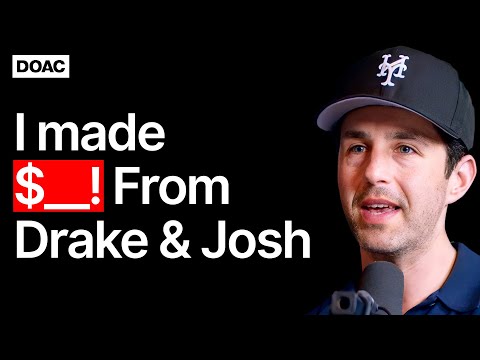
Josh Peck: The Surprising Truth Behind The 127lb Weight Loss | E238
Josh Peck (guest), Steven Bartlett (host)
In this episode of The Diary of a CEO, featuring Josh Peck and Steven Bartlett, Josh Peck: The Surprising Truth Behind The 127lb Weight Loss | E238 explores josh Peck Reveals Addiction, Father Wounds, And True Weight Loss Journey Josh Peck traces his story from a loving but financially unstable single-mother household in New York to early fame on Nickelodeon and Drake & Josh. Despite losing 127 pounds at 18 and achieving career success, he describes how unresolved pain from his absent father and deep insecurity simply migrated from food to alcohol and drugs. A rock-bottom moment at 21 led him into 12‑step recovery, where he learned that action, service, and accountability—not willpower or success—transformed his thinking. Now a husband and father, he reframes his past, makes emotional peace with the father he never met, and explains the daily tools he uses to keep self‑destructive tendencies at bay.
Josh Peck Reveals Addiction, Father Wounds, And True Weight Loss Journey
Josh Peck traces his story from a loving but financially unstable single-mother household in New York to early fame on Nickelodeon and Drake & Josh. Despite losing 127 pounds at 18 and achieving career success, he describes how unresolved pain from his absent father and deep insecurity simply migrated from food to alcohol and drugs. A rock-bottom moment at 21 led him into 12‑step recovery, where he learned that action, service, and accountability—not willpower or success—transformed his thinking. Now a husband and father, he reframes his past, makes emotional peace with the father he never met, and explains the daily tools he uses to keep self‑destructive tendencies at bay.
Key Takeaways
Losing weight doesn’t fix the underlying emotional cause; it only changes the symptom.
Peck lost 127 pounds between 17–18 by walking, making small daily changes, and improving his diet. ...
Get the full analysis with uListen AI
Food, substances, and other compulsions often function as emotional medicine, not simple ‘bad habits.’
From childhood, Peck used TV and comedy as escapes and food as his “first love” and primary coping mechanism. ...
Get the full analysis with uListen AI
Success and external validation cannot fill an internal void.
Even after a standing ovation at Sundance for The Wackness and acting with Ben Kingsley, Peck’s old feelings of inadequacy flooded back the next day. ...
Get the full analysis with uListen AI
Addiction often transfers forms unless the core discomfort is treated.
When Peck lost weight, the emotional “weight vest” was still there. ...
Get the full analysis with uListen AI
Recovery is driven by consistent action, not trying to ‘think your way’ out of problems.
Through 12‑step recovery, Peck learned that “you cannot think your way into right acting; you have to act your way into right thinking. ...
Get the full analysis with uListen AI
Our view of absent or harmful parents can change when we see their full humanity.
After his father’s death, Peck tracked down his half‑siblings on Facebook and saw photos and tributes that revealed his dad as a loving, involved father—to them. ...
Get the full analysis with uListen AI
Stable, committed relationships require unlearning avoidance and tolerating conflict.
Peck admits his pattern was the “Tony Montana approach”: if anything went wrong, he’d bail—assuming conflict meant the end. ...
Get the full analysis with uListen AI
Notable Quotes
“I dealt with the effect, but I didn’t deal with the cause.”
— Josh Peck
“My disease lies in my dis‑ease… it numbs the feeling, but it never deals with the underlying issue.”
— Josh Peck
“If you spend all your time thinking about how great you are or how shit you are, all you’re thinking about is you.”
— Josh Peck
“Everything was going right, and I still didn’t feel like enough.”
— Josh Peck
“You cannot think your way into right acting. You have to act your way into right thinking.”
— Josh Peck
Questions Answered in This Episode
You describe losing 127 pounds through small daily changes rather than extreme dieting—if you were designing a specific 30‑day plan for someone using that same philosophy, what would it look like in practical detail?
Josh Peck traces his story from a loving but financially unstable single-mother household in New York to early fame on Nickelodeon and Drake & Josh. ...
Get the full analysis with uListen AI
When you saw your father portrayed as a loving dad in your half‑siblings’ Facebook photos, did any specific belief about yourself instantly change, or was it more of a slow emotional shift over months and years?
Get the full analysis with uListen AI
You’ve said your real issue was self‑centeredness rather than just self‑hatred—can you walk through a recent day where you caught that pattern in real time and how you interrupted it before it led to old behaviors?
Get the full analysis with uListen AI
Given your experience with child stardom and the financial reality behind Drake & Josh, what concrete protections or industry changes would you implement for young performers if you were running a kids’ network today?
Get the full analysis with uListen AI
For people who resonate with your story but aren’t sure whether their behavior counts as ‘addiction’ or just ‘bad habits,’ what specific signs or internal checkpoints would you suggest they look for before deciding to seek help or try a 12‑step program?
Get the full analysis with uListen AI
Transcript Preview
With Drake & Josh, I felt pissed that I ... that started this whole mess. (bell rings)
Josh Peck, ladies and gentlemen.
He's an actor, comedian, one-half of Drake & Josh. A staple of my childhood. Hug me, brother! The headline of the first 10 years of my life was single mom, never knew my dad, didn't have enough money for a slice of pizza.
15 years old, Drake & Josh, one would assume that you'd be, like, set for life.
There was no residuals, and I'm as worried about next year's financial status as anyone else. I don't have that security, and I- I do want to say that I was not properly appreciated for my work. If I wanted to, at will, I could blow that up. (blowing)
18 years old, you lose 127 pounds.
Yeah.
One would assume that dropping 127 pounds would make you feel different about yourself.
I dealt with the effect, but I didn't deal with the cause. It was anger at my dad. It was anger at my circumstance. Everything was going right, and I still didn't feel like enough. Substituting what I used food for, with drinking and, and with other substance, at 21, it all came barreling down on me. I- I hurt relationships and work, I worried the people that love me, and I realized that I needed to do something. And what you do in that moment decides what's gonna happen next for you. You cannot think your way into right acting. You have to act your way into right thinking.
Is there anything that's really helped you that you might recommend to someone listening at home?
Yes. So ...
Before this episode starts, I have a small favor to ask from you. Two months ago, 74% of people that watch this channel didn't subscribe. We're now down to 69%. My goal is 50%, so if you've ever liked any of the videos we've posted, if you like this channel, can you do me a quick favor and hit the subscribe button? It helps this channel more than you know, and the bigger the channel gets, as you've seen, the bigger the guests get. Thank you, and enjoy this episode. (music) Josh, having read through your story extensively, it's quite clear to me that the, the most pertinent part of your story, and really, like, the through line begins, the sort of dot in that through line begins with this dynamic your parents had when you were very, very young. Can you take me back to 1980s in New York to give me the context that I'll need to understand to understand the things we're gonna talk about today?
Sure. I, uh, I was born in 1986. I, uh, was born to a single mom, and I never knew my dad. I was sort of the result of a, I guess what you would call a fling. Um, my mom always says, "You were a surprise, not an accident," so I like the way she, the messaging she's attached to that. But basically, my mom and dad knew each other sort of through business. They had a night, um, and nine months later came me. So, sort of so many different, especially now having two kids of my own, knowing how the process of creating life can be, uh, tenuous and random and arbitrary, and it can be incredibly easy or incredibly hard, to know that they were together once, and it just sort of happened that way is, uh, kinda crazy. It makes you believe, like, "Oh, maybe I'm meant to be here," or at least that's what I tell myself. But yeah, I, uh, I was the result of that, and my mom, who was 43 at the time, knew that she'd always wanted to have a child, but wasn't sure if she ever would, and immediately took it as sort of this gift. And my father who was in his 60s at the time and had a whole other family looked at it differently and decided not to be in my life, and I wound up never meeting him. And so, my origins were very much my mom and I sort of, uh, navigating the world together.
Install uListen to search the full transcript and get AI-powered insights
Get Full TranscriptGet more from every podcast
AI summaries, searchable transcripts, and fact-checking. Free forever.
Add to Chrome