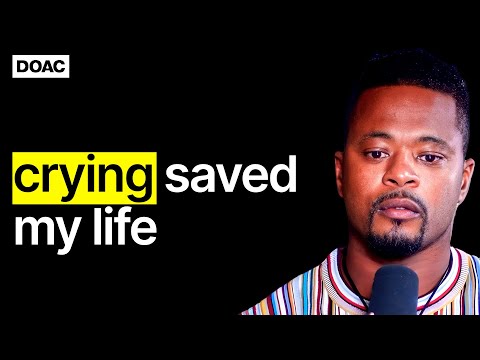
Patrice Evra: Learning How To Cry Saved My Life!
Patrice Evra (guest), Steven Bartlett (host)
In this episode of The Diary of a CEO, featuring Patrice Evra and Steven Bartlett, Patrice Evra: Learning How To Cry Saved My Life! explores patrice Evra Reveals Childhood Trauma, Toxic Masculinity And Emotional Rebirth Patrice Evra opens up about an extreme childhood marked by poverty, violence at home, sexual abuse by a head teacher, and his brother’s fatal drug addiction, and how these experiences shaped his “warrior” persona. He explains how toxic ideas of masculinity and never crying turned him into an emotionally shut‑down ‘robot’, even during his most successful years at Manchester United. A later relationship with his partner Margot became the catalyst for him to confront his trauma, learn to cry, seek emotional safety, and redefine what it means to be a man and a father. Throughout, he connects these personal changes to his views on racism, leadership, football culture, and his current mission to help others by sharing his story and using his platform for impact.
Patrice Evra Reveals Childhood Trauma, Toxic Masculinity And Emotional Rebirth
Patrice Evra opens up about an extreme childhood marked by poverty, violence at home, sexual abuse by a head teacher, and his brother’s fatal drug addiction, and how these experiences shaped his “warrior” persona. He explains how toxic ideas of masculinity and never crying turned him into an emotionally shut‑down ‘robot’, even during his most successful years at Manchester United. A later relationship with his partner Margot became the catalyst for him to confront his trauma, learn to cry, seek emotional safety, and redefine what it means to be a man and a father. Throughout, he connects these personal changes to his views on racism, leadership, football culture, and his current mission to help others by sharing his story and using his platform for impact.
Key Takeaways
Survival personas can become prisons if never re‑examined.
Evra describes how his childhood—24 siblings, severe poverty, domestic violence, and street life—forced him into a ‘warrior’ mindset where showing emotion equaled danger and weakness. ...
Get the full analysis with uListen AI
Unspoken trauma grows in the dark; speaking it aloud is a turning point.
He lived for decades without telling anyone that his school head teacher sexually abused him at 13. ...
Get the full analysis with uListen AI
Toxic masculinity harms men, their children, and their relationships.
Raised by a father who beat children harder when they cried and taught that tears were weakness, Evra replicated that pattern with his first son—minimizing pain, dismissing complaints, forbidding crying. ...
Get the full analysis with uListen AI
Emotional safety is the foundation for deep, transformative relationships.
Evra and host Steven Bartlett both describe partners who created a ‘safe space’ where they could express insecurity, trauma, and vulnerability without ridicule or power games. ...
Get the full analysis with uListen AI
Elite success often rests on sacrifice, pressure, and emotional numbing.
At Manchester United, Sir Alex Ferguson instilled a culture where winning was “normal” and the goal was four trophies a season; after winning the Champions League in 2008 there was no parade, only a warning to do it again or lose contracts. ...
Get the full analysis with uListen AI
Racism in football persists because institutions protect money, not people.
Evra recounts Luis Suárez racially abusing him, the lack of immediate on‑field action, death threats, and then Liverpool’s public ‘support Suárez’ T‑shirts after the ban. ...
Get the full analysis with uListen AI
Redefining success around impact and kindness can reorient a life.
He says comments like “your video made me smile after my dad died” now mean more than Premier League or Champions League medals. ...
Get the full analysis with uListen AI
Notable Quotes
“For me, crying was a sign of weakness. That’s the thing I grew up with – I can’t cry.”
— Patrice Evra
“One day he did. He put my pants down and he put my penis in his mouth. And I was just terrorized.”
— Patrice Evra
“Me, Patrice, the tough guy, don’t showing emotion… I cry like a baby. And she hugged me and said, ‘This is a strength. Stop thinking this is a weakness.’”
— Patrice Evra
“When I do a video and someone says, ‘My dad passed away, I watched one of your videos and I smiled’ – this is more important for me than winning the Champions League.”
— Patrice Evra
“I’m not perfect and I don’t wanna be perfect. I wanna be me.”
— Patrice Evra
Questions Answered in This Episode
When the police called you at 20 about the abusive head teacher, what specific fears or beliefs stopped you from telling them the truth, and how would you handle that call differently now?
Patrice Evra opens up about an extreme childhood marked by poverty, violence at home, sexual abuse by a head teacher, and his brother’s fatal drug addiction, and how these experiences shaped his “warrior” persona. ...
Get the full analysis with uListen AI
You’ve said toxic masculinity helped you survive your childhood but damaged you later; if you were designing a ‘curriculum’ for boys in tough neighborhoods, what would you keep from that warrior mindset and what would you replace it with?
Get the full analysis with uListen AI
Looking back on Manchester United’s culture under Sir Alex Ferguson, do you think the ‘robotic’ winning mentality could be achieved today without the same level of emotional sacrifice and family cost—and if so, how?
Get the full analysis with uListen AI
You contrasted football’s rapid shutdown of the Super League with its weak response to racism; what concrete structural changes (in rules, broadcasting, sponsorship, or social media policy) would actually put financial pressure behind anti‑racism?
Get the full analysis with uListen AI
Now that you’ve redefined success around impact and kindness, if you could speak to a 17‑year‑old academy player who only dreams of money and trophies, what practical steps would you give him to protect his mental health and sense of self along the way?
Get the full analysis with uListen AI
Transcript Preview
For me, playing was (smacks lips) ... it was just a dream. It's Patrice Evra. (crowd cheers) Growing up, it's a family, 24 brothers and sister, one breast chicken was for three days. Growing up in the street, you need to survive. Now, when I have those image in my head, I could hear him trying to touch me and touching himself in the same time next to the bed, you know? And I was even attaching my pajama with my shoelaces because to make sure, like, he can't put it down. And, uh, one day, he did, and I was just, like, terrorized. So, that's the things I grew up with. Like, you know, I can't cry. For me, crying was a sign of weakness. When I do a video and I see a comment, someone say, "Oh, Patrice, my dad pass away. I watch one of your video and I smile. Thank you," this is more important for me than winning the Champions League or the Premier League. I'm not perfect, and I don't wanna be perfect. I wanna be me. (upbeat music)
Patrice Evra. I've just sat here with him for an hour and a half, and at the very end of the conversation he said something which I think is the perfect description of the man. He referred to himself as an iceberg. I've followed him for almost two decades, and he was, to me, this football icon, this tough guy, this defender, this champion. But as he says in this conversation, the part of the iceberg that I never got to see was the most compelling, was the most heartbreaking, and was the most interesting. He grew up in a rough part of France with 24 brothers and sisters. He was sexually abused by his head teacher. His brother, a drug addict, overdosed and died. His mother raised him in total poverty to the point where he stole his food, his shoes, and his entertainment. He endured an early upbringing that you would never wish on any child, an enemy, or anyone at all, in any circumstances ever, and he hid it all. He hid it all for his entire life. And only recently has he found it within himself, after very personal conversations with his mother, to share it with the world. And only today, on this podcast, has he decided to share some of those heartbreaking details. After watching him on TV for almost two decades, I thought I knew Patrice Evra, this comedian, football champion, funny guy, happy guy. (sighs) I was wrong. All I knew was the tip of the iceberg. So, without further ado, I'm Steven Bartlett, and this is The Diary of a CEO. I hope nobody's listening, but if you are, then please keep this to yourself. (upbeat music) I've sat here with a lot of guests, and sometimes I feel obliged to start with their childhoods because it seems like the- the foundation of most people, specifically successful people, tends to be the case that the things they go through at an early age, especially with my sort of little background in childhood psychology, tend to shape them the most. But when I read your story in your book that's just come out, um, having watched you on screen as a Manchester United fan for many ...
Install uListen to search the full transcript and get AI-powered insights
Get Full TranscriptGet more from every podcast
AI summaries, searchable transcripts, and fact-checking. Free forever.
Add to Chrome