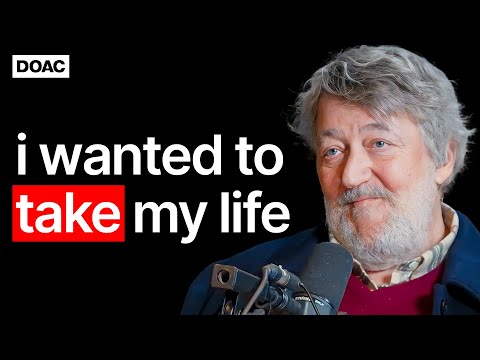
Stephen Fry: “Lost, alone and I wanted to take my life” | E201
Stephen Fry (guest), Steven Bartlett (host), Narrator, Narrator
In this episode of The Diary of a CEO, featuring Stephen Fry and Steven Bartlett, Stephen Fry: “Lost, alone and I wanted to take my life” | E201 explores stephen Fry Confronts Fame, Madness, Meaning And The Art Of Living Stephen Fry traces his journey from a disruptive, isolated child and teenage criminal to Cambridge scholar, beloved performer, and mental health advocate. He details his struggles with bipolar disorder, multiple suicide attempts, and a dramatic disappearance from a West End play that forced him into serious psychiatric help. Alongside candid accounts of mania, depression and addiction, Fry explores identity, free will, happiness, art, and the importance of friendship and craft. The conversation becomes a reflective guide to living with a chronic mind, finding purpose beyond success, and reshaping one’s goals around character and relationships.
Stephen Fry Confronts Fame, Madness, Meaning And The Art Of Living
Stephen Fry traces his journey from a disruptive, isolated child and teenage criminal to Cambridge scholar, beloved performer, and mental health advocate. He details his struggles with bipolar disorder, multiple suicide attempts, and a dramatic disappearance from a West End play that forced him into serious psychiatric help. Alongside candid accounts of mania, depression and addiction, Fry explores identity, free will, happiness, art, and the importance of friendship and craft. The conversation becomes a reflective guide to living with a chronic mind, finding purpose beyond success, and reshaping one’s goals around character and relationships.
Key Takeaways
Early labels and environments can miscast neurodivergence as moral failure—but diagnosis and reframing change the story.
Fry describes being seen as a ‘deeply difficult’ child, likely with undiagnosed ADHD and dyspraxia. ...
Get the full analysis with uListen AI
Feeling like an outsider can fuel both self‑destruction and extraordinary reinvention.
His sense of social failure (poor at sport, art, music), his sexuality in a hostile era, and class isolation pushed him toward theft, fraud and eventually prison. ...
Get the full analysis with uListen AI
Severe mood disorders are chronic and real, but they are manageable with a mix of medicine, structure and “folk wisdom.”
Post‑diagnosis, Fry cycled through mood stabilizers (including lithium), then slowly built a toolkit: walking daily while listening to audiobooks, deliberate weight loss to prove to himself he could control something, and engaging in meaningful, absorbing work. ...
Get the full analysis with uListen AI
Warning signs of crisis often appear as a powerful internal narrative of pointlessness.
Before suicide attempts and disappearances, Fry’s thoughts coalesced around ‘What’s the point? ...
Get the full analysis with uListen AI
Mania can feel transcendent and productive, which makes treating it psychologically difficult and risky to leave unchecked.
Fry recounts a manic episode in which he felt like Joan of Arc, ‘irradiated’ with power, simultaneously starting multiple tasks and convinced he’d never been more in control. ...
Get the full analysis with uListen AI
Lasting fulfillment comes more from character and relationships than from goals or status.
He likens post‑achievement emptiness to ‘gold medal depression’: each milestone (house, car, career success) reveals itself as ‘That’s not it. ...
Get the full analysis with uListen AI
Everyday creativity and craft are powerful, accessible mental health practices.
Fry distinguishes between capital‑A ‘Art’ and crafts, but insists both soothe the mind by inducing focused relaxation—what performers call being ‘in the zone. ...
Get the full analysis with uListen AI
Notable Quotes
“I was lost and adrift, and really what I first wanted to do was to take my life.”
— Stephen Fry
“The best I could do after a disastrous childhood, I decided, was now concentrate on getting into Cambridge.”
— Stephen Fry
“Happiness comes from somewhere else… and I’ve yet to meet anyone who can tell you where it comes from, regularly, where it can be tapped like some resource.”
— Stephen Fry
“You have to accept that the weather is real… but you also have to accept that you didn’t cause it and that it will pass.”
— Stephen Fry
“What really matters is how you treat people and how they treat you back, and how you try to be a better person.”
— Stephen Fry
Questions Answered in This Episode
You described ‘What’s the point?’ as a dangerous thought pattern preceding your suicide attempts. If you were designing an early‑warning checklist for someone with bipolar or recurrent depression, what specific cognitive or physical signs would you tell them—and their loved ones—to watch for?
Stephen Fry traces his journey from a disruptive, isolated child and teenage criminal to Cambridge scholar, beloved performer, and mental health advocate. ...
Get the full analysis with uListen AI
In your BBC documentary you asked people with bipolar if they would press a button to remove both their depression and mania, and many refused. Looking back now, with more years of experience, do you personally feel any differently about that hypothetical button and why?
Get the full analysis with uListen AI
You draw a sharp line between being an ‘entertainer’ who wants to please and the uncompromising artist who doesn’t care if audiences are horrified. Do you think that distinction is psychologically healthy for you, or has wanting to please sometimes deepened your mental health struggles?
Get the full analysis with uListen AI
You’re critical of how some people treat ‘free speech’ as an end in itself. If you were tasked with redesigning a platform like Twitter to maximise both free expression and collective well‑being, what concrete design and governance choices would you make?
Get the full analysis with uListen AI
You likened bipolar disorder to the weather—real, not your fault, but beyond your direct control. For someone who finds that lack of control frightening rather than comforting, how would you suggest they build a sense of agency and meaning without slipping into self‑blame?
Get the full analysis with uListen AI
Transcript Preview
I was lost and adrift, and really what I first wanted to do was to take my life.
Stephen Fry!
He's a comedian, an actor, and a national treasure. He's a director, he's a writer. I, I, I've probably missed things out.
He's a master of language. And tonight's my night! I was a deeply difficult child, and my parents took me to a psychiatrist when I was 14. I started doing weird things. I was sent to prison. So, the best I could do after a disastrous childhood, I decided, was now concentrate on getting into Cambridge. That changed everything.
Ladies and gentlemen, Stephen Fry!
I want to please people. And if I don't please them, I get upset. I've, I've done it wrong.
Age 37, you star in a play. The play gets some pretty harsh reviews.
I was lost and adrift, and really what I first wanted to do was to take my life. Stephen vanished on Monday, leaving a number of letters for friends. That started my journey into my mental health.
When you were 55, it was your third suicide attempt.
Afraid so, that's right.
Can you take me back to that moment?
Mm-hmm.
Before this episode starts, I have a small favor to ask from you. Two months ago, 74% of people that watch this channel didn't subscribe. We're now down to 69%. My goal is 50%. So if you've ever liked any of the videos we've posted, if you like this channel, can you do me a quick favor and hit the subscribe button? Thank you and enjoy this episode. I'm, I'm so fascinated by, um, people's foundations, their earliest years, their context, because it seems so apparent that that ends up shaping who we are and who we become and our orientation in life. So, as I read through your story and your earliest years, it was, it was an unthinkable rollercoaster ride of twists and turns. But what do I need to know about, about Stephen Fry's earliest years to understand the man that's sat in front of me?
Well, to use the language of the time, I was a disruptive, deeply difficult, screwed-up child. That's kind of the language they used then. And I think, to g- give myself some, I won't say credit, I would probably, in later years, have been diagnosed as having attention deficit hyperactivity disorder. I was extremely difficult to keep still, and I found it hard to focus. I was, I'll say, um, vain as it may sound, I think, um, intellectually advanced for my age. I was very quick with language and with speech, um, and just seeing things and remembering things in particular. So I never had to revise and so, in that sense, I had a lot of spare time. But on the other hand, socially, and where it matters to a child, I, I never fitted in or felt fitted in because I was bad at all the things that are valued when you're a child. I, I couldn't catch a ball. You know, I sort of did the, the sort of uncoordinated hand-clapping method of trying to catch-
Install uListen to search the full transcript and get AI-powered insights
Get Full TranscriptGet more from every podcast
AI summaries, searchable transcripts, and fact-checking. Free forever.
Add to Chrome