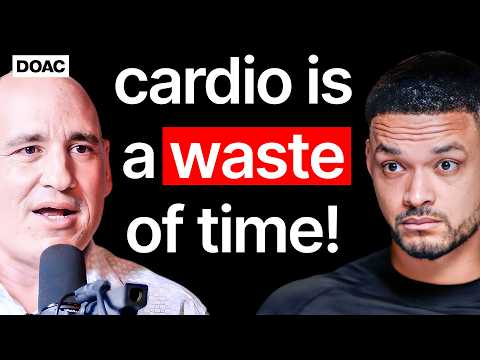
The Heart Surgeon: Cardio Is A Waste Of Time For Weight Loss! Philip Ovadia | E240
Dr Philip Ovadia (guest), Steven Bartlett (host)
In this episode of The Diary of a CEO, featuring Dr Philip Ovadia and Steven Bartlett, The Heart Surgeon: Cardio Is A Waste Of Time For Weight Loss! Philip Ovadia | E240 explores heart Surgeon Reveals Why Cardio Fails And Food Is Killing Us Heart surgeon Dr. Philip Ovadia explains why most heart disease is preventable and argues that poor metabolic health, driven largely by processed food and sugar, is the true root cause. He shares his own transformation from morbidly obese, pre-diabetic surgeon to metabolically healthy doctor after redefining health and diet around whole, unprocessed foods.
Heart Surgeon Reveals Why Cardio Fails And Food Is Killing Us
Heart surgeon Dr. Philip Ovadia explains why most heart disease is preventable and argues that poor metabolic health, driven largely by processed food and sugar, is the true root cause. He shares his own transformation from morbidly obese, pre-diabetic surgeon to metabolically healthy doctor after redefining health and diet around whole, unprocessed foods.
Ovadia contends that the medical system over-relies on pharmaceuticals and procedures while neglecting upstream lifestyle drivers, and that genetics are vastly overstated as an explanation for chronic disease. He outlines simple markers of metabolic health and insists that 88% of adults currently fail them, including many people who appear slim.
He challenges common beliefs about weight loss, saying chronic cardio is ineffective for fat loss and that building and maintaining muscle, improving sleep, and reducing meal frequency are far more impactful strategies. Throughout, he warns that if metabolic health trends don’t improve within the next 50 years, society will struggle to sustain itself.
Key Takeaways
Metabolic health is the foundation of long-term health—and 88% of adults are failing it.
Ovadia defines metabolic health as the body properly using food for energy, repair, and limited storage. ...
Get the full analysis with uListen AI
Genetics play a minor role; diet and environment drive the chronic disease epidemic.
Human genetics haven’t changed meaningfully in 100–150 years, but obesity, diabetes, and heart disease have exploded in that time. ...
Get the full analysis with uListen AI
Processed food and sugar are central culprits in heart disease and metabolic breakdown.
Historically, scientists debated whether cholesterol or sugar was the main cause of heart disease. ...
Get the full analysis with uListen AI
Cardio is unreliable for fat loss; building muscle is far more powerful.
Research shows steady-state cardio (jogging, long runs, typical gym cardio) doesn’t reliably produce fat loss. ...
Get the full analysis with uListen AI
Whole, real food—especially animal products—is the common denominator of successful diets.
Across carnivore, keto, Mediterranean, paleo, and even well-constructed vegan diets, the consistent success factor is eliminating processed food and focusing on whole foods. ...
Get the full analysis with uListen AI
Meal frequency and sleep patterns significantly influence metabolic health.
Modern people eat, on average, about eight times per day, versus two to three meals historically. ...
Get the full analysis with uListen AI
The healthcare and food systems are structurally misaligned with prevention and long-term health.
Ovadia criticizes medicine’s tendency to assume illness is inevitable and to default to pharmaceutical or surgical solutions rather than addressing root causes. ...
Get the full analysis with uListen AI
Notable Quotes
“The vast majority of the surgeries that I do are preventable, shouldn’t need to be done in the first place.”
— Dr. Philip Ovadia
“Cardio is not effective for weight loss. Science is pretty clear on that.”
— Dr. Philip Ovadia
“Human genetics don’t change that quickly, yet in the past 100 years we’ve seen this explosion of chronic disease.”
— Dr. Philip Ovadia
“Processed food is addictive. Sugar is more addictive than heroin.”
— Dr. Philip Ovadia
“If we don’t change the course in the next 50 years, we’re not gonna have a society left.”
— Dr. Philip Ovadia
Questions Answered in This Episode
You argue that sugar likely plays a central role in heart disease; what specific daily sugar thresholds (in grams or food examples) do you consider safe for someone who is currently metabolically unhealthy?
Heart surgeon Dr. ...
Get the full analysis with uListen AI
If chronic cardio is ineffective for fat loss, what would a simple, week-by-week beginner strength-training plan look like for a 45-year-old who has never lifted weights but wants to improve metabolic health?
Ovadia contends that the medical system over-relies on pharmaceuticals and procedures while neglecting upstream lifestyle drivers, and that genetics are vastly overstated as an explanation for chronic disease. ...
Get the full analysis with uListen AI
You’re strongly pro–animal products; how do you reconcile that with epidemiological data often associating higher meat intake with increased disease risk, and what flaws do you see in those studies?
He challenges common beliefs about weight loss, saying chronic cardio is ineffective for fat loss and that building and maintaining muscle, improving sleep, and reducing meal frequency are far more impactful strategies. ...
Get the full analysis with uListen AI
For someone whose doctor insists their high LDL is the primary problem and dismisses your metabolic-health framework, what lab results, studies, or questions would you suggest they bring to that next appointment to challenge the LDL-centric view constructively?
Get the full analysis with uListen AI
You warned that in 50 years we may not have enough healthy people to sustain society—what specific policy changes (in food regulation, healthcare reimbursement, or education) do you believe could most realistically reverse that trajectory at scale?
Get the full analysis with uListen AI
Transcript Preview
Cardio is not effective for weight loss. (dramatic music)
Why isn't it helping me lose weight? It seems like a bit of a head spin.
There are two reasons. Number one is- (record scratching)
That's bad news, isn't it?
That is bad news. (record scratches) Dr. Philip Ovadia. The world renowned heart doctor- Has conducted over 3,000 heart surgeries. His book, Stay Off My Operating Table-
Fighting to make America healthy again. When you were 40 years old, you described yourself as being morbidly obese.
I was 100 pounds heavier than I am today. I was gonna end up on my own operating table. I came to realize the true root cause of our health problems. Sugar is more addictive than heroin. Processed food is addictive. 88% of adults are not healthy, and 600,000 people die from heart disease every year. If we don't change the course in the next 50 years, we're not gonna have a society left. A very young woman, a 30-year-old, ended up on my operating table, and I had to go tell her young children, "I'm sorry that we weren't able to save your mother."
Was her heart condition preventable?
Yes. The surgeries that I do shouldn't need to be done in the first place. I want people to be healthy again.
Dr. Ovadia, what is the diet that's gonna keep my health intact?
That's really the million dollar question. So- (dramatic music)
Before this episode starts, I have a small favor to ask from you. Two months ago, 74% of people that watched this channel didn't subscribe. We're now down to 69%. My goal is 50%, so if you've ever liked any of the videos we've posted, if you like this channel, can you do me a quick favor and hit the subscribe button? It helps this channel more than you know, and the bigger the channel gets, as you've seen, the bigger the guests get. Thank you and enjoy this episode. (upbeat music) Dr. Ovadia, tell me the mission that you're on, and also tell me why you chose to pursue that mission.
So, I am on a mission to normalize health. I want people to be healthy again, and it really was my own personal journey that set me off on that mission. Um, I found myself at a spot that I was a very unhealthy heart surgeon, and that's gonna sound pretty surprising, I think, to people. You know, they think that here I was, uh, here I am, a heart surgeon, in many ways, at the pinnacle of medicine, um, and trying to get people back from the brink of death. Uh, and yet, I was headed down that same pathway myself, and I was so unhealthy myself, and I had to figure out how to save myself. Um, and that has really opened my eyes to how much we need to save society at this point, 'cause we are a very sick society, and we need to be saved.
Install uListen to search the full transcript and get AI-powered insights
Get Full TranscriptGet more from every podcast
AI summaries, searchable transcripts, and fact-checking. Free forever.
Add to Chrome