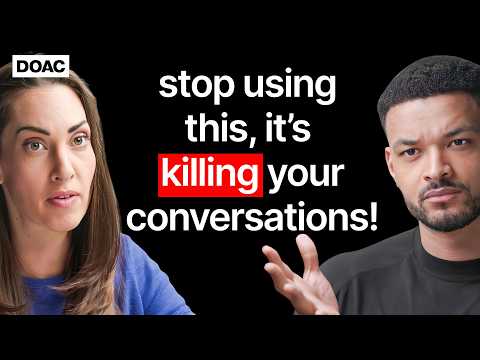
Body Language Expert: Stop Using This, It’s Making People Dislike You, So Are These Subtle Mistakes!
Vanessa Van Edwards (guest), Steven Bartlett (host)
In this episode of The Diary of a CEO, featuring Vanessa Van Edwards and Steven Bartlett, Body Language Expert: Stop Using This, It’s Making People Dislike You, So Are These Subtle Mistakes! explores master Charisma: Science-Backed Cues Transform Confidence, Connection, And Success Behavioral researcher Vanessa Van Edwards explains how subtle nonverbal and verbal ‘cues’ drive 82% of the impressions we make, shaping our success in relationships, careers, and dating. She distinguishes between warmth (trust, likability) and competence (power, reliability) and shows how most people unknowingly mis-signal both. Drawing on 17+ years of research and 400,000 students, she shares specific body language, vocal, and conversational tools that can be learned—even by “recovering awkward people”—to build authentic charisma rather than “faking it.”
Master Charisma: Science-Backed Cues Transform Confidence, Connection, And Success
Behavioral researcher Vanessa Van Edwards explains how subtle nonverbal and verbal ‘cues’ drive 82% of the impressions we make, shaping our success in relationships, careers, and dating. She distinguishes between warmth (trust, likability) and competence (power, reliability) and shows how most people unknowingly mis-signal both. Drawing on 17+ years of research and 400,000 students, she shares specific body language, vocal, and conversational tools that can be learned—even by “recovering awkward people”—to build authentic charisma rather than “faking it.”
Vanessa breaks cues into four channels—body language, voice, words, and ornaments—and demonstrates how resting facial expression, hand gestures, eye contact, and even calendar subject lines or profile photos dramatically alter how others treat us. She also explores friendship, attraction, loneliness, and self‑narrative, revealing how our stories about ourselves (hero, healer, victim) and our social environments either lift or sabotage us.
Throughout, she offers highly practical frameworks: five power cues for competence, five warmth cues to dial down intimidation, better conversation openers, and tests to audit our relationships and digital presence. The core message: people skills are not optional or innate; they are a learnable, high‑leverage skill set that can change your career, love life, and confidence.
Key Takeaways
Charisma is learned, not innate—and is built from warmth and competence cues.
Research by Susan Fiske shows that 82% of our impression of others comes down to perceived warmth (friendliness, trustworthiness) and competence (capability, power). ...
Get the full analysis with uListen AI
Your body broadcasts confidence or anxiety long before you speak.
Two core posture metrics matter: the distance between earlobe and shoulder (shrugged = anxious; dropped and relaxed = confident), and the distance between arms and torso (penguin arms = tension; free arms and visible gestures = presence). ...
Get the full analysis with uListen AI
Hand gestures and eye contact massively boost perceived credibility and engagement.
In an analysis of TED Talks, the most‑viewed speakers used about 465 hand gestures in 18 minutes vs. ...
Get the full analysis with uListen AI
Your voice can instantly undermine or reinforce trust and authority.
Two vocal patterns strongly affect perceived honesty and competence: the question inflection (pitch rising at the end of a statement) and the downward inflection (pitch falling at the end). ...
Get the full analysis with uListen AI
Tiny cues in photos and words radically change how others feel about you.
In profile photos, showing upper eye whites (“fear eyes”), asymmetrical ‘contempt’ smirks, or fake smiles (mouth only, no cheek/eye activation) triggers impressions of anxiety, negativity, or inauthenticity. ...
Get the full analysis with uListen AI
Likability and friendship are built by being a ‘first-liker,’ not by impressing.
A large high‑school study found the most popular kids simply had the longest list of people they liked. ...
Get the full analysis with uListen AI
Your environment and relationships are contagious; invest deliberately in who’s around you.
A study across 11 companies and 58,000 work hours found that sitting within 25 feet of a high performer raises your performance by 15%, while sitting near a low performer drops it by 30%. ...
Get the full analysis with uListen AI
Notable Quotes
“Very highly successful people speak a hidden language, and that is the language of cues.”
— Vanessa Van Edwards
“82% of our impressions of people are based on warmth and competence.”
— Vanessa Van Edwards
“If you don’t have people skills, you cannot succeed. You cannot succeed in life, you cannot succeed in love, you cannot succeed in business.”
— Vanessa Van Edwards
“Cues tell others how to treat you.”
— Vanessa Van Edwards
“Stop trying to be perfect. Own your authentic vulnerabilities. Don’t purposely spill a smoothie.”
— Vanessa Van Edwards
Questions Answered in This Episode
You mentioned that too much competence without warmth makes people suspicious; how would you advise a high‑performing but introverted executive to adjust their cues in a board meeting without feeling fake?
Behavioral researcher Vanessa Van Edwards explains how subtle nonverbal and verbal ‘cues’ drive 82% of the impressions we make, shaping our success in relationships, careers, and dating. ...
Get the full analysis with uListen AI
In the study where fear sweat triggered fear in others, how should leaders realistically manage their own anxiety before high‑stakes events so they don’t chemically and nonverbally transmit it to their teams?
Vanessa breaks cues into four channels—body language, voice, words, and ornaments—and demonstrates how resting facial expression, hand gestures, eye contact, and even calendar subject lines or profile photos dramatically alter how others treat us. ...
Get the full analysis with uListen AI
For someone who recognizes they have a strong victim self‑narrative, what are the first three concrete, daily behaviors you’d prescribe to start shifting into a hero narrative?
Throughout, she offers highly practical frameworks: five power cues for competence, five warmth cues to dial down intimidation, better conversation openers, and tests to audit our relationships and digital presence. ...
Get the full analysis with uListen AI
You argued that ‘ambivalent’ relationships are more damaging than clearly toxic ones; what’s the practical process for deciding whether to upgrade or phase out an ambivalent friend or colleague?
Get the full analysis with uListen AI
You showed how profile photos and Instagram content can repel or attract the right partner; what are the most common mismatches you see between what people *say* they want in love and what their online cues actually advertise?
Get the full analysis with uListen AI
Transcript Preview
Your brain is 12.5 times more likely to believe my gesture over my words, and that's because it is very hard to lie with our gestures. For example, you wanna do an experiment with me?
Sure.
Okay, I want you to say five, but hold up the number three.
Five.
Hard, right?
Yeah. I had to think about them separately.
This is why liars use less gestures. But knowing tools like that is critical if you're trying to set yourself up for success.
And we're gonna go through all of them?
Oh, yeah.
Vanessa Van Edwards is a behavioral investigator whose science-backed research from body language and microexpressions to vocal tones and first impressions has revolutionized the way we build confidence and create more authentic relationships in every social and professional interaction.
I'm a recovering awkward person. And I thought that charisma was genetic and I didn't know how to have conversations. I didn't even know how to have friends. But then I discovered that highly successful people speak a hidden language, and that is the language of cues. This is directly from the research. They know the blueprints to talk to anyone. They know that if you sit within 25 feet of a high performer, your own performance improves by 15%, and that there's a direct correlation between confidence and anxiety and the distance between our shoulder and our earlobe.
So interesting.
They also know that 82% of our impressions of people are based on warmth and competence. So if you worry that people don't take you seriously, you have trouble getting raises, you feel anxious and overwhelmed, I have five power cues for competence. But if you have ever been told you're intimidating, hard to talk to, I want you to use these five warmth cues first.
What about how to get a partner in terms of cues and body language?
Let's start with a study that blew my mind. It's impossible to be attracted to someone who ******.
That's so crazy. Just such a small-
That one little thing.
This has always blown my mind a little bit. 53% of you that listen to this show regularly haven't yet subscribed to the show. So could I ask you for a favor before we start? If you like the show and you like what we do here and you wanna support us, the free, simple way that you can do just that is by hitting the subscribe button. And my commitment to you is, if you do that, then I'll do everything in my power, me and my team, to make sure that this show is better for you every single week. We'll listen to your feedback, we'll find the guests that you want me to speak to, and we'll continue to do what we do. Thank you so much. Vanessa Van Edwards.
Hmm.
For someone that's just clicked on this conversation now, and they're wondering why they should stay and listen to what we're gonna talk about, what would you say to them?
Install uListen to search the full transcript and get AI-powered insights
Get Full TranscriptGet more from every podcast
AI summaries, searchable transcripts, and fact-checking. Free forever.
Add to Chrome