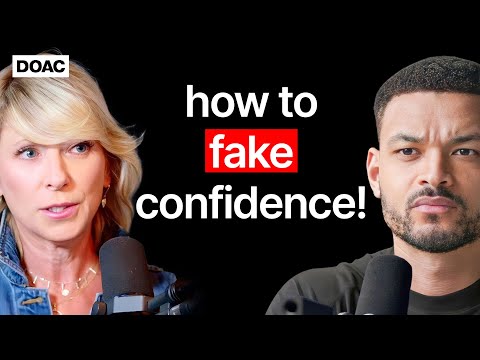
The Body Language Expert: 4 Body Language Tricks That Will Make People Love You & Respect You!
Steven Bartlett (host), Dr. Amy Cuddy (guest)
In this episode of The Diary of a CEO, featuring Steven Bartlett and Dr. Amy Cuddy, The Body Language Expert: 4 Body Language Tricks That Will Make People Love You & Respect You! explores body Language, Power, And Self-Story: Tiny Tweaks, Massive Life Change Dr. Amy Cuddy explains how body language doesn’t just communicate to others, it continually sends powerful signals to our own brain about safety, confidence, and power. She connects posture, breathing, and movement to mood, performance, authenticity, and even clinical issues like depression and PTSD, arguing that expanding our bodies can shift us from threat to opportunity mindsets.
Body Language, Power, And Self-Story: Tiny Tweaks, Massive Life Change
Dr. Amy Cuddy explains how body language doesn’t just communicate to others, it continually sends powerful signals to our own brain about safety, confidence, and power. She connects posture, breathing, and movement to mood, performance, authenticity, and even clinical issues like depression and PTSD, arguing that expanding our bodies can shift us from threat to opportunity mindsets.
The conversation explores practical, research-backed ways to feel more powerful and socially brave: from micro-postural adjustments and breathing to self-affirmation exercises and “self‑nudging” through small behavioral experiments. They also examine how authenticity shows up nonverbally, why confident and warm body language increases attractiveness and leadership impact, and why trust is the real conduit of influence.
In the second half, Cuddy shares a raw, personal account of severe academic bullying, describing how coordinated status attacks can amount to “social death.” She argues that bullying is preventable when bystanders act early, that our self-story is crucial to survival and growth, and that we can collectively change norms around cruelty, status, and power.
Key Takeaways
Your body is constantly sending signals back to your brain about power and safety.
Cuddy explains that body language isn’t one-way; how you sit, stand, breathe, and move feeds back into your nervous system. ...
Get the full analysis with uListen AI
Small, deliberate postural changes can meaningfully improve mood and performance.
Studies show that briefly opening posture in people with major depressive disorder reduces depressive symptoms, and expansive yoga plus breathing significantly eases PTSD in combat veterans. ...
Get the full analysis with uListen AI
Authenticity is primarily communicated through alignment between words and body, not eye contact.
What most reliably reveals deception or inauthenticity is asynchrony: your words say one emotion but your body expresses another. ...
Get the full analysis with uListen AI
Confidence and warmth in body language increase both professional effectiveness and romantic attractiveness.
Research on dating apps shows that open, confident postures in profile photos make both men and women appear more attractive. ...
Get the full analysis with uListen AI
Changing your ‘self-story’ is more powerful than memorizing body language tricks.
Cuddy distinguishes “fake it till you make it” (performing a false self to fool others) from “fake it till you become it” (using expansive behavior to create conditions where you can discover and grow into your real self). ...
Get the full analysis with uListen AI
Effective behavior change comes from self‑nudging: improving one small element per high‑stakes situation.
Instead of grand resolutions, Cuddy recommends picking one recurring challenging context (e. ...
Get the full analysis with uListen AI
Bullying is a status game that thrives on bystander silence—and it can be interrupted early.
From her experience of sustained academic bullying, Cuddy describes primary bullies as repeat offenders driven by scarcity mindsets and status hunger, not low self-esteem. ...
Get the full analysis with uListen AI
Notable Quotes
“Our body language is always speaking to us as well.”
— Amy Cuddy
“When we feel powerful, we are more likely to take action, not just on behalf of ourselves, but also on behalf of others.”
— Amy Cuddy
“How we tell our stories to ourselves matters.”
— Amy Cuddy
“Trust is the conduit of influence. If you don’t build trust, you have no medium through which your ideas can travel.”
— Amy Cuddy
“They stole my future… It is an absolute theft of your life.”
— Amy Cuddy
Questions Answered in This Episode
You mentioned that expansive yoga significantly helped combat veterans with PTSD—what specific poses and practice structure (duration, frequency) did those successful interventions actually use, and how might a layperson safely replicate a starter version at home?
Dr. ...
Get the full analysis with uListen AI
In your own bullying experience, what were the first ‘test’ behaviors you now recognize in hindsight, and concretely, what could one courageous bystander have said or done in those early moments that would most likely have changed the trajectory?
The conversation explores practical, research-backed ways to feel more powerful and socially brave: from micro-postural adjustments and breathing to self-affirmation exercises and “self‑nudging” through small behavioral experiments. ...
Get the full analysis with uListen AI
You drew a link between inauthentic self-presentation and the nonverbal patterns we see in deliberate deception; how should hiring managers or investors ethically use that insight without sliding into pseudo–lie-detection or unfair bias against anxious but honest candidates?
In the second half, Cuddy shares a raw, personal account of severe academic bullying, describing how coordinated status attacks can amount to “social death. ...
Get the full analysis with uListen AI
For someone who feels socially powerless but also lives in a culture where overt expansiveness is frowned upon, what are culturally-sensitive, low-visibility body language shifts (posture, breath, micro-movements) that can still build inner power without triggering social backlash?
Get the full analysis with uListen AI
Your self-affirmation exercise hinges on identifying core values—how would you advise someone whose bullying or chronic imposter feelings have so eroded their self-concept that they struggle to name any values or traits that still feel genuinely ‘theirs’?
Get the full analysis with uListen AI
Transcript Preview
Is body language really that important?
Yes. For example, when you change the posture of people who are depressed, it reduces their symptoms. Tiny tweaks lead to big changes.
Dr. Amy Cuddy, expert on the behavioral science of power.
A Harvard professor coined the term Power Pose... The second most watched TED Talk of all time. Our posture can affect some of the biggest moments of our lives. Your body language is betraying you. 50% of our first impression is based around body language, so the way that we carry ourselves really affects your life 'cause if people feel utterly powerless, they see challenges as threats instead of opportunities. They are less creative, less authentic. So that's my mission, to help people feel more powerful and become more socially brave. And there's all kinds of ways in which we can fix it.
Is there a relationship there as well between our body language and attractiveness?
Yeah. There's research showing that if you... That body language is more effective both in the workplace and in dating situations. How we tell our stories to ourselves matters.
W- as I read through your story, there was bullying in your life.
It's the worst thing that ever happened to me. I had to leave my job after I'd worked so hard to get there.
Mm-hmm.
I almost decided to die. Like, I'm so afraid of them still. Um...
I think this is fascinating. I looked at the back end of our YouTube channel, and it says that since this channel started, 69.9% of you that watch it frequently haven't yet hit the subscribe button. So, I have a favor to ask you. If you've ever watched this channel and enjoyed the content, if you're enjoying this episode right now, please, could I ask a small favor? Please hit the subscribe button. It helps this channel more than I can explain. And I promise, if you do that, to return the favor, we will make this show better, and better, and better, and better, and better. That's a promise I'm willing to make you if you hit the subscribe button. Do we have a deal? Amy, there's lots of, um, myths around body language and how important it is, and y- you hear all these phrases about, "Oh, 80% of our-
Yup.
... communication is non-verbal, or 90%. I can't remember the numbers, but you hear all of this stuff. Is body language really that important?
Yes. It, it, it is important, absolutely. And, and it, it is, it probably affects, uh, about, about half of our impression of others. Our first impression is based around body language. I'm not go- maybe it's higher than that, but I would say it's at least 50%. Body language isn't just y- us speaking to others. We're also speaking to ourselves. The way that we carry ourselves is sending messages back to our, our brain about whether we're, um, safe or unsafe. Are, are we threatened or not threatened? Are we, you know, confident or not confident? And so...
Install uListen to search the full transcript and get AI-powered insights
Get Full TranscriptGet more from every podcast
AI summaries, searchable transcripts, and fact-checking. Free forever.
Add to Chrome