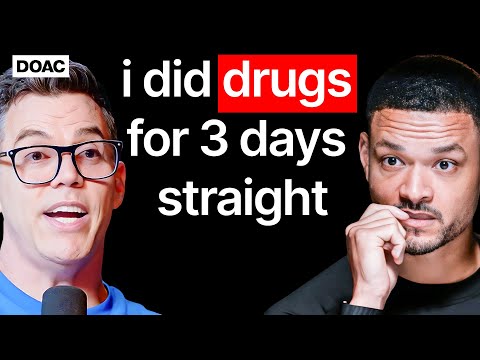
Steve-O: Childhood Trauma, Addiction, Mocking Death & Craving Attention!
Steve-O (Stephen Gilchrist Glover) (guest), Steven Bartlett (host)
In this episode of The Diary of a CEO, featuring Steve-O (Stephen Gilchrist Glover) and Steven Bartlett, Steve-O: Childhood Trauma, Addiction, Mocking Death & Craving Attention! explores steve-O Confronts Addiction, Mortality, Fame And Finally Finding Real Love Stephen Gilchrist Glover (Steve-O) traces a life shaped by childhood instability, parental addiction, and a desperate hunger for attention into a career built on extreme stunts, addiction, and public self-destruction.
Steve-O Confronts Addiction, Mortality, Fame And Finally Finding Real Love
Stephen Gilchrist Glover (Steve-O) traces a life shaped by childhood instability, parental addiction, and a desperate hunger for attention into a career built on extreme stunts, addiction, and public self-destruction.
He explains how a deep fear of death paradoxically drove him to mock and taunt mortality with ever more dangerous acts, intensified by substance abuse and psychosis broadcast to an industry-wide email list.
A violent intervention in 2008 began 15+ years of sobriety, during which he rebuilt his relationship with his father, developed standup comedy built around ultra-extreme stunts, and learned to separate ‘Steve-O’ the persona from Stephen the person.
Today, he credits radical honesty, 12‑step recovery principles, and his relationship with his fiancée Lux with giving him a sustainable sense of worth beyond fame, while still channeling his need for attention into creative work like his ‘Bucket List’ tour.
Key Takeaways
Unmet childhood needs often get converted into extreme attention-seeking behaviors.
Steve-O links constantly moving countries, absent workaholic father, and an alcoholic mother cared for by maids to becoming an “attention whore. ...
Get the full analysis with uListen AI
Addiction can override even the clearest negative examples in a family.
Despite seeing his mother’s devastating alcoholism and fully understanding, as a child, that one drink meant days or weeks of binging, he still became an alcoholic. ...
Get the full analysis with uListen AI
A warped relationship with mortality can drive both risk-taking and artistry.
From childhood, he was convinced he wouldn’t live long and felt inherently “defective,” a mindset he connects to alcoholism. ...
Get the full analysis with uListen AI
Public spirals can be both a cry for help and a form of performance.
At his worst, Steve-O lived in a drug den with multiple apartments, inhaling roughly 600 nitrous oxide cartridges at a time while on multi-day cocaine binges, sliding into profound psychosis. ...
Get the full analysis with uListen AI
Sobriety can create a better version of oneself, not just a restored one.
He emphasizes that addiction is unique among diseases: when treated through 12‑step recovery, people don’t just return to baseline—they often become more honest, functional, and emotionally mature than ever before. ...
Get the full analysis with uListen AI
Separating the public persona from the private self is essential for long-term wellbeing.
He is explicit that it’s “of paramount importance” to find separation between Stephen and ‘Steve-O. ...
Get the full analysis with uListen AI
Healthy romantic love can retrain emotional patterns shaped by trauma and fame.
With Lux, he practices rules like not being apart for more than two weeks and credits her with ‘teaching him to love. ...
Get the full analysis with uListen AI
Notable Quotes
“It is of paramount importance that I find separation between me and the persona of Steve-O.”
— Stephen Gilchrist Glover (Steve-O)
“I felt defective… I believed that I was going to fail at life, like badly and quickly.”
— Stephen Gilchrist Glover (Steve-O)
“I was lashing out at death, taunting it… I was mocking death.”
— Stephen Gilchrist Glover (Steve-O)
“As upsetting as alcoholism and drug addiction is, it’s the only disease where once you treat it, you become a better version of yourself than you were before.”
— Stephen Gilchrist Glover (Steve-O)
“Lux has taught me to love. She’s increased my capacity to love.”
— Stephen Gilchrist Glover (Steve-O)
Questions Answered in This Episode
You describe stunts as ‘mocking death’ and coping with mortality—if you look at your wildest Jackass or Bucket List stunt now, can you pinpoint the exact fear or belief about death that particular stunt was expressing?
Stephen Gilchrist Glover (Steve-O) traces a life shaped by childhood instability, parental addiction, and a desperate hunger for attention into a career built on extreme stunts, addiction, and public self-destruction.
Get the full analysis with uListen AI
When you were sending RAD emails and effectively live-streaming your breakdown to 200 powerful people, did any responses (or silences) fundamentally change the way you see Hollywood’s responsibility toward obviously unwell talent?
He explains how a deep fear of death paradoxically drove him to mock and taunt mortality with ever more dangerous acts, intensified by substance abuse and psychosis broadcast to an industry-wide email list.
Get the full analysis with uListen AI
You’ve said sobriety makes you a better version of yourself than you were even before addiction—what are one or two specific character traits or daily habits you have now that absolutely did not exist in ‘pre-addiction Stephen’?
A violent intervention in 2008 began 15+ years of sobriety, during which he rebuilt his relationship with his father, developed standup comedy built around ultra-extreme stunts, and learned to separate ‘Steve-O’ the persona from Stephen the person.
Get the full analysis with uListen AI
How did your first year in recovery change the way you related to pain—like your mother’s death and your success guilt—without the option of numbing out with substances or stunts?
Today, he credits radical honesty, 12‑step recovery principles, and his relationship with his fiancée Lux with giving him a sustainable sense of worth beyond fame, while still channeling his need for attention into creative work like his ‘Bucket List’ tour.
Get the full analysis with uListen AI
As you push ‘Bucket List’ beyond what Jackass could ever do, where do you draw the ethical line between honoring your authentic urge for extreme expression and glorifying self-harm in a way that might influence younger fans?
Get the full analysis with uListen AI
Transcript Preview
It is of paramount importance that I find separation between me and the persona of Steve-O.
Why?
Ooh. We have to go back to the beginning of my journey. I didn't get attention from my parents. My dad was a businessman, and my mom suffered from alcoholism.
Your father would praise you for stunts, diving headfirst for baseballs.
And he'd give $1. I don't think you have to be Sigmund Freud to imagine that had something to do with becoming an attention whore. That was when I started doing dangerous stunts. I'm Steve-O, and this is the Fish Hook.
Why stunts?
Growing up, I've felt defective, and the thought was, I wasn't gonna live very long. So, I was lashing out at death, taunting it, but I lost my mom in 2003, and that traumatized me more than anything. I was out of control, broadcasting my downward spiral to 200 influential people in real time.
You were manhandled into a psych ward.
Yeah. This was gonna be my legacy, having miserably failed at life, and the, the toughest thing is that I wanted to make my mom proud.
Stephen Gilchrist Glover, AKA Steve-O. Honesty. Honesty saved Steve-O's life. But the man that sits in front of me today isn't Steve-O, it is Stephen Gilchrist Glover, which is a man you've probably never met before. But once you meet Stephen Gilchrist Glover, you'll undoubtedly understand Steve-O, that guy that we grew up with, on our screens doing those crazy jackass stunts, that behind the scenes struggled with a deep discomfort of being in his own skin. Depression, drug addiction, existential panic, an obsession with attention, crippling grief, and most surprisingly and paradoxically of all, a deep, deep fear of death. It absolutely doesn't appear to make sense, but once you listen to this conversation, if you listen closely, you'll understand exactly why that's driving him. This conversation will make you laugh. It will inspire you. It will motivate you. It will challenge you. It will make you feel understood, and it will teach you what it takes and what it means to live a good life, including the role that romantic love has played in Steve-O finally living a good life. And for me, it reaffirms to me once again that in order to live that good life, in order to find that good life, we need to surrender, stop fighting life, and we need to be honest. And once we are, we might just find all of the things that we're looking for. You're gonna love this one. Steven.
All right.
You've lived a anomalous life.
Okay.
The man that sits before me today is, uh, an anomaly in many respects. It's, uh, th- the professional path you've walked is extraordinary, to say the least. In order to understand you, what, what do I need to understand about your, your earliest context to understand who you are and why you walked the path you did in your life?
Install uListen to search the full transcript and get AI-powered insights
Get Full TranscriptGet more from every podcast
AI summaries, searchable transcripts, and fact-checking. Free forever.
Add to Chrome