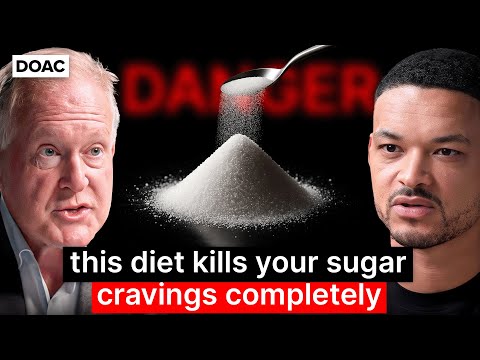
No. 1 Sugar Expert: You've Been Sold A Lie About "Healthy" Food!
Dr. Robert Lustig (guest), Steven Bartlett (host)
In this episode of The Diary of a CEO, featuring Dr. Robert Lustig and Steven Bartlett, No. 1 Sugar Expert: You've Been Sold A Lie About "Healthy" Food! explores sugar, Dopamine, Dementia: Why ‘Healthy’ Food Is Killing You Dr. Robert Lustig explains how sugar, artificial sweeteners, and ultra‑processed foods drive an epidemic of metabolic and brain disorders, including dementia, depression, and cancer. He introduces the concept of the “hostage brain,” where chronic stress and dopamine-driven habits trap people in cycles of addiction, overeating, and misery.
Sugar, Dopamine, Dementia: Why ‘Healthy’ Food Is Killing You
Dr. Robert Lustig explains how sugar, artificial sweeteners, and ultra‑processed foods drive an epidemic of metabolic and brain disorders, including dementia, depression, and cancer. He introduces the concept of the “hostage brain,” where chronic stress and dopamine-driven habits trap people in cycles of addiction, overeating, and misery.
Lustig details the neurobiology of dopamine and serotonin, mitochondrial energy failure in neurons, and a new mechanistic theory of Alzheimer’s that links diet, stress, and reactive oxygen species. He argues that 95% of Alzheimer’s risk is environmental and heavily influenced by ultra‑processed food, sweeteners, and lifestyle.
The conversation also covers the limits and risks of ‘shortcuts’ like GLP‑1 drugs (Ozempic), the role of psychedelics, vaccine misinformation, and how corporate food reformulation can improve public health without hurting profits.
Practically, Lustig lays out clear rules for shopping and eating, how to reduce sugar addiction, why exercise doesn’t cause weight loss, and how to use tools like continuous glucose monitors and “metabolic matrix” principles to reclaim health.
Key Takeaways
Ultra‑processed food and added sugar are acting as systemic poisons
Lustig argues that around 73% of products in U. ...
Get the full analysis with uListen AI
Dopamine addiction underlies compulsive eating and many modern behaviors
Dopamine drives both learning and reward, but chronic overstimulation (from sugar, social media, drugs, gambling, pornography, etc. ...
Get the full analysis with uListen AI
A new Alzheimer’s model: dietary ROS + stress-induced ATP crisis
Lustig outlines a three-step mechanism: (1) mitochondria produce ATP and reactive oxygen species (ROS); if antioxidant defenses (glutathione, vitamins, phytonutrients) are inadequate—often due to ultra‑processed food—ROS feed back and shut down mitochondrial energy production. ...
Get the full analysis with uListen AI
Non-nutritive sweeteners are likely not a safe escape from sugar
Recent research in Annals of Neurology shows diet sweetener intake correlates with dementia. ...
Get the full analysis with uListen AI
Escaping sugar and dopamine addiction requires receptor recovery, not willpower alone
Dopamine receptors must ‘come back up’ to break addiction cycles; chronic stimulation keeps them downregulated. ...
Get the full analysis with uListen AI
Practical food rules: how to shop and eat to protect your brain
Lustig’s simple rules: never shop hungry; stay around the perimeter of the supermarket where real food lives; avoid the central aisles filled with ultra‑processed products; treat any food label as a warning label; if sugar is in the first three ingredients, it’s dessert—no matter what it’s called. ...
Get the full analysis with uListen AI
Exercise is vital for health—but not because it ‘burns off’ calories
Exercise does not meaningfully ‘work off’ a donut; the calorie model is misleading. ...
Get the full analysis with uListen AI
Notable Quotes
“People say, 'Oh, Alzheimer's is genetic.' Garbage. That genetic component is only 5%, so that means 95% of Alzheimer's risk is environmental.”
— Dr. Robert Lustig
“If a food has a label, it's a warning label.”
— Dr. Robert Lustig
“You can't love if your brain is inflamed.”
— Dr. Robert Lustig
“If you think exercise is going to make you lose weight, you are deluded.”
— Dr. Robert Lustig
“Anything that passes your lips that does none of the three—protect the liver, feed the gut, support the brain—is poison, whether it's ultra‑processed or not.”
— Dr. Robert Lustig
Questions Answered in This Episode
You argue that aspartame and sucralose generate large amounts of reactive oxygen species and are linked to dementia—what specific daily intake levels or exposure durations do you believe become meaningfully dangerous for the average person?
Dr. ...
Get the full analysis with uListen AI
In your three-step Alzheimer’s model (ROS → ATP crisis → plaques), which single lifestyle change—if any—do you think would have the largest impact on reducing risk: removing sweeteners, improving sleep/stress, or increasing antioxidant-rich whole foods?
Lustig details the neurobiology of dopamine and serotonin, mitochondrial energy failure in neurons, and a new mechanistic theory of Alzheimer’s that links diet, stress, and reactive oxygen species. ...
Get the full analysis with uListen AI
Given that GLP‑1 drugs appear to dampen reward circuits and may reduce motivation more broadly, how would you design a protocol that uses them short-term for severe obesity or addiction without leaving patients emotionally blunted or sarcopenic?
The conversation also covers the limits and risks of ‘shortcuts’ like GLP‑1 drugs (Ozempic), the role of psychedelics, vaccine misinformation, and how corporate food reformulation can improve public health without hurting profits.
Get the full analysis with uListen AI
Your ‘metabolic matrix’ reformulation project in Kuwait reportedly maintained profits while improving metabolic health—what were one or two concrete product changes (e.g., sugar cuts, fiber additions, emulsifier swaps) that had the biggest metabolic impact without consumers noticing?
Practically, Lustig lays out clear rules for shopping and eating, how to reduce sugar addiction, why exercise doesn’t cause weight loss, and how to use tools like continuous glucose monitors and “metabolic matrix” principles to reclaim health.
Get the full analysis with uListen AI
You distinguish loneliness from solitude based on serotonin sufficiency; what would a practical 90-day protocol look like—nutritionally and behaviorally—for a lonely, ultra‑processed‑food eater to restore serotonin, reduce brain inflammation, and increase their capacity to form loving relationships?
Get the full analysis with uListen AI
Transcript Preview
People say, "Oh, Alzheimer's is genetic." Garbage. That genetic component is only 5%, so that means 95% of Alzheimer's risk is environmental. Air pollution, microplastics, ultra-processed food. And a paper just came out showing that sweetener consumption correlates with dementia, and we think we know why.
And you've not talked about this publicly yet?
No. Let's talk. Dr. Robert Lustig is a world-leading sugar expert.
Who's teaching the world how to reclaim their health from the industry that profits off your vulnerabilities.
73% of the items in the American grocery store are poison because sugar's hidden in all the foods. For instance, there's 262 names for sugar and the food industry uses all of them, because they knew when they add it, you buy more. But the problem is, it's providing people with a dopamine hit, and that dopamine is addictive. And that's when you actually have a biochemical and medical problem. And we have data to show that ultra-processed food has been associated with dementia, diabetes, cancer, every single mental health disease. So, the question is, how can you buy healthy food and not be tempted by the bad stuff? So, first, if a food has a label, it's a warning label. The second thing, if any food has a sugar in the first three ingredients, it's dessert. And then when they go to the store, don't go hungry.
And what about exercise?
Well, it doesn't really impact your desire to reach for sugar. It has its own metabolic benefits, but if you think exercise is going to make you lose weight, you are deluded. And we can talk about that.
So, with all of this in mind, if I've got a sugar problem, or if I've got an addiction problem, what is the remedy?
I will tell you that this is one of the things I did in my obesity clinic. So, the only way you're gonna be able to fix the problem is...
I see messages all the time in the comments section that some of you didn't realize you didn't subscribe, so if you could do me a favor and double-check if you're a subscriber to this channel, that would be tremendously appreciated. It's the simple, it's the free thing that anybody that watches this show frequently can do to help us here to keep everything going in this show and the trajectory it's on. So, please do double-check if you've subscribed, and, uh, thank you so much. Because in a strange way, you are- you're part of our history, and you're on this journey with us, and I appreciate you for that. So, yeah, thank you. Dr. Robert, good to have you back.
Oh, my pleasure.
I am particularly fascinated by this term "hostage brain." I know you're in the early stages of working on a book about this subject, but for anyone that doesn't understand. See, when I look at this word "the hostage brain," I think of all the times that I've been out of control. And when I say out of control, I- I- I'm gonna let you define it, but when I say out of control, I mean there's so many things I want to do as it relates to my health, my fitness, other aspects of my life, whether it's avoiding eating the cookie at 2:00 A.M. in a hotel room somewhere, or other areas of my life where I want to have greater elements of control. What does- what do you mean by "the hostage brain?"
Install uListen to search the full transcript and get AI-powered insights
Get Full TranscriptGet more from every podcast
AI summaries, searchable transcripts, and fact-checking. Free forever.
Add to Chrome