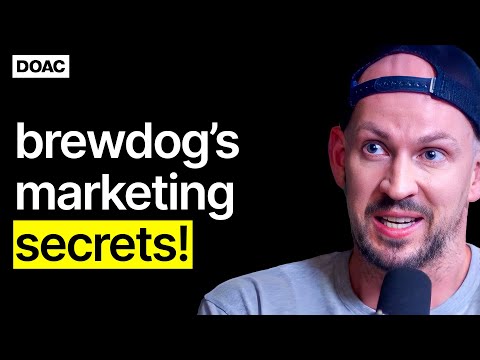
Brewdog Founder: The Untold Story Of One Britain’s Fastest Growing Companies: James Watt | E157
Steven Bartlett (host), James Watt (guest), Narrator, Narrator
In this episode of The Diary of a CEO, featuring Steven Bartlett and James Watt, Brewdog Founder: The Untold Story Of One Britain’s Fastest Growing Companies: James Watt | E157 explores from Fishing Boats To Unicorn Brewer: James Watt Confronts Controversy James Watt, co‑founder and CEO of BrewDog, charts his journey from a socially awkward kid in a Scottish fishing village and trawler captain to leading one of Britain’s fastest‑growing and most controversial companies.
From Fishing Boats To Unicorn Brewer: James Watt Confronts Controversy
James Watt, co‑founder and CEO of BrewDog, charts his journey from a socially awkward kid in a Scottish fishing village and trawler captain to leading one of Britain’s fastest‑growing and most controversial companies.
He explains how outsider status, an inadequacy complex, and extreme work ethic fueled BrewDog’s 87% average annual growth, disruptive marketing, and radical crowdfunding model ‘Equity for Punks.’
Watt openly addresses allegations of toxic culture, bullying, and misleading marketing, accepting that he has pushed people too hard, mishandled culture during periods of hyper‑growth, and is now overhauling leadership, transparency, and employee ownership.
The conversation also dives into mental health, therapy, carbon‑negative ambitions, and why, despite achieving unicorn status and personal wealth, Watt still feels driven by the same restless inner voice.
Key Takeaways
Outsider traits and an ‘inadequacy complex’ can be powerful entrepreneurial fuel—if you channel them.
Watt’s childhood speech impediment, severe acne, and harsh maternal criticism left him feeling like an outsider with a deep sense of not being ‘good enough. ...
Get the full analysis with uListen AI
Extreme resilience under pressure is developed in real adversity—and should inform how you choose leaders.
Six years on a North Atlantic trawler taught Watt that you only see what someone is truly made of when everything is going wrong at 2 a. ...
Get the full analysis with uListen AI
Community ownership can be both a funding engine and a brand superpower.
Unable or unwilling to raise traditional capital, BrewDog invented ‘Equity for Punks’ in 2009—equity crowdfunding before it was mainstream. ...
Get the full analysis with uListen AI
Constraints, not capital, often produce the most effective marketing and strategy.
With no ad budget and competing against global giants, BrewDog applied two tests to every marketing idea: (1) Could another company do this? ...
Get the full analysis with uListen AI
If you don’t design culture with your people, it will be designed for you—and possibly against you.
Watt admits that during hyper‑growth he led like a trawler captain—intense, directive, deadline‑driven—while under‑investing in HR and failing to communicate ‘the why. ...
Get the full analysis with uListen AI
Aligning rewards with responsibility turns employees into owners—on paper and in behavior.
To match high expectations with fair upside, BrewDog’s Blueprint gives salaried staff equity worth ~£120k over four years (at current valuation) and shares 50% of bar profits with venue teams. ...
Get the full analysis with uListen AI
Radical transparency and personal work (therapy, self‑inquiry) are becoming core CEO tools, not optional extras.
Watt describes hypervigilance, anxiety, and loneliness in the CEO role, especially under media attack. ...
Get the full analysis with uListen AI
Notable Quotes
“If 99% of people think you are wrong, you're either massively mistaken or about to make history.”
— James Watt
“We were going to die in a ditch for this thing. If I quit, that voice wins…and I couldn’t let that voice win.”
— James Watt
“You only really see what someone’s made of when things are difficult…would I want to be on the deck of a North Atlantic fishing boat at 2am in a storm with this person?”
— James Watt
“It's completely fair to say I did push people too far. I set standards for the team that I would set for myself, but for a lot of people that is unattainable.”
— James Watt
“I always thought: build a unicorn and I’ll feel complete. The next day I was just like, ‘Okay, let’s go. Where do we go from here?’”
— James Watt
Questions Answered in This Episode
You’ve said your inner ‘you’re not good enough’ voice hasn’t softened at all with success. If you discovered a way to permanently quiet it, would you actually take it—or do you believe your drive depends on that discomfort?
James Watt, co‑founder and CEO of BrewDog, charts his journey from a socially awkward kid in a Scottish fishing village and trawler captain to leading one of Britain’s fastest‑growing and most controversial companies.
Get the full analysis with uListen AI
In hindsight, is there a specific year or inflection point where you now think, ‘If we’d slowed growth by 20% and doubled HR investment, we could have avoided many of the culture issues’—and what concrete decision would you change at that moment?
He explains how outsider status, an inadequacy complex, and extreme work ethic fueled BrewDog’s 87% average annual growth, disruptive marketing, and radical crowdfunding model ‘Equity for Punks.’
Get the full analysis with uListen AI
Equity for Punks turned customers into co‑owners and critics; has there ever been a time when that community power clearly constrained a strategic decision you badly wanted to take, and did you regret listening to them or not listening enough?
Watt openly addresses allegations of toxic culture, bullying, and misleading marketing, accepting that he has pushed people too hard, mishandled culture during periods of hyper‑growth, and is now overhauling leadership, transparency, and employee ownership.
Get the full analysis with uListen AI
You’ve framed sustainability as businesses and scientists stepping in where governments are too slow. What’s one hard, profit‑reducing sustainability move BrewDog should make in the next three years that you haven’t yet had the courage or capital to attempt?
The conversation also dives into mental health, therapy, carbon‑negative ambitions, and why, despite achieving unicorn status and personal wealth, Watt still feels driven by the same restless inner voice.
Get the full analysis with uListen AI
If one of your daughters grew up to work at BrewDog and later signed a Punks With Purpose‑style critical letter about your leadership, how would you want your future self to respond differently from how you handled this episode?
Get the full analysis with uListen AI
Transcript Preview
You've had a lot of controversy over the last two years: bullying, lying, unfair dismissals, all of this stuff. What do you say to that?
I did. I did push people too far.
How fast did BrewDog grow?
We have grown, on average, 87% a year.
Fucking hell.
Everyone told us, "Make your beer cheaper. Change your name. Change your packaging," and we didn't listen to any of that. How can we get our name out there with no money at all? So we had to do things that were intentionally provocative and sometimes we kinda crossed that (laughs) e- edge as well. The best entrepreneurs have got to find a way to do things differently to how other people are doing things. We've got two very simple tests that we apply to everything that we do. So the first test is... This is the worst public health crisis for a generation. I've only ever been in tears once in, in my job, and I broke down in tears addressing our team in March of 2020, thinking that we're not going to be able to pay you, we're not going to be able to keep you in a job. I think people don't realize, like, being a CEO is a very, very lonely job at times.
That day. Talk me through what it's like to be a CEO when 300 people sign a letter making these allegations-
Yeah.
... about toxic workplace culture, unfair dismissals, all of this stuff. So without further ado, I'm Steven Bartlett, and this is The Diary of a CEO. I hope nobody's listening, but if you are, then please keep this to yourself. James, what is the... You've listened to this podcast before, so you know I have a theme of (laughs) where I start. I'm, like, trying to frame it as a surprise-
Mm-hmm.
... that I'm gonna start with your childhood. But... (laughs) Um, first, thank you for being here. It's, um, you know, it's always lovely to hear that people are, um... guests that we have on also kind of understand the format. Where I wanted to, to start with you is to take you right back, because that, for me, is always the context of, of somebody. So when you, when you look back, and when I read back at your early years in that small fishing community you grew up in, um... Was it Gardenstone?
Yeah, Gardenstone, up in the Northeast of Scotland.
When you, when you look back yourself at the foundational shaping, um, pivotal events of, like, those early years that are responsible for who you became in your life, the first events that you look back and go, "Now, that's the first dot I can connect," what are those?
I think there's, uh, I think there's a few. So, we grew up in a tiny fishing village northeast of Scotland. My dad was a fisherman. My mom was a schoolteacher. And being a fisherman is, is tough. And, uh, I just remember, like, the kinda hard work ethic instilled from, like, grandparents, whose, uh, grandfather, who was also a fisherman, my dad, who was a fisherman. So, kind of really hard working, really honest, kind of salt of the earth type character. But then he was always away and I'd be at home with my mum, and my relationship with my mum was, was never that good. And I think I struggled a lot when I was, when I was a kid. Um, I had quite a severe speech impediment when I was, when I was grown up and, um, this is something I haven't spoken about before, so... (laughs) Um, so that kind of always made me a little bit of an outsider, a little bit of a loner. Always felt a bit socially awkward. As I grew up and became a bit older, I had quite severe acne, so again, outsider, loner, socially awkward. And I think it's a trait that a lot of entrepreneurs have in common, they're a bit socially awkward. And I think if you're less likely to read social cues-
Install uListen to search the full transcript and get AI-powered insights
Get Full TranscriptGet more from every podcast
AI summaries, searchable transcripts, and fact-checking. Free forever.
Add to Chrome