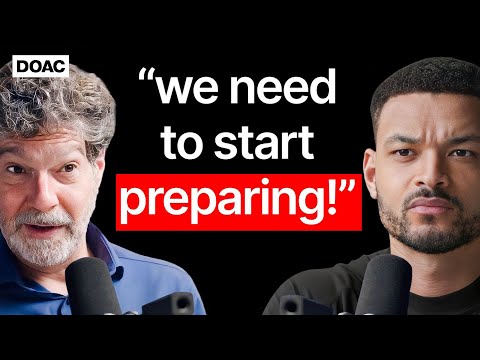
The Professor Banned From Speaking Out: "We Need To Start Preparing” - Dr Bret Weinstein
Dr Bret Weinstein (guest), Steven Bartlett (host), Narrator, Narrator
In this episode of The Diary of a CEO, featuring Dr Bret Weinstein and Steven Bartlett, The Professor Banned From Speaking Out: "We Need To Start Preparing” - Dr Bret Weinstein explores bret Weinstein Warns: Hyper-Novelty Is Quietly Driving Human Extinction Risk Bret Weinstein, evolutionary biologist and former professor, argues that humanity faces multiple accelerating existential threats driven by 'hyper‑novelty'—a rate of technological and social change far beyond what humans are adapted to handle.
Bret Weinstein Warns: Hyper-Novelty Is Quietly Driving Human Extinction Risk
Bret Weinstein, evolutionary biologist and former professor, argues that humanity faces multiple accelerating existential threats driven by 'hyper‑novelty'—a rate of technological and social change far beyond what humans are adapted to handle.
He highlights under‑discussed dangers such as solar storms, geomagnetic pole shifts, fragile electrical grids, nuclear reactor design, institutional collapse, and AI’s psychological and economic impacts, which he believes dwarf mainstream concerns like climate change.
Weinstein also contends that COVID exposed a systemic failure across public health, academia, media, and politics, and warns that a refusal to honestly investigate these failures is itself an existential risk.
Amid the macro dangers, he offers practical guidance: harden critical infrastructure, build personal resilience, cultivate trustworthy human relationships, invest in generalist cognitive skills, and live in closer alignment with ancestral biology to preserve individual and civilizational health.
Key Takeaways
Hyper-novelty is the core meta-risk accelerating all other existential threats.
Weinstein defines 'hyper‑novelty' as a rate of environmental and technological change so fast that human biology and culture cannot adapt. ...
Get the full analysis with uListen AI
The electrical grid and nuclear reactors are dangerously fragile to solar activity—and can be cheaply hardened.
A major coronal mass ejection like the 1859 Carrington Event could induce massive electromagnetic pulses (EMPs), frying transformers, computers, and cars, potentially turning a continent dark for months or longer. ...
Get the full analysis with uListen AI
Institutional collapse has created a 'Cartesian crisis' where people can no longer trust any source of truth.
Weinstein argues that newspapers, universities, public health bodies, and courts no longer function as truth‑seeking institutions but often do the opposite, selectively amplifying narratives that serve hidden incentives (e. ...
Get the full analysis with uListen AI
AI’s most credible dangers lie in narrative manipulation, empowerment of bad actors, epistemic breakdown, and economic disruption—not just sci‑fi takeover scenarios.
Weinstein lists five AI risks: (1) AI deciding humans are competitors; (2) mis-specified goals (e. ...
Get the full analysis with uListen AI
COVID-19 revealed systemic corruption and incompetence—from origins to treatment to vaccines—and we are refusing to learn from it.
Weinstein argues that SARS‑CoV‑2 almost certainly resulted from U. ...
Get the full analysis with uListen AI
To remain viable in an AI-driven, unstable world, individuals should invest in generalist cognitive tools, tangible projects, and real relationships.
Weinstein advises against chasing specific 'safe' careers because the landscape is opaque and rapidly shifting. ...
Get the full analysis with uListen AI
Living more like our ancestors—in diet, development, and relationships—improves both personal health and resilience.
Humans are exquisitely designed for ancestral environments. ...
Get the full analysis with uListen AI
Notable Quotes
“We are creating a rate of change that is so rapid that there is no conceivable way for us to keep up.”
— Bret Weinstein
“A solar storm could take a continent and turn it dark with no plan for bringing the lights back on.”
— Bret Weinstein
“There is nothing more dangerous than an AI that tells you what you want to hear.”
— Bret Weinstein
“The COVID story diagnoses the system. Every institution you would have expected to function failed.”
— Bret Weinstein
“There’s no point at which it makes sense to stop paddling, even if you think you’re going over the waterfall.”
— Bret Weinstein
Questions Answered in This Episode
You argue that EMP‑proofing transformers and moving spent nuclear fuel to dry casks are 'cheap' compared to the risk. Have you seen any concrete cost–benefit analyses or pilot projects that validate this claim at national scale?
Bret Weinstein, evolutionary biologist and former professor, argues that humanity faces multiple accelerating existential threats driven by 'hyper‑novelty'—a rate of technological and social change far beyond what humans are adapted to handle.
Get the full analysis with uListen AI
Your geomagnetic and galactic current‑sheet concerns hinge on work by Ben Davidson and others outside mainstream space physics. What specific empirical predictions from that model would you most want tested first, and by whom?
He highlights under‑discussed dangers such as solar storms, geomagnetic pole shifts, fragile electrical grids, nuclear reactor design, institutional collapse, and AI’s psychological and economic impacts, which he believes dwarf mainstream concerns like climate change.
Get the full analysis with uListen AI
On COVID, you claim early treatment with ivermectin and hydroxychloroquine would have made the illness 'highly manageable.' What high‑quality clinical or real‑world data do you consider strongest for that position, and how do you address the negative RCTs critics cite?
Weinstein also contends that COVID exposed a systemic failure across public health, academia, media, and politics, and warns that a refusal to honestly investigate these failures is itself an existential risk.
Get the full analysis with uListen AI
You warn that pornography and soon humanoid sex robots will entrench predatory male strategies. What would a realistic, non‑authoritarian cultural or policy response look like that protects sexual development without returning to prudish censorship?
Amid the macro dangers, he offers practical guidance: harden critical infrastructure, build personal resilience, cultivate trustworthy human relationships, invest in generalist cognitive skills, and live in closer alignment with ancestral biology to preserve individual and civilizational health.
Get the full analysis with uListen AI
If a new, genuinely truth‑seeking university or newspaper wanted to avoid the capture and perverse incentives you described, what concrete governance structures, funding models, and editorial norms would you design from day one to keep it resilient over decades?
Get the full analysis with uListen AI
Transcript Preview
I painted a scenario that was gonna result in the extinction of humanity and approximately how long it would take. The problem is, it's already underway on a timescale of decades, and we have created a fragile world that cannot endure this shift. People, should they be preparing? Absolutely.
That's quite scary. Dr. Bret Weinstein is an evolutionary biologist and former professor-
Uncovering the world's most pressing and controversial issues and offering his solutions to save humanity from a destructive future.
Humanity is in terrible danger, and the number of existential threats is growing. For example, I am profoundly concerned we are going to squander the lesson of COVID. You can see the complete collapse of journalism, our political institutions, our courts. They all failed. The tragedy is most people don't know that we are still not being honest about the origin of COVID, and the truth is it's
It's all kind of ******.
... but our political institutions don't wanna talk about it, which is gonna mean that the failures are gonna come back.
Is there anything else on your list of concerns?
So I have five different existential threats that AI poses, and we will go through them. But we have no evolutionary preparedness for living in a world where a computer can out-compete a human being. That's a dangerous world to live in.
Is there anything we can do to prepare or to avert this crisis?
Yes. Here's what I suggest.
Bret, of all these existential threats, is there one that's at the very top of your list?
Yes. There's nothing more dangerous than this, and that is...
This is a sentence I never thought I'd say in my life. Um, we've just hit seven million subscribers on YouTube, and I wanna say a huge thank you to all of you that show up here every Monday and Thursday to watch our conversations. Um, from the bottom of my heart, but also on behalf of my team, who you don't always get to meet, there's almost 50 people now behind The Diary of a CEO that worked to put this together. So, from all of us, thank you so much. Um, we did a raffle last month, and we gave away prizes for people that subscribed to the show up until seven million subscribers, and you guys loved that raffle so much that we're gonna continue it. So every single month, we're giving away money can't buy prizes, including meetings with me, invites to our events, and £1,000 gift vouchers to anyone that subscribes to the Diary of a CEO. There's now more than seven million of you, so if you make the decision to subscribe today, you can be one of those lucky people. Thank you from the bottom of my heart. Let's get to the conversation. (instrumental music) Bret, who are you, and what mission are you on? And when I ask that second question, I'm looking at the full body of your work, and I'm trying to encapsulate it maybe in just a couple of sentences.
Install uListen to search the full transcript and get AI-powered insights
Get Full TranscriptGet more from every podcast
AI summaries, searchable transcripts, and fact-checking. Free forever.
Add to Chrome