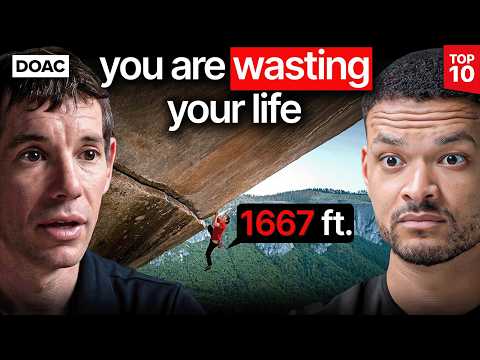
World's Greatest Climber: If I Had One Last Climb It Would Be...
Steven Bartlett (host)
In this episode of The Diary of a CEO, featuring Steven Bartlett, World's Greatest Climber: If I Had One Last Climb It Would Be... explores alex Honnold on chosen risk, fear conditioning, and mastery’s long arc Alex Honnold challenges the popular myth that he “doesn’t feel fear,” arguing that his calmness is largely the result of decades of repeated exposure, preparation, and learning to manage fear rather than eliminate it.
Alex Honnold on chosen risk, fear conditioning, and mastery’s long arc
Alex Honnold challenges the popular myth that he “doesn’t feel fear,” arguing that his calmness is largely the result of decades of repeated exposure, preparation, and learning to manage fear rather than eliminate it.
He traces key influences—an emotionally muted, performance-focused upbringing; his father’s sudden death; and years living cheaply in a van—into a philosophy of choosing risks intentionally because mortality is guaranteed either way.
Honnold details how mastery actually happens: breaking enormous objectives (El Cap, Taipei 101) into small trainable pieces, stacking goals over years, and persisting through long “flat” periods before compounding returns arrive.
The conversation expands beyond climbing into relationships (acts of service vs verbal affection), career economics (value first, money later), and his Honnold Foundation’s practical impact through community solar projects.
Key Takeaways
Fear isn’t absent; it’s trained and managed.
Honnold says climbers live with constant low-level fear because consequences exist even with ropes. ...
Get the full analysis with uListen AI
Free soloing is often more controlled than roped “unknown” climbing.
He claims his scariest moments were usually on rope during expeditions (e. ...
Get the full analysis with uListen AI
Big achievements look sudden, but they’re usually decade-long stacks of small reps.
El Cap free solo appears like a “magic trick,” yet he frames it as the visible tip of 10+ years of route familiarity and 30 years of near-daily climbing practice.
Get the full analysis with uListen AI
The fastest way to reduce fear is sustained, repeated exposure—not hacks.
He dismisses quick “courage” tricks as unreliable, especially in slow sports like climbing where fear can re-enter move-by-move; durable fear reduction comes from doing scary things repeatedly until they’re normalized.
Get the full analysis with uListen AI
Choose risks intentionally because you’re taking risks either way.
He argues many people take high risks unintentionally (buzzed driving, sedentary health risk) while judging climbers as reckless. ...
Get the full analysis with uListen AI
Set appropriately sized goals; ‘Taipei 1’ comes before ‘Taipei 101.’
Honnold warns that giant “white whale” goals can be paralyzing, especially for someone starting from low motivation. ...
Get the full analysis with uListen AI
Don’t let perfectionism block action—iterate toward better.
In reaction to his mother’s perfectionism (“almost doesn’t count”), he adopts “don’t let perfect be the enemy of good,” prioritizing attempts, learning, and forward motion over flawless execution.
Get the full analysis with uListen AI
Value creation tends to precede monetization in winner-take-all markets.
He describes years earning modest sponsor money (roughly $10k–$100k) before inflection points (Free Solo, corporate speaking) changed the economics—arguing you should focus on making the work ‘rad’ first.
Get the full analysis with uListen AI
Love can be expressed as attention and acts of service, not just words.
Sanni’s letter reframes his blunt practicality as a form of love—“paying attention is love. ...
Get the full analysis with uListen AI
Purpose gets sturdier when it produces direct, measurable impact.
He sees climbing as inspiring but indirect; his foundation work feels unambiguous—people gain first-time energy access, enabling study after dark, refrigeration, water pumping, and community resilience.
Get the full analysis with uListen AI
Notable Quotes
“You’re still gonna freaking die either way. So you might as well take smart, calculated risks and do all the things that you wanna do.”
— Alex Honnold
“There’s no hack. You just get really freaking scared over and over for so long, and eventually, it’s not that scary anymore.”
— Alex Honnold
“After 20 years of climbing five days a week and being really freaking scared, I respond differently than an average person.”
— Alex Honnold
“I don’t want to be crippled by perfectionism… Don’t let perfect be the enemy of good.”
— Alex Honnold
“Filling the space that would normally be taken up by all these feelings is the ability to truly see things… paying attention is love.”
— Sanni McCandless (letter read by Steven Bartlett)
Questions Answered in This Episode
When you say you keep free soloing within a “healthy margin,” how do you define that margin in practice (moves, conditions, fatigue, exit options)?
Alex Honnold challenges the popular myth that he “doesn’t feel fear,” arguing that his calmness is largely the result of decades of repeated exposure, preparation, and learning to manage fear rather than eliminate it.
Get the full analysis with uListen AI
What specific preparation checklist did you use for Taipei 101 (holds mapping, transitions, rest points), and what would have been a “no-go” finding during scouting?
He traces key influences—an emotionally muted, performance-focused upbringing; his father’s sudden death; and years living cheaply in a van—into a philosophy of choosing risks intentionally because mortality is guaranteed either way.
Get the full analysis with uListen AI
You argue the amygdala scan was misunderstood—what experiment design would actually test fear response in a way you’d consider meaningful?
Honnold details how mastery actually happens: breaking enormous objectives (El Cap, Taipei 101) into small trainable pieces, stacking goals over years, and persisting through long “flat” periods before compounding returns arrive.
Get the full analysis with uListen AI
In Antarctica, what were the concrete decision points where you considered retreat, and what factors kept you moving upward despite deteriorating conditions?
The conversation expands beyond climbing into relationships (acts of service vs verbal affection), career economics (value first, money later), and his Honnold Foundation’s practical impact through community solar projects.
Get the full analysis with uListen AI
You compare “chosen” risk (climbing) to “unchosen” risk (sedentary life, buzzed driving). How should someone quantify and compare those risks without fooling themselves?
Get the full analysis with uListen AI
Transcript Preview
It drives me crazy that nobody else thinks about risk in this way. People look at my life and they're like, "Well, you're crazy. You're such a risk-taker." Well, at least I'm taking the risks that I'm choosing. Because think of all the people that, like, go out partying every weekend, and they get buzzed, and they drive home. And even sedentary people who are like, "Well, I don't take risks. I stay home and I play video games." No, you're at a much higher risk of heart disease. Like, they're taking all kinds of risk that they're not actually choosing to take, and you're still gonna freaking die either way. So you might as well take smart, calculated risks and do all the things that you wanna do, and at least die happy when you go. [chuckles] He's done it! Alex Honnold has made history again.
Scaling one of the world's tallest skyscrapers. But the conclusion that a lot of people have arrived at is that you don't experience fear. Because when they look at these two brain scans, your amygdala is lighting up less when you're shown scary images.
I, I actually hate all the brain stuff because people always put me in this box of like, "Well, you're different." And I'm like, "Well, not really." Like, I'm a middle-class suburban kid. Nobody in my family is athletic. I just... After 20 years of climbing five days a week and being really freaking scared, I respond differently than an average person. And there was tons of emotional turmoil throughout it, periods where you're just like, "I'm trying so hard, and I'm just, like, not as good as I want to be." You know, I was, like, living in a car, and I had, like, a couple hundred bucks a month for 10 years. Like, that's challenging, but you just can't master a craft overnight.
I guess that's what people don't see. And so how do you create the conditions to out-persist other people? And then in all your career, when is the moment where you were most scared?
On an expedition in Antarctica, I kept hoping that it's gonna get better, and it just kept getting worse, like I could die.
Do you have a conversation with your partner before you go and do something like this? Because she wrote a letter.
Oh, gosh.
"Obviously, this is your worst nightmare," she said, "but we all have to do scary things sometimes, Alex." [drumbeat] Guys, I've got a quick favor to ask you. We're approaching a significant subscriber milestone on this show, and roughly sixty-nine percent of you that listen and love this show haven't yet subscribed for whatever reason. If there was ever a time for you to do us a favor, if we've ever done anything for you, given you value in any way, it is simply hitting that Subscribe button. And it means so much to myself, but also to my team, 'cause when we hit these milestones, we go away as a team and celebrate. And it's the thing, the simple, free, easy thing you can do to help make this show a little bit better every single week. So that's a favor I would ask you, and, um, if you do hit the Subscribe button, I won't let you down, and we'll continue to find small ways to make this whole production better. Thank you so much for being part of this journey. It means the world, and, uh, yeah, let's do this. [upbeat music] Alex, to understand you, I think from everything I've learned about you, from the research I've done, from speaking to your wife, your agent, everybody I could speak to, I think to understand your context, we first need to understand the circumstances in which you were raised and the childhood you had, because it seems to be... I mean, for all of us, there's, like, fingerprints left on, left on us that define the anomaly, um, that many of us become, including yourself. So what do I need to know? What does the viewer need to know about the early context?
Install uListen to search the full transcript and get AI-powered insights
Get Full TranscriptGet more from every podcast
AI summaries, searchable transcripts, and fact-checking. Free forever.
Add to Chrome