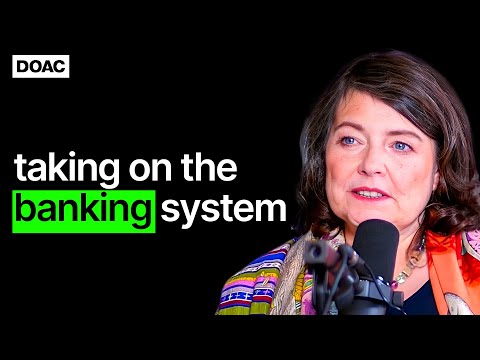
Starling CEO: Building a $1.5 Billion Business Against The Odds: Anne Boden | E107
Anne Boden (guest), Steven Bartlett (host), Narrator
In this episode of The Diary of a CEO, featuring Anne Boden and Steven Bartlett, Starling CEO: Building a $1.5 Billion Business Against The Odds: Anne Boden | E107 explores anne Boden’s Audacious Journey: Reinventing Banking At 54 Against Odds Anne Boden, founder and CEO of Starling Bank, recounts how she left a 30‑year corporate banking career at 54 to start a fully licensed digital bank from scratch, despite industry skepticism and entrenched stereotypes. She describes early fundraising failures, an explosive co‑founder split with Tom Blomfield that left her alone in an empty office, and the emotional toll of rebuilding everything from zero. A pivotal backing from a Bahamas‑based family office enabled her to raise £48m for a majority stake, eventually scaling Starling into a multi‑billion‑pound, tech‑driven bank with millions of customers.
Anne Boden’s Audacious Journey: Reinventing Banking At 54 Against Odds
Anne Boden, founder and CEO of Starling Bank, recounts how she left a 30‑year corporate banking career at 54 to start a fully licensed digital bank from scratch, despite industry skepticism and entrenched stereotypes. She describes early fundraising failures, an explosive co‑founder split with Tom Blomfield that left her alone in an empty office, and the emotional toll of rebuilding everything from zero. A pivotal backing from a Bahamas‑based family office enabled her to raise £48m for a majority stake, eventually scaling Starling into a multi‑billion‑pound, tech‑driven bank with millions of customers.
Throughout, Boden explores gender bias, ageism, and the loneliness of entrepreneurship, contrasting corporate life with the total personal responsibility of a founder. She explains how her upbringing, mindset of gratitude, and refusal to be bitter helped her navigate humiliation, public misreporting, and intense operational stress to build the kind of bank she believes the industry should have been all along.
Key Takeaways
Deep industry expertise can be a stronger asset than stereotypical ‘startup credentials’.
Boden spent over 30 years in global banks and consulting before founding Starling. ...
Get the full analysis with uListen AI
Fundraising is far harder, more biased, and less meritocratic than most narratives suggest.
Despite senior roles and a clear proposition, Boden was repeatedly rejected by VCs who doubted a 50‑something Welsh woman could build a tech bank. ...
Get the full analysis with uListen AI
Co‑founder breakups can be terminal—or transformational—depending on how you respond.
The split with Tom Blomfield cost Starling its initial team (16 people) and pending funding, leaving Boden alone in the office with almost no tech built. ...
Get the full analysis with uListen AI
Equity dilution can be a smart trade if it unlocks transformational capital.
On a yacht in the Bahamas, investor Harold McPike offered £48m for 66% of Starling when it was still essentially a 16‑page deck and an in‑progress licence application. ...
Get the full analysis with uListen AI
Under‑promising and over‑delivering can be a powerful, if slower, growth strategy.
Coming from corporate and as a woman, Boden says she was conditioned not to oversell, which made early pitching harder but built a culture where Starling consistently exceeded expectations. ...
Get the full analysis with uListen AI
Mindset—especially gratitude and perspective—is critical protection against entrepreneurial burnout.
Boden describes inheriting from her father a habit of ‘changing the chatter’ in her head: counting blessings, focusing on what’s going right, and remembering she isn’t the centre of everyone’s attention. ...
Get the full analysis with uListen AI
Life choices that defy social expectations can be a source of focus, not just sacrifice.
Boden openly discusses not marrying or having children—not as a conscious rejection, but as a path that unfolded because ‘the right man never came along’ and work dominated her priorities. ...
Get the full analysis with uListen AI
Notable Quotes
“People don’t start banks. And if they do start a bank, they are probably a billionaire.”
— Anne Boden
“I was prepared to give up my part in Starling for the good of Starling, and that was a very stupid thing to do.”
— Anne Boden
“Nothing was gonna stop Starling succeeding after that happened.”
— Anne Boden
“I was trying to raise three million. He said, ‘No, I’m not gonna give you three million. I’m gonna give you forty‑eight.’”
— Anne Boden
“I have the privilege of running Starling, and it is a privilege… there’s lots of pressures on me, but it’s a great privilege to have.”
— Anne Boden
Questions Answered in This Episode
Looking back at the moment on that yacht, would you structure the £48m for 66% deal differently now that Starling is worth over a billion, or do you still see it as the optimal trade‑off between control and capability?
Anne Boden, founder and CEO of Starling Bank, recounts how she left a 30‑year corporate banking career at 54 to start a fully licensed digital bank from scratch, despite industry skepticism and entrenched stereotypes. ...
Get the full analysis with uListen AI
You’ve said the public story of your split with Tom Blomfield and the 16 staff is ‘not actually what happened’—if you could correct one specific misconception about that episode, what would it be?
Throughout, Boden explores gender bias, ageism, and the loneliness of entrepreneurship, contrasting corporate life with the total personal responsibility of a founder. ...
Get the full analysis with uListen AI
How do you practically protect your frontline staff from burnout when they’re dealing daily with customers who’ve been scammed, bereaved, or driven into debt—what systems or training have you put in place beyond telling them to be empathetic?
Get the full analysis with uListen AI
Given your critique of VC herd mentality and bias, if you were designing a new funding model to better back non‑stereotypical founders, what would it look like in terms of selection criteria, incentives, and decision‑makers?
Get the full analysis with uListen AI
You’ve admitted that some of the things you were ‘100% certain of’ from your old banking career turned out to be wrong once you became a founder; can you name two or three specific beliefs you had to unlearn, and how Starling might look different today if you hadn’t challenged them?
Get the full analysis with uListen AI
Transcript Preview
It was humiliating reading in the press what had happened. I got fired twice in six months. Unless we could raise funding- I was never paid. ... there weren't going to be any jobs. And after six months, I just thought, "I can't work with this person." He had a tough time. Really damaging to me and my mental health. Tom didn't think I was capable. And so I resigned. Nothing was gonna stop Starling succeeding. People don't start banks, and if they do start a bank, they are probably a billionaire. When I started talking to people about, "I am gonna start a bank," you know, I could see people thinking I was totally crazy. I hadn't raised a penny. The only money that had gone into the business was my money. And he said, "No, I'm not gonna give you $3 million. I'm gonna give you 48." Now, I have the privilege of running Starling, and it is a privilege, and there's lots of things going wrong, and lots of pressures on me, but it's a great privilege to have.
(Music) If you've been listening to this podcast for a while, you would have heard the episode I did with Tom Blomfield. He was the former CEO and founder of Monzo Bank, one of the big fintech disruptor banks here in the UK. And during that episode, he also tells us the story of his time at Starling Bank, the rival bank that he co-founded with Anne Boden. And that episode is dramatic, it should be a movie. They talk about their fallout. In the episode, Tom claims that Anne fired 16 members of staff in the same day. So in this episode, Anne wanted to come in to tell her side of the story, but also to tell her story. And it's an incredible story, it's an inspiring story, it's a story that doesn't quite make sense in the fact that she's achieved so much in an industry where she was an underdog, at an age when she also admits she is an underdog, confronting stereotypes that make her an underdog. And despite the odds being stacked against her, she's built a multi-billion dollar bank here in the UK. It really is a crazy story, one that I believe one day will be a Netflix show. Think about that, two people came together to take on the banking world, they came together and founded a bank called Starling Bank, they had this major blowup, they separated, Anne starts again, and they both build incredibly successful, multi-billion dollar banks individually. It is one hell of a story. It twists, it turns, and it inspires you. So without further ado, I'm Steven Bartlett, and this is the Diary of a CEO. I hope nobody's listening, but if you are, then please keep this to yourself. (Music) Anne, humble beginnings. Do you think that's a accurate phrase to describe the start of your life?
Yeah, it was humble. Um, my, my father worked in the steelworks. Um, my father came ho- home from work with newspapers under his arm, all greasy from, you know, sort of doing hard work. My mum worked in the local department store, um, and we were happy.
Install uListen to search the full transcript and get AI-powered insights
Get Full TranscriptGet more from every podcast
AI summaries, searchable transcripts, and fact-checking. Free forever.
Add to Chrome