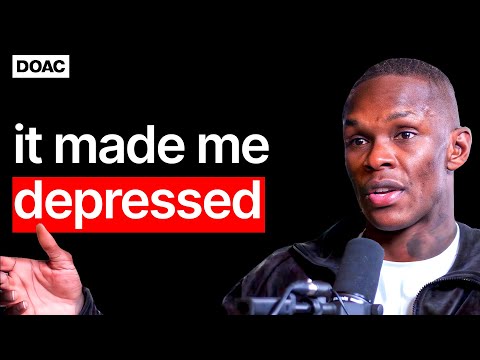
Israel Adesanya: Becoming World Champion Was The Lowest Day Of My Life!
Steven Bartlett (host), Israel Adesanya (guest), Narrator
In this episode of The Diary of a CEO, featuring Steven Bartlett and Israel Adesanya, Israel Adesanya: Becoming World Champion Was The Lowest Day Of My Life! explores israel Adesanya: Fame, Trauma, Fighting And The Cost Of Greatness Israel Adesanya unpacks the gap between his spectacular public persona and the vulnerable, reflective person behind it, from childhood racism and people-pleasing to depression, therapy and imposter syndrome.
Israel Adesanya: Fame, Trauma, Fighting And The Cost Of Greatness
Israel Adesanya unpacks the gap between his spectacular public persona and the vulnerable, reflective person behind it, from childhood racism and people-pleasing to depression, therapy and imposter syndrome.
He describes how bullying, immigration and cultural dislocation shaped his identity, why he consciously rejects fame while loving its perks, and how he protects his mental health in a sport that rarely talks about it.
Adesanya explains his philosophy on purpose, masculinity, legacy, and raising future children differently from the traditional school system, while also revealing how he handles fans, media, cancel culture and close relationships.
Throughout, he argues for radical authenticity: speaking your truth, accepting your flaws, and designing a life that serves your values rather than public expectations.
Key Takeaways
Childhood bullying and dislocation can quietly create lifelong people‑pleasing habits.
Moving from Nigeria to New Zealand, Adesanya went from feeling normal to being racially targeted and socially isolated. ...
Get the full analysis with uListen AI
High achievement often triggers emotional crashes that require proactive mental health tools.
After his spectacular UFC debut and six‑figure payday, Adesanya found himself unexpectedly sad and empty once the cameras were gone. ...
Get the full analysis with uListen AI
Imposter syndrome can make earned rewards feel undeserved—unless you consciously reframe them.
When he bought a McLaren after beating Robert Whittaker, negative comments from someone close (“more deserving people at the gym”) sank in so deeply he parked the car for a week, feeling like a fraud. ...
Get the full analysis with uListen AI
Therapy and honest self‑talk are as essential as physical training for long‑term performance.
Adesanya treats mental health like physical health: if you don’t maintain it, you’ll eventually get sick. ...
Get the full analysis with uListen AI
Healthy masculinity needs outlets for aggression, not suppression of it.
He argues that young men, flooded with hormones and unresolved emotions, need structured, physical outlets to avoid destructive behavior. ...
Get the full analysis with uListen AI
Radical authenticity is a powerful defense against cancel culture and media manipulation.
Adesanya refuses to brand himself as a flawless role model. ...
Get the full analysis with uListen AI
Fame is addictive and dehumanizing, so strict boundaries are survival, not arrogance.
He loves the perks of fame—access, opportunities, experiences—but dislikes being famous. ...
Get the full analysis with uListen AI
Notable Quotes
“Guys like us, we're not meant to fit in, we're meant to stand out.”
— Israel Adesanya
“I don't have to match everyone's energy… Hard pill to swallow: I'm not excited to meet you as much as you are to meet me.”
— Israel Adesanya
“There's no good people, there's no bad people. People are just capable of great good and great evil.”
— Israel Adesanya
“I know when it's all said and done, when I'm dead, my name will be remembered in history.”
— Israel Adesanya
“Everything comes from the imagination… I can manifest like a motherfucker.”
— Israel Adesanya
Questions Answered in This Episode
You described your 2013 ‘Great Depression’ as being triggered by losing both your relationship and your ability to fight; if you were mentoring a young fighter in an identical situation today, what concrete steps would you tell him to take in those first 30 days?
Israel Adesanya unpacks the gap between his spectacular public persona and the vulnerable, reflective person behind it, from childhood racism and people-pleasing to depression, therapy and imposter syndrome.
Get the full analysis with uListen AI
When you parked the McLaren for a week after hearing people at your own gym say others ‘deserved it more,’ what exact inner conversation or exercise flipped your mindset from shame to ‘I earned this’?
He describes how bullying, immigration and cultural dislocation shaped his identity, why he consciously rejects fame while loving its perks, and how he protects his mental health in a sport that rarely talks about it.
Get the full analysis with uListen AI
You’ve said that after fighting you’ll need to do something a couple of times a year that feels like you might die to ‘tame the beast’; given what you know about addiction to adrenaline and fame, how will you stop that from sliding into self‑destruction?
Adesanya explains his philosophy on purpose, masculinity, legacy, and raising future children differently from the traditional school system, while also revealing how he handles fans, media, cancel culture and close relationships.
Get the full analysis with uListen AI
Your vision for your future kids rejects traditional school in favor of tutors, martial arts, and adventures; how would you practically protect them from becoming socially isolated or entitled in a world where most other kids are still in the conventional system?
Throughout, he argues for radical authenticity: speaking your truth, accepting your flaws, and designing a life that serves your values rather than public expectations.
Get the full analysis with uListen AI
You’re very open about using manifestation and imagination to create your life; can you walk through one specific non‑fighting thing you manifested step‑by‑step—from the first idea, to the way you held it in your mind, to the actions you took until it became real?
Get the full analysis with uListen AI
Transcript Preview
Could you do me a quick favor if you're listening to this? Please hit the follow or subscribe button. It helps more than you know, and we invite subscribers in every month to watch the show in person.
Introducing the interim UFC Middleweight Champion, Israel Adesanya! Oh, shit. I know when it's all said and done, when I'm dead, my name will be remembered in history.
Why does that matter?
Guys like us, we're not meant to fit in, we're meant to stand out. But I've felt it. It's addicting, so I need to do something that's gonna just tame the beast. If not, it's gonna seep in other ways that I wouldn't want it to in my life.
Are you happy?
I think 2013 was my great depression. I wasn't able to fight and then I just felt like I don't deserve it. This world, one thing I've seen, they'll build you up and then tear you down. People naturally just wanna see you fail. I had to take a hard look at myself and I put that pressure on myself, like, "Watch this." I don't feel like I have anything to hide. I put things out there that I probably shouldn't sometimes, but that's my way of being vulnerable, where I'm just like, "This is me."
So without further ado, I'm Steven Bartlett, and this is The Diary of a CEO. I hope nobody's listening, but if you are, then please keep this to yourself. Israel.
Yes.
Thank you for being here. Massive inspiration for me in so many ways, and I've watched your, your rise over the years with, with inspiration and, um, admiration for so many reasons. Reason number one, we have a, I, I guess a shared heritage in the fact-
Mm-hmm.
... that we're both from-
Omo Naija.
I'm half Nigerian, you're Nigerian as well. And-
Yes, sir.
And your story, as I read it, it sounded so bizarrely like my story in so many ways. And then the other, I mean, I could... there, there's an exhaustive list of reasons why you've inspired me personally. But then seeing what you've done with yourself as a brand, as a marketeer-
Mm.
... again, inspired me in a completely different way.
(laughs)
And I'll never forget, and I played it for my girlfriend last night.
Mm.
Your entrance against Robert Whittaker.
The first time.
The first time.
Yeah, yeah, yeah.
And I'm like, "This guy is breaking the rules."
Yeah, the entrance. Um, for me, that was, uh, I felt like that was my way of staying away from the fight in a way, 'cause I know that night Robert was just like stewing over the fight.
Yeah.
He was sleeping. He wouldn't be... no, no, he wasn't sleeping, I'm sure. He was just worried about the fight, thinking about the fight, just thinking about... But for me, I was literally, like, fell asleep with my phone in my hand watching my rehearsals for that entrance like, "This is gonna look sick. Replay." Probably replayed it like 60 times the night before, and I fell asleep with my phone in my hand watching that, just the rehearsals. So it was like, there was no paralysis over analysis. I was just like focused on how sick that was gonna look.
Install uListen to search the full transcript and get AI-powered insights
Get Full TranscriptGet more from every podcast
AI summaries, searchable transcripts, and fact-checking. Free forever.
Add to Chrome