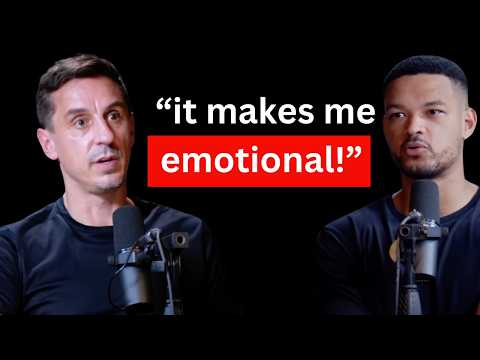
Gary Neville: From Football Legend To Building A Business Empire | E170
Gary Neville (guest), Steven Bartlett (host), Narrator, Narrator
In this episode of The Diary of a CEO, featuring Gary Neville and Steven Bartlett, Gary Neville: From Football Legend To Building A Business Empire | E170 explores gary Neville On Relentless Work, Burnout, Leadership, Legacy And Loss Gary Neville reflects on his journey from working‑class beginnings to Manchester United legend and multi‑business owner, and how relentless work ethic shaped both his success and his health scares. He explains why resilience is learned, not innate, crediting his parents, grandparents, and Sir Alex Ferguson’s culture for his mindset and standards.
Gary Neville On Relentless Work, Burnout, Leadership, Legacy And Loss
Gary Neville reflects on his journey from working‑class beginnings to Manchester United legend and multi‑business owner, and how relentless work ethic shaped both his success and his health scares. He explains why resilience is learned, not innate, crediting his parents, grandparents, and Sir Alex Ferguson’s culture for his mindset and standards.
Neville dissects Manchester United’s current decline as a failure of leadership, culture and infrastructure from the very top, and contrasts that with the high‑performing environment he grew up in. He also shares candidly about burnout, collapsing on live duty, seeing a psychiatrist as a player, and the coping mechanisms that now underpin his mental health.
Away from football he details his business philosophy in Greater Manchester, his views on modern work culture and remote flexibility, and his political stance as a ‘champagne socialist’ entrepreneur within the Labour Party. The conversation ends with an emotional admission about not telling his mother and grandparents how much they shaped him, and his regret about not putting family first.
Key Takeaways
Resilience, robustness and hard work are teachable, not innate.
Neville insists his and his siblings’ sporting success came from layers of exposure to demanding role models: hard‑grafting parents, old‑school youth coaches like Eric Harrison, then figures such as Sir Alex Ferguson, Roy Keane and Peter Schmeichel. ...
Get the full analysis with uListen AI
Relentless drive without boundaries has a real health cost.
He describes collapsing and having a fit live during Euro 2020 after a Raheem Sterling goal, then being told in hospital that he was doing too much and needed to slow down. ...
Get the full analysis with uListen AI
Presence and boundaries with technology are crucial for sanity and culture.
Neville notes he’s often physically present but mentally elsewhere, planning the next thing even while answering questions. ...
Get the full analysis with uListen AI
Culture and leadership from the top dictate performance far more than individual talent.
Explaining United’s decline, Neville frames it like a failing school: Ofsted doesn’t blame the kids, it looks at governors and the headteacher. ...
Get the full analysis with uListen AI
Great leadership combines high standards with deep personal care.
Sir Alex is portrayed as relentlessly hard‑working and demanding—at Carrington alone at 6:30am days after a Champions League final defeat—but also as someone who knew every staff member’s name and family, protected employees, and knew how to ‘press buttons’ in each player (for Neville, talking about his grandparents’ wartime sacrifices). ...
Get the full analysis with uListen AI
Rigid rules often backfire; shared standards and trust work better.
After Roy Hodgson warned him that formal rules are usually broken by the people you least want to punish, Neville stopped writing rigid policies in his businesses. ...
Get the full analysis with uListen AI
Mental health is managed through perspective, routine and accepting bad days.
At 24–25, after poor performances for United and England and a long relationship breakup, Neville lost confidence, feared games and even thought about his ex during matches. ...
Get the full analysis with uListen AI
Notable Quotes
“Resilience and robustness and hard work can be taught and learnt. I don't think it's something you're born with.”
— Gary Neville
“The only thing you can ever do in life is work as hard as you possibly can and never give in.”
— Gary Neville (recalling Sir Alex Ferguson’s core message)
“These players go out onto the pitch now, they feel alone.”
— Gary Neville (on current Manchester United squad)
“What I miss most is what he's missing with my children.”
— Gary Neville (on his late father)
“Of all the people that I always talk about having the influence on my life, I never mention my mum and her mum and dad… They're far better people than I am.”
— Gary Neville
Questions Answered in This Episode
You described collapsing during Euro 2020 as a turning point—what specific commitments or opportunities have you said no to since then that you would previously have accepted?
Gary Neville reflects on his journey from working‑class beginnings to Manchester United legend and multi‑business owner, and how relentless work ethic shaped both his success and his health scares. ...
Get the full analysis with uListen AI
If you were given full control of Manchester United for five years with a capped budget, what exact sequence of cultural and structural changes would you implement first, and in what order?
Neville dissects Manchester United’s current decline as a failure of leadership, culture and infrastructure from the very top, and contrasts that with the high‑performing environment he grew up in. ...
Get the full analysis with uListen AI
You said rigid rules backfire and you now prefer unwritten standards—can you recall a time in your businesses where that philosophy went wrong and you had to tighten things up?
Away from football he details his business philosophy in Greater Manchester, his views on modern work culture and remote flexibility, and his political stance as a ‘champagne socialist’ entrepreneur within the Labour Party. ...
Get the full analysis with uListen AI
When you compare the emotional cost of missing your children grow up with your pride in building hotels, a university and a football club, would you still make the same trade‑offs if you could relive the last 10 years?
Get the full analysis with uListen AI
You’ve been labeled a ‘champagne socialist’ for combining luxury developments with Labour politics—how would you redesign Labour’s economic narrative so that successful entrepreneurs like you feel fully represented rather than pushed to the margins?
Get the full analysis with uListen AI
Transcript Preview
That's making me a little bit upset. (sighs) Gary Neville! (crowd roars) Fantastic, incredible man. It's the owners of that business. It's really simple. Joke. I don't think anyone can believe it.
One of the things that people don't know about you is just the scale of your business portfolio. It's quite honestly mental.
The only thing you can ever do in life is work as hard as you possibly can and never give in.
What is the cost?
I basically collapsed to the floor and had a fit. I went to the hospital, I had checks, and then found that I needed to slow down a little bit and had stopped doing the things that kept me well, and I'd just run myself into the ground. So I knew at that- that point then, I needed to see somebody.
Manchester United are failing.
I do feel sorry for the current players. And that won't go down well with a lot of Manchester United fans. These players go out onto the pitch now, they feel alone. But that's where I'm a little bit critical of Cristiano. You're the star. Now is not the time to be throwing your arms around. Now is the time to make sure you lead those people. Resilience and robustness and hard work can be taught and learnt. I don't think it's something you're born with. From the minute I joined at 11 to the minute I left at 36, Manchester United got everything out of me. Everything. Of all the people that I always talk about having the influence on my life, I never mention my mum and her mum and dad. They're far better people than I am. That's making me a little bit upset. (instrumental music plays) (sighs)
So without further ado, I'm Steven Bartlett, and this is The Diary of a CEO. I hope nobody's listening, but if you are, then please keep this to yourself. (instrumental music plays) We are a normal working-class family. There are no famous sporting ancestors in our- in our family, yet somehow we won a combined 218 caps for our country at football and netball between us. Tracey Neville MBE, your sister, went twice to the Commonwealth Games and World Championships, representing England 74 times, and coached the national team. How and why is that possible, that three siblings in a family reach sport- sporting greatness when there isn't a long lineage of, you know, "The grandad was at Manchester United, this person was at this club and they opened doors for me"?
(tuts) (sighs) I don't know really. I mean, I- I- I'll start at the end because I was having a conversation yesterday about, um... It was actually, how long should you take off after you've had a baby as a couple, whether it be the- the man or the woman. And I was thinking about my sister, and she took, like, two or three weeks off and then she was back at it. And also, my father passed away seven years ago, and on the morning of his funeral, I went and presented, uh, our project St. Michael's at a council meeting, and then went and got ready at home and went to his funeral straight after it. And someone said to me, "It's not normal that." And- and- and my sister... My dad passed away in Australia whilst he was- whilst he was watching my sister play for the Commonwealth Games. And, uh, me and my brother flew straight over there. My sister was still coaching the team. She never broke stride. And he was on a ventilator keeping him alive, even though he'd actually, to be fair, passed away, and they were just waiting for us to get over. The day after we got there, my sister said, "I've got a game tomorrow. We can't pronounce that he's actually dead until after I finish the game and I come back to the hospital." And when I think of that, that's the end... I suppose, in terms of that sort of that feeling of just that drive, that commitment to what we do, it- it... uh, people say it's not normal. Someone said to me, they say it's not normal that, that we would continue our lives irrespective of... And that probably came from my dad and from my mum. But I think of it as in different layers for me personally. I don't know what it was like for my sister or my brother. But for me personally, I think of it as being the first layer was my mum and dad, their love for sport, their commitment to get there early, to do things. My dads used to say, "Get up early, get there early, get your job done." And then when I got to United, I'm hit by Nobby Stiles, Brian Kidd, you know, Manchester United European Cup winners of 1968, and then Eric Harrison, a northern, tough Yorkshireman who, every single day, drilled us about what it was to be a Manchester United player. And then you're exposed to Sir Alex Ferguson and Roy Keane and Peter Schmeichel and Mark Hughes. So these different layers of, you know, monstrous mentalities of people who are just massive leaders, we've been exposed to them. I was exposed to them. And that's why I always say that resilience and robustness and hard work can be taught and learnt. I don't think it's something you're born with. And I think when you say, like, "How did we achieve that?" I just think we're very fortunate with our parents and the exposure that we had to brilliant leaders throughout our career and examples and the s- the standard-bearers that were next to us.
Install uListen to search the full transcript and get AI-powered insights
Get Full TranscriptGet more from every podcast
AI summaries, searchable transcripts, and fact-checking. Free forever.
Add to Chrome