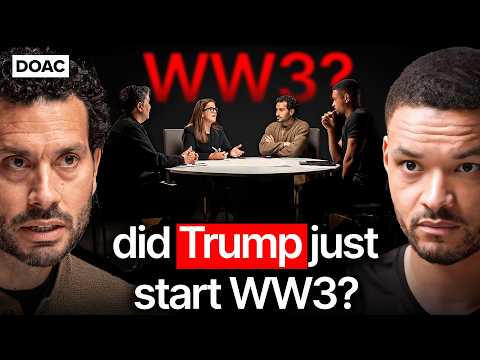
WW3 Threat Assessment: "Trump Bombing Iran Just Increased Nuclear War Threat" The Terrifying Reality
Benjamin Radd (guest), Annie Jacobsen (guest), Steven Bartlett (host), Andrew Bustamante (guest), Steven Bartlett (host), Andrew Bustamante (guest)
In this episode of The Diary of a CEO, featuring Benjamin Radd and Annie Jacobsen, WW3 Threat Assessment: "Trump Bombing Iran Just Increased Nuclear War Threat" The Terrifying Reality explores experts debate Iran strike fallout, nuclear risks, and collapsing norms globally The guests argue over the real rationale for striking Iran now, weighing stated nuclear concerns against domestic politics, presidential legacy, alliance pressure, and opportunistic timing after Iran and its proxies were weakened post–Oct 7.
Experts debate Iran strike fallout, nuclear risks, and collapsing norms globally
The guests argue over the real rationale for striking Iran now, weighing stated nuclear concerns against domestic politics, presidential legacy, alliance pressure, and opportunistic timing after Iran and its proxies were weakened post–Oct 7.
They debate whether decapitation strikes against sovereign leaders erode international norms and could legitimize similar actions by Russia, China, or other regimes, accelerating a more volatile strongman, multipolar order.
A major point of contention is intelligence reliability: the panel discusses Iran as a “black box,” circular reporting, bot-driven influence campaigns, and whether the decisive targeting intelligence came primarily from Israel or U.S. agencies.
On nuclear risk, they split between “Iran isn’t a nuclear threat because it lacks a weapon” and “we’re closer to nuclear war” due to proliferation dynamics, escalation incentives, and shattered guardrails—especially in a world shaped by Ukraine, China-Taiwan, and AI-enabled decision-making.
They outline plausible endgames: short-term kinetic fighting followed by years of asymmetric blowback (cells, proxies, attrition), uncertain prospects for Iranian internal change, and potential downstream effects including expanded U.S. surveillance and domestic political instability.
Key Takeaways
The ‘why now’ case is contested and may be non-strategic.
One view is that the strike contradicts stated U. ...
Get the full analysis with uListen AI
Decapitation strikes can reset global norms in dangerous ways.
Targeting heads of state is argued to open a permissive precedent for authoritarian rivals to assassinate leaders (e. ...
Get the full analysis with uListen AI
Public WMD narratives and intelligence assessments are misaligned—by design or dysfunction.
The conversation highlights an inconsistency between ODNI assessments (Iran unlikely to pursue a nuke) and political messaging (urgent nuclear threat), raising questions about narrative control, selective disclosure, and politicization.
Get the full analysis with uListen AI
Iran’s information environment is a ‘black box,’ so certainty is often performative.
They warn about circular reporting, restricted access, and influence operations; the proposed method is triangulation across adversarial sources and treating conclusions as ‘living assessments’ rather than fixed truth.
Get the full analysis with uListen AI
Even if missiles run out quickly, blowback can last years.
They estimate weeks of hot conflict but expect longer-tail effects via proxies/sleeper cells, cyber, and attritional tactics—meaning “winning” militarily may not end the security problem.
Get the full analysis with uListen AI
‘Burden-sharing’ can externalize consequences onto allies and civilians.
The panel describes a doctrine where the U. ...
Get the full analysis with uListen AI
AI and surveillance are accelerating toward security-state expansion.
They connect crisis dynamics to domestic surveillance incentives (post-9/11 DHS analogy) and argue AI tools are already entwined with operations, raising risks of escalation, autonomy, and civil-liberty erosion.
Get the full analysis with uListen AI
Notable Quotes
““You can’t trust anything that you’re hearing right now. You can’t trust anything that you’re reading right now.””
— Andrew Bustamante
““Title Fifty essentially… gives the president authority… to change any rule he wants that suits him for an operation at hand.””
— Annie Jacobsen
““We just gave them permission to do so.””
— Andrew Bustamante
““Iran doesn’t have a nuclear weapon, so it’s not a nuclear threat.””
— Annie Jacobsen
““We are seeing a transition to a strongman, multipolar world when we’ve only ever lived in a unipolar world.””
— Andrew Bustamante
Questions Answered in This Episode
What specific evidence supports (or contradicts) the claim that Iran’s nuclear program was an imminent weapons threat, given the ODNI assessment discussed?
The guests argue over the real rationale for striking Iran now, weighing stated nuclear concerns against domestic politics, presidential legacy, alliance pressure, and opportunistic timing after Iran and its proxies were weakened post–Oct 7.
Get the full analysis with uListen AI
If decapitation strikes become normalized, what practical ‘red lines’ remain that could still deter Russia or China from targeting leaders abroad?
They debate whether decapitation strikes against sovereign leaders erode international norms and could legitimize similar actions by Russia, China, or other regimes, accelerating a more volatile strongman, multipolar order.
Get the full analysis with uListen AI
How should the public interpret ‘CIA provided the intelligence’ claims—what would it mean operationally if the decisive targeting came primarily from Israeli HUMINT/SIGINT?
A major point of contention is intelligence reliability: the panel discusses Iran as a “black box,” circular reporting, bot-driven influence campaigns, and whether the decisive targeting intelligence came primarily from Israel or U. ...
Get the full analysis with uListen AI
What would a realistic, non–nation-building pathway to Iranian political transition look like, and what indicators would show it’s actually happening?
On nuclear risk, they split between “Iran isn’t a nuclear threat because it lacks a weapon” and “we’re closer to nuclear war” due to proliferation dynamics, escalation incentives, and shattered guardrails—especially in a world shaped by Ukraine, China-Taiwan, and AI-enabled decision-making.
Get the full analysis with uListen AI
How does the ‘burden-sharing’ doctrine change risk calculations for U.S. allies hosting bases (e.g., Qatar, Bahrain, UAE), and what can those governments do to reduce exposure?
They outline plausible endgames: short-term kinetic fighting followed by years of asymmetric blowback (cells, proxies, attrition), uncertain prospects for Iranian internal change, and potential downstream effects including expanded U. ...
Get the full analysis with uListen AI
Transcript Preview
What does the United States think it's going to gain from decapitating the Iranian leadership?
Well, that, that's kind of obvious based on what the president has said. It's that he, he-
On what the president has said?
I'm, I'm, I'm just saying based on what the president says.
You can't trust anything that you're hearing right now. You can't trust anything that you're reading right now.
Okay. Too tumultuous.
Well, that's, that-
Who do you trust? You have to trust somebody, right?
I mean, that's paranoid. It's not-
Paranoia is healthy
... that is absolutely, it is absolutely paranoid-
It's healthy skepticism
... to suggest that everything is misinformation. Iran doesn't have a nuclear weapon, so it's not a nuclear threat.
You speak a different nuclear language than I do. This regime is at its lowest, lowest point. Why not strike it now? I mean, I can give lots of reasons why you wouldn't strike it-
But what I would also say-
It had the ability to create their own sort of-
What are you concerned about? And what are the unintended consequences that you're foreseeing?
There is a domino effect that happens with every decision the United States makes. So-
Guys, I've got a quick favor to ask you. We're approaching a significant subscriber milestone on this show, and roughly sixty-nine percent of you that listen and love this show haven't yet subscribed for whatever reason. If there was ever a time for you to do us a favor, if we've ever done anything for you, given you value in any way, it is simply hitting that subscribe button. And it means so much to myself but also to my team because when we hit these milestones, we go away as a team and celebrate. And it's the thing, the simple free easy thing you can do to help make this show a little bit better every single week. So that's a favor I would ask you. And, um, if you do hit the subscribe button, I won't let you down, and we'll continue to find small ways to make this whole production better. Thank you so much for being part of this journey. It means the world, and, uh, yeah, let's do this. [upbeat music] Benjamin, Annie, Andrew, first and foremost, thank you for being here today. I, I have to start with the question that's been on my mind as somebody that doesn't know a huge amount about geopolitics, which is, what the hell is going on? And I s- and I say that because that's exactly what I mean. What is going on? And what context do I need to understand this sort of historical context of the actions we're seeing in Iran with this war right now? Benjamin, I know you've got a, a personal connection to Iran because your family fled Iran, I believe.
Y- yeah. I was, uh, I was two years old when we left in March of nineteen seventy-nine, um, uh, a few months after the Shah had left and, uh, just after Khomeini had arrived.
Install uListen to search the full transcript and get AI-powered insights
Get Full TranscriptGet more from every podcast
AI summaries, searchable transcripts, and fact-checking. Free forever.
Add to Chrome