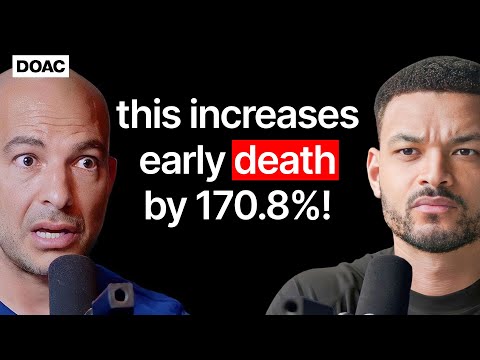
The LIFE-EXTENSION Doctor: "The ONE thing that's increasing your chance of early-death by 170.8%!"
Dr Peter Attia (guest), Steven Bartlett (host)
In this episode of The Diary of a CEO, featuring Dr Peter Attia and Steven Bartlett, The LIFE-EXTENSION Doctor: "The ONE thing that's increasing your chance of early-death by 170.8%!" explores longevity Doctor Reveals Exercise, Emotion, and Early Action Against Slow Death Dr. Peter Attia outlines his "Medicine 3.0" approach, arguing that modern healthcare excels at preventing fast deaths like infections but largely fails against slow killers such as cardiovascular disease, cancer, diabetes, and dementia. He emphasizes early, personalized prevention focused on exercise, nutrition, sleep, emotional health, and judicious use of drugs and hormones. Attia presents striking hazard ratio data showing that poor fitness and low strength increase all‑cause mortality more than smoking or diabetes. He also shares his own journey through trauma and workaholism to illustrate why emotional health is foundational to true longevity and healthspan, not just lifespan.
Longevity Doctor Reveals Exercise, Emotion, and Early Action Against Slow Death
Dr. Peter Attia outlines his "Medicine 3.0" approach, arguing that modern healthcare excels at preventing fast deaths like infections but largely fails against slow killers such as cardiovascular disease, cancer, diabetes, and dementia. He emphasizes early, personalized prevention focused on exercise, nutrition, sleep, emotional health, and judicious use of drugs and hormones. Attia presents striking hazard ratio data showing that poor fitness and low strength increase all‑cause mortality more than smoking or diabetes. He also shares his own journey through trauma and workaholism to illustrate why emotional health is foundational to true longevity and healthspan, not just lifespan.
Key Takeaways
Cardiorespiratory fitness and strength matter more than most traditional risk factors
Measured by VO2 max, being in the top 2. ...
Get the full analysis with uListen AI
Start prevention decades earlier and think in terms of lifetime risk
Modern Medicine 2. ...
Get the full analysis with uListen AI
Emotional health is a non‑negotiable pillar of longevity
Attia admits he was physically optimized but emotionally miserable—angry, detached, and workaholic—until intensive trauma therapy forced him to confront his behavior and inner narrative. ...
Get the full analysis with uListen AI
You can dramatically improve outcomes with modest, consistent exercise
Going from zero activity to just 90 minutes of exercise per week cuts all‑cause mortality by about 15%. ...
Get the full analysis with uListen AI
Train strength, muscle, and stability to avoid the cascade of age‑related decline
Muscle is your primary glucose sink (storing ~80% of glycogen) and a metabolic organ that protects against insulin resistance and type 2 diabetes. ...
Get the full analysis with uListen AI
Weight loss is about energy deficit, but context—sleep, stress, exercise, protein—determines success
Attia frames energy deficit strategies as CR/DR/TR: calorie restriction (eat less overall), dietary restriction (cut specific food groups like carbs or animal products), and time restriction (shorter eating windows). ...
Get the full analysis with uListen AI
Sleep and alcohol are powerful, underrated levers for long‑term health
Evolution wouldn’t have preserved sleep—8 hours of vulnerability a night—unless it was essential for brain and body maintenance. ...
Get the full analysis with uListen AI
Notable Quotes
“If we want to really figure out a way to live longer, and I would argue more importantly live better, we need a totally different playbook, and that playbook is Medicine 3.0.”
— Dr. Peter Attia
“When you compare the fittest 2.5% to the least fit 25%, that’s a hazard ratio of five – a 400% difference in all‑cause mortality.”
— Dr. Peter Attia
“Isn't it really ironic that you are putting so much energy into helping people live longer and yet you are paying no attention to your own misery?”
— Dr. Peter Attia (quoting his therapist)
“Once you hit the age of 65, if you fall and you break your hip, there's a 15 to 30% chance you will be dead within the next 12 months.”
— Dr. Peter Attia
“Those are adaptations to something that you didn’t deserve… it made me realize there is a real innocence to children that can very easily get injured.”
— Dr. Peter Attia
Questions Answered in This Episode
You showed that top‑tier VO2 max has a hazard ratio of about 5 compared with the lowest quartile. For someone who can only train three hours a week, what specific weekly protocol (types of workouts, intensities, and targets) would you design to maximize their VO2 max gains?
Dr. ...
Get the full analysis with uListen AI
You argue that atherosclerosis starts at birth and that young patients should be managed based on lifetime rather than 10‑year risk. What concrete diagnostic thresholds (e.g., ApoB, Lp(a), CAC score) would trigger you to start medications in a 30‑year‑old who otherwise "looks healthy"?
Get the full analysis with uListen AI
In the emotional health chapter, you describe rewiring your inner critic through daily recorded self‑talk. For someone who can’t access residential trauma treatment, what is the minimum viable at‑home protocol you’d recommend to begin similar work in a structured, safe way?
Get the full analysis with uListen AI
You’re skeptical of widespread insole use and advocate strengthening feet and using minimalist shoes, but many clinicians still prescribe orthotics as standard care. Under what specific clinical scenarios do you believe orthotics are truly necessary, and when do they actually impede long‑term stability and resilience?
Get the full analysis with uListen AI
Current alcohol epidemiology is confounded and messy, yet public guidelines still suggest "moderate" drinking is acceptable. If you were rewriting national alcohol guidelines from a Medicine 3.0 standpoint, what would they say, and how would you communicate them honestly without triggering backlash or disbelief?
Get the full analysis with uListen AI
Transcript Preview
Going from zero activity to just 90 minutes a week is about a 15% reduction in all cause mortality.
Jesus Christ.
Dr. Peter Attia-
World-renowned physician.
The go-to doctor for anything performance or longevity related.
He has the secret for living a long, healthy and happy life.
Most people listening to us are gonna die from cardiovascular disease, cancer, diabetes. If we want to really figure out a way to live longer, we need a totally different playbook.
How early do some of these diseases begin?
The minute you're born. We only really think about the risk over a 10-year time horizon. As a 30-year-old, you don't get excited about exercise and your sleep, but there's a 400% higher risk of dying in the coming year when you compare the fittest 2.5% to someone at the bottom 25%.
In the coming year?
And then once you hit the age of 65, if you fall and you break your hip, there's a 15 to 30% chance you will be dead within the next 12 months.
Really?
You have to realize you're taking this for granted.
Shit. When you talk about the deterioration of health, you have these three categories. Emotional health deterioration. Why have you included that?
Because despite being very physically healthy, I was not living a good life. I was in such an awful cycle of anger, workaholism that I don't think my marriage would've survived. I realized, I don't want to be this person and lose my kids. I don't think I could've survived it, and I'm sure many people listening to us can relate.
Were you able to discover the root cause of that?
More than that, I was able to get rid of it.
How?
So what you really need to do is-
What are the biggest misconceptions in your mind about weight loss?
I have thought a lot about this, so-
Dr. Peter Attia. He is the man that wrote the book on how to live a long, happy and healthy life, and he argues that everything we know about health and what that actually means, health of the mind, the body and the emotions, is wrong and outdated. He says that there's disease growing in you and me right now, but the problem is because we can't see it, we're doing nothing about it. Dr. Peter's work turns the light on. It allows you to see that in many cases, inaction now will increase your chance of disease and a much shorter life by 70%, 170%, and in some cases, if we don't take action now, by 400%. I've had lots of conversations on this podcast about health, about diet, about all of these things, but for many of you, this one will be the one that changes your life. This will be the one that makes you ask some difficult but important questions about your health and what health means for you. I walked away from this conversation realizing that if I don't take action now, I'm going to be forced to take action then, and I can unequivocally say that this conversation has changed my life. I have a suspicion it's gonna change yours. (instrumental music) Peter, Dr. Peter, you talk about so much in your work. I've been through every interview you've done, your book, other conversations you've had. You talk about a lot, so many things that I'm absolutely fascinated by. My first question for you is, what is your mission and why are you doing this?
Install uListen to search the full transcript and get AI-powered insights
Get Full TranscriptGet more from every podcast
AI summaries, searchable transcripts, and fact-checking. Free forever.
Add to Chrome