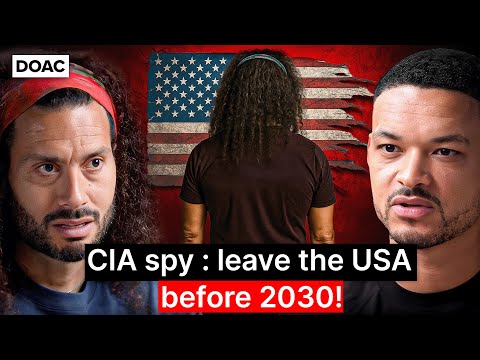
Former CIA Spies (NEW): Leave the USA Before 2030! The CIA Tried To Ban This Story!
Andrew Bustamante (guest), Steven Bartlett (host), Narrator, Narrator, Jihi (Jihee) Bustamante (guest), Jihi (Jihee) Bustamante (guest), Narrator, Andrew Bustamante (guest)
In this episode of The Diary of a CEO, featuring Andrew Bustamante and Steven Bartlett, Former CIA Spies (NEW): Leave the USA Before 2030! The CIA Tried To Ban This Story! explores married CIA spies expose mole hunt, spy tradecraft, and America’s future Former CIA officers Andrew and Jihee Bustamante reveal, for the first time, how they were used as a married ‘tandem couple’ in a high‑stakes operation to rebuild US espionage inside a hostile country and flush out a mole within the CIA. Code‑named operations in a friendly state (“WOLF”) and an adversary (“FALCON”) leveraged terrorist‑style cell structures and advanced tradecraft like cleansing routes, dry cleaning, surveillance detection, and commercial cover companies.
Married CIA spies expose mole hunt, spy tradecraft, and America’s future
Former CIA officers Andrew and Jihee Bustamante reveal, for the first time, how they were used as a married ‘tandem couple’ in a high‑stakes operation to rebuild US espionage inside a hostile country and flush out a mole within the CIA. Code‑named operations in a friendly state (“WOLF”) and an adversary (“FALCON”) leveraged terrorist‑style cell structures and advanced tradecraft like cleansing routes, dry cleaning, surveillance detection, and commercial cover companies.
Their work helped generate new intelligence sources against a hard target and fed into the FBI sting that ultimately caught a CIA turncoat later arrested on US soil. Along the way, they describe the moral gray zones of espionage, the reality of global surveillance and digital insecurity, and the institutional pressures that led them to leave the Agency to protect their family.
In the final act, they connect their experiences to broader geopolitical risk, arguing the US is in a dangerous transition period that could resemble Venezuela’s rapid collapse, and they are planning to leave America before 2030 while urging listeners to prioritize mobility, awareness, and present‑focused living.
Key Takeaways
Espionage is a team sport, not a lone‑wolf fantasy
The Bustamantes dismantle the James Bond myth: intelligence work is executed by cells—targeters, case officers, techs, linguists, and planners—coordinating around specific objectives. ...
Get the full analysis with uListen AI
New collection methods can be used to expose insiders
CIA couldn’t act on an ally’s tip about a mole until it had its own legal evidence. ...
Get the full analysis with uListen AI
Tradecraft hinges on managing patterns, not just hiding once
Andrew explains cleansing routes (“dry cleaning”)—routing travel from a friendly to a neutral country, swapping passports, then entering the hostile country so adversaries misattribute your origin. ...
Get the full analysis with uListen AI
Digital privacy is far weaker than most people assume
They state flatly that no phone or device is truly secure: border agencies can clone drives; passwords can be cracked or obtained via providers; FISA warrants unlock otherwise private Apple/Google accounts; and adversaries and criminals both target any ‘secure’ platform as a priority. ...
Get the full analysis with uListen AI
Double agents are driven more by psychology than pure money
The mole who penetrated CIA was allegedly paid hundreds of thousands of dollars, but the Bustamantes emphasize that money is usually one of several rewards. ...
Get the full analysis with uListen AI
Institutional loyalty can clash directly with family priorities
After Shadow Cell, when Jihee became pregnant, they proposed a ‘light duty’ track to have two children and then return to high‑risk work; CIA refused, insisting on redeploying them to highly sensitive roles and explicitly signaling that family was ‘not our problem. ...
Get the full analysis with uListen AI
The US is entering a high‑risk transition that demands mobility
Drawing on Venezuela’s rapid collapse from prosperous democracy to failed state within a few years, and on current US gridlock, institutional distrust, and rising executive power, the Bustamantes argue that Americans are wrong to believe ‘it can’t happen here. ...
Get the full analysis with uListen AI
Notable Quotes
“Espionage is a team sport. It’s not James Bond or Jason Bourne; it’s a cell of ordinary people doing extraordinary, coordinated work.”
— Andrew Bustamante
“I don’t think people recognize that CIA is morally ambivalent to how it executes espionage operations. The goal is to keep Americans safe.”
— Andrew Bustamante
“Anytime somebody says, ‘That can’t happen here,’ that’s a lie. That can happen anywhere.”
— Jihee Bustamante
“Privacy’s not real. If you think nobody can ever look at your stuff, that’s wrong.”
— Jihee Bustamante
“We will never go back to what we were. This is new America now, so you either take part in it or you leave.”
— Jihee Bustamante
Questions Answered in This Episode
You mention multiple simultaneous penetrations of CIA during your tenure. Without naming names, what patterns or vulnerabilities do you see inside the Agency that make it especially susceptible to insider compromise?
Former CIA officers Andrew and Jihee Bustamante reveal, for the first time, how they were used as a married ‘tandem couple’ in a high‑stakes operation to rebuild US espionage inside a hostile country and flush out a mole within the CIA. ...
Get the full analysis with uListen AI
Shadow Cell adopted terrorist cell structures to outmaneuver a state adversary. If CIA hadn’t gone through the war on terror, what specific vulnerabilities do you think would still exist in US operations against hard targets like FALCON?
Their work helped generate new intelligence sources against a hard target and fed into the FBI sting that ultimately caught a CIA turncoat later arrested on US soil. ...
Get the full analysis with uListen AI
Given your assertion that no device is truly secure and FISA can unlock most data, what would a realistic but non‑paranoid ‘digital hygiene protocol’ look like for a high‑net‑worth individual or CEO today?
In the final act, they connect their experiences to broader geopolitical risk, arguing the US is in a dangerous transition period that could resemble Venezuela’s rapid collapse, and they are planning to leave America before 2030 while urging listeners to prioritize mobility, awareness, and present‑focused living.
Get the full analysis with uListen AI
You argue the US is 60% likely to end up in a worse place before it gets better, and you plan to leave before 2030. What concrete indicators—economic, legal, or security‑related—would trigger your actual departure, versus signs that would convince you to stay and help shape ‘new America’?
Get the full analysis with uListen AI
You describe CIA’s culture as simultaneously building elite capability and fostering dependence on institutional validation. How could an intelligence agency—or any high‑performance organization—deliberately redesign its culture to retain top talent without creating the psychological vulnerabilities that foreign services exploit?
Get the full analysis with uListen AI
Transcript Preview
When this story hits the airwaves, it's going to transform people's opinion about the CIA and the depths to which CIA will dive to collect intelligence that protects Americans. So, one of its own officers became a spy, reporting our secrets to a foreign adversary. My wife and I were included in an operation to bait the mole to make a mistake so that the mole could be found and disclosed.
Your wife is here today and you've never told this story before, have you?
No. And your curiosity right now is a major issue with CIA, because they don't want the world to know who those people are. It's a dangerous game.
Well, obviously my research team tried to figure out who it was. (laughs)
(laughs)
(laughs)
So, was this the mole?
Married CIA spies Andrew and Jihee Bustamante were tasked with unraveling one of the greatest intelligence operations in modern history.
Their untold story shows you how to build trust, manipulate, and thrive under pressure. What actually happened?
A foreign ally contacted CIA and said, "You have somebody inside your organization sharing information on operations, officers, assets to an enemy country." They deployed us to the country and crafted new identities, new aliases so that we could build new sources of intelligence and try to find the mole.
And we were really successful in doing that.
Nobody felt like they were in imminent danger. But then that changed. My presence in the enemy country became known. I called Jihee and said, "I'm coming home early."
And from that, I knew that something was wrong, because it is very real that you can be disappeared by a foreign adversary.
Or worse, being captured. And the president can plausibly deny that you're CIA. So, I had to try to escape the country, but everything went wrong.
And what happens next?
A horrible story. So-
This is the first time I'm setting you at home a challenge when you listen to this episode. Can you figure out which country Andrew and Jihee were undercover in as spies from what they say? But also, our team here figured out that the mole in the CIA was one of these three people. Can you figure out from what they say which person was the mole? It might make sense for you at this moment to screenshot these three faces and the details below so you can remember their profiles. And by the end of the conversation, I want you to comment below which country you thought Andrew was undercover in as a spy and which one of these people was the mole within the CIA. Let's do this. Listen, to my regular listeners, I know you don't like it when I ask you to subscribe at the start of these conversations. I don't like saying it, I don't like it being in there. None of us like it. It's frustrating. Do you know what's also frustrating? It's also frustrating when I go into the backend of the YouTube channel and I see that 56% of you that listen frequently to this podcast haven't yet subscribed, and so many of you don't even know that you haven't subscribed because I'll see in the comments section, you say to me, you go, "I didn't even realize I didn't subscribe." And that actually fuels the show. It's basically like you're making a donation to the show. So, that's why I ask all the time, because it enables us to build and build and build and build, and we're going for the long term here. So, all I'd ask you is if you've seen this show before and you like it, help me, help my team here. Hit the subscribe button and we'll continue to build this show for you. That's my promise. Thank you to all of you guys that do subscribe. It means the world to me. Let's get on with the show. Andrew, you've never told this story before, have you?
Install uListen to search the full transcript and get AI-powered insights
Get Full TranscriptGet more from every podcast
AI summaries, searchable transcripts, and fact-checking. Free forever.
Add to Chrome