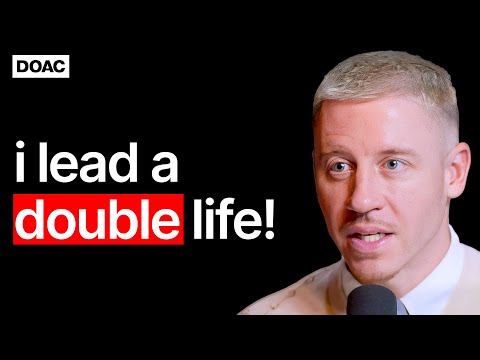
Macklemore: How You Can Overcome Your Darkest Days & Hardest Battles!
Macklemore (guest), Steven Bartlett (host)
In this episode of The Diary of a CEO, featuring Macklemore and Steven Bartlett, Macklemore: How You Can Overcome Your Darkest Days & Hardest Battles! explores macklemore On Addiction, Faith, Fatherhood And Finding Real Creative Freedom Macklemore (Ben Haggerty) traces his life from formative childhood moments with music through severe addiction, relapse, and eventual recovery, explaining how those experiences shaped both his art and his sense of purpose.
Macklemore On Addiction, Faith, Fatherhood And Finding Real Creative Freedom
Macklemore (Ben Haggerty) traces his life from formative childhood moments with music through severe addiction, relapse, and eventual recovery, explaining how those experiences shaped both his art and his sense of purpose.
He describes addiction as a disease driven by compulsion, escape, and often trauma, and details the critical role of surrender, 12‑step programs, and spiritual practice in staying sober and creating meaningful work.
The conversation explores how pain gets repurposed into purpose in songs like “Same Love,” “Other Side,” and “Drug Dealer,” and how genuine vulnerability creates powerful connection with listeners and fans in recovery.
Ben also reflects on fatherhood, nearly losing his marriage, his evolving relationship with fame and social media, and why he now prioritizes presence, service, and authenticity over metrics, expectations, and conformity.
Key Takeaways
Addiction often begins as an escape from an overactive mind, then becomes an uncontrollable ‘allergy’.
Macklemore describes his first real drinking experience at 14 as the first time his mind went quiet: an immediate feeling of reprieve and freedom. ...
Get the full analysis with uListen AI
Surrender—not willpower—is the pivotal turning point in recovery.
Both his own story and his friend’s illustrate that the real shift comes when an addict drops the mask, admits they’re not okay, and asks for help. ...
Get the full analysis with uListen AI
Family and friends must learn to support without trying to control or ‘fix’ the addict.
He stresses that loved ones are as powerless over the addict as the addict is over drugs. ...
Get the full analysis with uListen AI
Spiritual and practical habits create the mental clarity necessary for deep creative work.
Macklemore links his best work to being clear and spiritually grounded: exercise (especially cardio), time outdoors, being of service to others, meditation, 12‑step work, and consciously acting from faith rather than fear. ...
Get the full analysis with uListen AI
Radical honesty about addiction and identity can transform both the artist and the audience.
Songs like “Other Side,” “Drug Dealer,” and “Same Love” emerged from his decision to drop secrecy and reputation management. ...
Get the full analysis with uListen AI
Addiction devastates relationships primarily through dishonesty and gaslighting, not just substance use itself.
Macklemore is candid that his lowest behavior wasn’t only using—it was lying, living a double life, and making his wife feel ‘crazy’ for suspecting relapse. ...
Get the full analysis with uListen AI
Authenticity will confuse people, but it’s the only sustainable path to long‑term creative and personal fulfillment.
His album “Ben” spans dance, pop, classic hip‑hop and deeply personal storytelling. ...
Get the full analysis with uListen AI
Notable Quotes
“Maybe this world's not for me 'cause I don't know what I'm doing here anymore. I feel nothing.”
— Macklemore
“The greatest thing that we can do is surrender… to snitch on ourselves, to wave that white flag.”
— Macklemore
“It's said that we're only as sick as our secrets. I didn't wanna be sick anymore. I just wanted to tell my truth.”
— Macklemore
“All of these little moments, all of these mistakes, all of this pain eventually finds its way into purpose… an artist's highest form is to be able to take pain and repurpose it into purpose.”
— Macklemore
“Happiness is fleeting… What is sustainable is meaning, is purpose.”
— Macklemore
Questions Answered in This Episode
You’ve described exercise, service, and spiritual practice as key to staying clear—what does a ‘perfect’ recovery‑aligned day actually look like hour by hour for you on tour versus at home?
Macklemore (Ben Haggerty) traces his life from formative childhood moments with music through severe addiction, relapse, and eventual recovery, explaining how those experiences shaped both his art and his sense of purpose.
Get the full analysis with uListen AI
Looking back, is there a specific relapse warning sign you now recognize in yourself that your wife or close friends could realistically watch for, and how have you agreed to respond when they see it?
He describes addiction as a disease driven by compulsion, escape, and often trauma, and details the critical role of surrender, 12‑step programs, and spiritual practice in staying sober and creating meaningful work.
Get the full analysis with uListen AI
When you wrote “Same Love” and “Other Side,” did you have any private fears about backlash from the hip‑hop community, and were there any specific reactions—positive or negative—that changed how you view the culture?
The conversation explores how pain gets repurposed into purpose in songs like “Same Love,” “Other Side,” and “Drug Dealer,” and how genuine vulnerability creates powerful connection with listeners and fans in recovery.
Get the full analysis with uListen AI
If The Residency gets its permanent home, how would you design the curriculum and environment so that young artists don’t have to make some of the painful trade‑offs between authenticity, addiction, and industry pressure that you did?
Ben also reflects on fatherhood, nearly losing his marriage, his evolving relationship with fame and social media, and why he now prioritizes presence, service, and authenticity over metrics, expectations, and conformity.
Get the full analysis with uListen AI
You and Stephen both admitted struggling to have emotionally deep conversations with your fathers; if you decided to actually have that talk tomorrow, what’s the first uncomfortable sentence you’d say to him, and what outcome would you accept as ‘enough’ regardless of how he responds?
Get the full analysis with uListen AI
Transcript Preview
Maybe this world's not for me 'cause I don't know what I'm doing here anymore. I feel nothing and I think that that's the hardest part. I haven't really spoke about this. It's, um... Yeah, I- I'll just say it. I mean- Macklemore! The man behind our favorite hits. Music superstar. Grammy Award winner. We're just getting started. You have no idea.
Where does the desire to be on stage come from?
Michael Jackson. I wanted to make music, art with melody. It was where I felt an escape from my head. 14-year-old taking 12 shots of vodka, you know, on a school night by myself, running from the police and doing drugs that never stopped.
I've read, um, your wife had taken a pregnancy test.
Yeah. We were in our home and I'm there, I'm high. Her period was late, went and got her the pregnancy test and I'm just, like, praying, "Let this be a negative pregnancy test. I'm not ready to give up the drugs." And then I heard the tears. And I remember walking outside and I just started bawling 'cause I couldn't feel any sort of happiness, and I knew what that meant.
If you were to go back and be able to have a conversation now with young Ben at 14 years old, before that first drink, what would you say?
That's a great question. It's gonna cause way more pain than good, but at the same time...
Would you like to go for dinner with me and my guests here on The Diary of a CEO? We are holding dinner parties all around the world over the coming months, and our subscribers on this YouTube channel are invited. We're inviting 20 subscribers to every dinner. So if you'd like to come for dinner with me and my guests here on The Diary of a CEO, I have a favor to ask you. All you've got to do is hit the subscribe button and I hope to see you at dinner somewhere around the world very soon. Ben, when I, when I think about people's lives, I... And I think from doing this podcast, this has become more sort of clear to me. I see their lives as like a series of dots-
Mm-hmm.
... you know, like, or a series of dominoes that fall to lead them to where they are today. And if you go back to the very start of that, that series of dots to understand the most influential moments or things that, um, inspired you to become the person you are today, in every sense of the word, what are those first dots, those first experiences that I need to know in order to understand you?
My first dots. My first dots, I think, would be listening to the radio outside, summertime, nextdoor neighbor's yard, and being introduced to music and loving music, falling in love that summer. I believe I was six years old, and, you know, I had an older neighbor who was maybe four or five years older than me and he had a bunch of, um... You know, my best friend was next door. He was five years older than us. It was like a collection of, of kids in the neighborhood, and I remember that summer being this magical introduction to art, to music, to listening to the radio, and falling in love with, with melody, with sound. That was my first, that was my first dot. And then my next dot shortly after that was falling in love with hip-hop music at the age of seven. And those were the first two dots that really set me on a path, a trajectory, and this desire to be on a stage.
Install uListen to search the full transcript and get AI-powered insights
Get Full TranscriptGet more from every podcast
AI summaries, searchable transcripts, and fact-checking. Free forever.
Add to Chrome