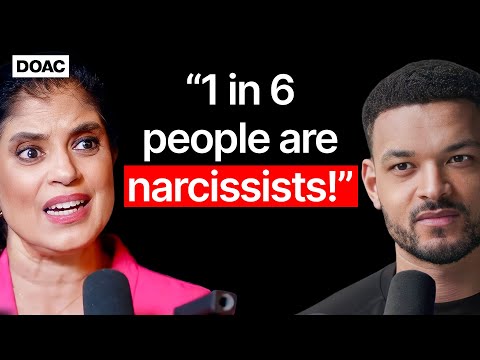
The Narcissism Doctor: "1 In 6 People Are Narcissists!" How To Spot Them & Can They Change?
Dr. Ramani Durvasula (guest), Steven Bartlett (host)
In this episode of The Diary of a CEO, featuring Dr. Ramani Durvasula and Steven Bartlett, The Narcissism Doctor: "1 In 6 People Are Narcissists!" How To Spot Them & Can They Change? explores inside Narcissism: Identifying, Surviving, And Navigating A Hidden Epidemic Clinical psychologist Dr. Ramani Durvasula explains narcissism as a personality style on a spectrum, marked by low empathy, entitlement, grandiosity, and chronic manipulation rather than just vanity or arrogance. She estimates roughly one in six people display noticeable narcissistic traits, with profound impacts on partners, families, workplaces, and even geopolitics.
Inside Narcissism: Identifying, Surviving, And Navigating A Hidden Epidemic
Clinical psychologist Dr. Ramani Durvasula explains narcissism as a personality style on a spectrum, marked by low empathy, entitlement, grandiosity, and chronic manipulation rather than just vanity or arrogance. She estimates roughly one in six people display noticeable narcissistic traits, with profound impacts on partners, families, workplaces, and even geopolitics.
The conversation unpacks different types of narcissism (grandiose, vulnerable, malignant, communal), how narcissistic relationships form and trap people, and why narcissists rarely change in any meaningful way. A major focus is on survivors: the psychological toll of gaslighting, projection, coercive control, and trauma bonding—and how people can regain their sense of reality, identity, and agency.
Dr. Ramani also explores why narcissists rise to the top in business and politics, how money and social media amplify narcissistic tendencies, and why systems often reward these personalities. Despite the bleak dynamics, she emphasizes that healing for survivors is absolutely possible with education, radical acceptance, and healthy social connection.
Key Takeaways
Narcissism is a personality configuration, not a bad mood or occasional selfishness.
Narcissism is characterized by low or variable empathy, entitlement, grandiosity, excessive need for admiration, emotional shallowness, self-centeredness, and chronic patterns of devaluation, manipulation, and blame-shifting. ...
Get the full analysis with uListen AI
Narcissistic people are often highly attractive and successful—especially at first.
They can be charming, charismatic, socially skilled, and even rated more attractive, which pulls people in. ...
Get the full analysis with uListen AI
There are distinct subtypes of narcissism, and all exist on a spectrum.
Grandiose narcissists are showy, charismatic, ambitious, and larger‑than‑life. ...
Get the full analysis with uListen AI
Narcissists rarely fundamentally change; therapy tends to produce only micro‑shifts.
Dr. ...
Get the full analysis with uListen AI
Gaslighting and projection are central tools of narcissistic abuse.
Gaslighting is a repetitive, trust‑based power play where your perception, memory, and sanity are systematically doubted (“I never said that,” “You’re crazy”), then flipped so you appear petty or unstable even when you present proof. ...
Get the full analysis with uListen AI
Surviving a narcissistic relationship often depends on radical acceptance and alternative sources of connection.
If you can’t leave—due to children, finances, culture, or family—Dr. ...
Get the full analysis with uListen AI
Narcissistic abuse is widespread, but recovery is very possible with awareness and support.
Dr. ...
Get the full analysis with uListen AI
Notable Quotes
“Exposure to people who have narcissistic personalities…can really steal a person away from themselves.”
— Dr. Ramani Durvasula
“All narcissism is on a spectrum…at the lowest ends, it’s Instagram saviors, but at the severe end…you’re talking about a cult leader.”
— Dr. Ramani Durvasula
“I’ve not seen them become a not‑narcissist. I’ve seen them make micro‑changes.”
— Dr. Ramani Durvasula
“The behavior is unacceptable. I don’t care about the backstory.”
— Dr. Ramani Durvasula
“We’ve gotten lots of cool stuff in our lives from them. Just don’t marry them.”
— Dr. Ramani Durvasula
Questions Answered in This Episode
You estimate roughly 15–18% of people are noticeably narcissistic; if you had unlimited funding, how would you design a large‑scale study to more accurately measure that prevalence across cultures and industries?
Clinical psychologist Dr. ...
Get the full analysis with uListen AI
In therapy with self‑aware narcissists who actually come in saying, ‘I think I’m a narcissist,’ what specific interventions, if any, have led to the most meaningful micro‑changes you’ve observed over time?
The conversation unpacks different types of narcissism (grandiose, vulnerable, malignant, communal), how narcissistic relationships form and trap people, and why narcissists rarely change in any meaningful way. ...
Get the full analysis with uListen AI
You argue all domestic abusers are narcissistic, which many in the domestic‑violence field might contest; what would you say to critics who believe this framing risks oversimplifying or medicalizing abuse?
Dr. ...
Get the full analysis with uListen AI
For someone who has chosen radical acceptance and is staying in a narcissistic marriage for now, what does a concrete, week‑by‑week plan to rebuild their own identity and support network actually look like?
Get the full analysis with uListen AI
If you were tasked with training a cohort of diplomats to negotiate with narcissistic and psychopathic leaders, what three psychological principles or red‑flag behaviors would you insist they master before ever entering a negotiation room?
Get the full analysis with uListen AI
Transcript Preview
We believe one in six people are narcissistic and exposure can become a life or death situation. But the key step to identify narcissism is...
Dr. Ramani Durvasula. Licensed clinical psychologist.
The world's leading expert on narcissism. All narcissism is on a spectrum. At the lowest ends, it's Instagram saviors, but the severe end of the spectrum, you're talking about a cult leader. They have low empathy. They will dominate people. They have to get the last word. They get angry very quickly. And that's just the top of the iceberg.
What about the impacts of narcissism on relationships?
Narcissistic people, they can go out in the world and they're able to be charming and charismatic. And narcissistic relationships start strong. They wanna get you quick. And then, it becomes dismissiveness, manipulation, gaslighting. The world thinks this person's fantastic. A lot of people say, "Aren't ya lucky that you're married to that guy?" And behind closed doors, they psychologically destroy you.
Narcissism in work. How do I know if my boss is a narcissist?
You're gonna feel it in the sense of you don't feel seen, you don't feel valued, you feel like the workplace is unpredictable. You might even feel that it's psychologically unsafe.
What about world leaders? If our adversary in another country is a narcissist, would we rather our leader be a narcissist as well?
That's a fantastic question, and I think...
So the big question, how do you know if you are a narcissist and can you cure narcissism?
So here's where we get into some interesting muddy waters.
It's absolutely crazy to me that so many of you have decided to watch our show, um, and so many of you have decided to subscribe to our show. We now have five million subscribers on YouTube, which is a number that I just can't comprehend, and it's a dream that I absolutely never could have had. We started the Diary of a CEO just over three years ago now, and in my wildest expectations, we might have had 100,000 subscribers by now. So you can imagine how shocked I am that so many of you have chosen to tune into these conversations every week, um, and spend some time with us. So thank you. And I made a deal with you. I made a deal that if you subscribed to this show that we would continue to raise the bar. And in 2024, we're gonna raise the bar like never before. I've been working for the last nine months on a surprise for all of you that have subscribed to this show, and I'm very excited to deliver that for you. The production's gonna change. We're gonna go even further with our guests, and we're gonna tell even more global stories. So as always, if you appreciate what we're doing here, the simple free favor I'll ask from you is to hit the subscribe button. Let's get on with the episode. Dr. Ramani?
Install uListen to search the full transcript and get AI-powered insights
Get Full TranscriptGet more from every podcast
AI summaries, searchable transcripts, and fact-checking. Free forever.
Add to Chrome