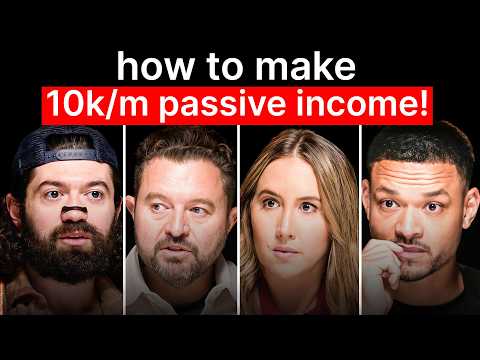
The SIMPLE (& Proven) Way To Earn $100,000 From Nothing! | The Money Making Experts
Steven Bartlett (host), Alex Hormozi (guest), Narrator, Daniel Priestley (guest), Codie Sanchez (guest), Guest (guest), Guest (guest), Narrator, Narrator, Guest (guest), Guest (guest), Narrator
In this episode of The Diary of a CEO, featuring Steven Bartlett and Alex Hormozi, The SIMPLE (& Proven) Way To Earn $100,000 From Nothing! | The Money Making Experts explores three Elite Entrepreneurs Reveal Simple Frameworks To Build Wealth Fast Three high-performing entrepreneurs – Alex Hormozi, Codie Sanchez and Daniel Priestley – join Steven Bartlett to break down practical, repeatable ways to go from nothing to six and seven figures. They share decision frameworks like MOTE for judging business ideas, pain–passion–profession for choosing what to sell, and client-financed acquisition and pricing tactics for scaling profitably.
Three Elite Entrepreneurs Reveal Simple Frameworks To Build Wealth Fast
Three high-performing entrepreneurs – Alex Hormozi, Codie Sanchez and Daniel Priestley – join Steven Bartlett to break down practical, repeatable ways to go from nothing to six and seven figures. They share decision frameworks like MOTE for judging business ideas, pain–passion–profession for choosing what to sell, and client-financed acquisition and pricing tactics for scaling profitably.
A recurring theme is leverage: selling to those who gain the most value from your work, using content and proof to build influence, and structuring deals so customers or investors fund your growth. They also stress the underrated power of proximity – working for or partnering with great operators, and learning financial and deal-making ‘money games’.
The conversation covers how to pick a niche, why most people undercharge, how to think about passive vs active income, what skills to build first, and how AI and content will reshape opportunity. It closes with each guest explaining exactly what they’d do with $1k, $10k, or $100k today to build a scalable business from scratch.
Key Takeaways
Use the MOTE framework to decide if a business is worth pursuing or funding.
MOTE stands for Margin, Operations, Advantage and Total Addressable Market. ...
Get the full analysis with uListen AI
Stop selling to people with no money; sell to those who get the biggest economic upside from you.
The same skill applied to a richer or more leveraged client can be worth 10–100x. ...
Get the full analysis with uListen AI
You’re almost certainly undercharging; price for rejection and protect profit early.
Hormozi suggests you’re appropriately priced when about 7 of 10 prospects say no. ...
Get the full analysis with uListen AI
In the early stages, obsess over increasing active income and leverage, not passive income fantasies.
All three argue that most ‘passive income’ content is either misframed tax jargon or distribution industry marketing. ...
Get the full analysis with uListen AI
Influence beats views: build status, power, credibility and likeness so people actually act on your recommendations.
Many creators have tens of millions of views but failed product launches because they have attention without influence. ...
Get the full analysis with uListen AI
Proof beats promise: lead with testimonials, case studies and concrete demonstrations.
You can literally sell by saying almost nothing and showing 60 minutes of proof. ...
Get the full analysis with uListen AI
You can fund fast growth by designing ‘client-financed acquisition’ money models.
Hormozi defines a 100M money model as one where your 30‑day gross profit per customer is at least 2x your customer acquisition cost plus cost of delivery. ...
Get the full analysis with uListen AI
Notable Quotes
“If you wanna know if your business is going to make you money or not, we use the MOTE strategy.”
— Daniel Priestley
“Usually you’re appropriately priced when seven out of ten people are saying no.”
— Alex Hormozi
“You will never be able to have the return on investment in somebody else’s asset that you will in yourself.”
— Codie Sanchez
“The absolute foolproof method for making educational content is: do epic shit, and then talk about the epic shit you did.”
— Alex Hormozi
“The whole game relates to constrained supply and excess demand.”
— Daniel Priestley
Questions Answered in This Episode
For someone with a small, low-margin local service business today, how would you practically apply the MOTE framework to either transform it into a ‘fund it’ opportunity or decide to walk away?
Three high-performing entrepreneurs – Alex Hormozi, Codie Sanchez and Daniel Priestley – join Steven Bartlett to break down practical, repeatable ways to go from nothing to six and seven figures. ...
Get the full analysis with uListen AI
You all advocate selling to richer, more leveraged clients, but how should a beginner with no track record and no ‘rich network’ tactically find and pitch those affluent customers without coming off as out of their depth?
A recurring theme is leverage: selling to those who gain the most value from your work, using content and proof to build influence, and structuring deals so customers or investors fund your growth. ...
Get the full analysis with uListen AI
Codie, you argued that a lot of passive income messaging is effectively a wealth-transfer mechanism to the already rich; what would you say to someone who is currently dollar‑cost averaging into index funds and feels attacked by that critique?
The conversation covers how to pick a niche, why most people undercharge, how to think about passive vs active income, what skills to build first, and how AI and content will reshape opportunity. ...
Get the full analysis with uListen AI
Alex, your client‑financed acquisition model assumes strong 30‑day cash payback; in what types of businesses does this NOT work well, and how should those founders think about funding and growth differently?
Get the full analysis with uListen AI
All of you emphasized proof and deep parasocial connections as AI floods the content landscape; if a talented 20‑year‑old has no big wins yet, what concrete 12‑month ‘do then document’ plan would you set for them to build both proof and a small but highly influential audience?
Get the full analysis with uListen AI
Transcript Preview
(upbeat music) I've got three boxes here. One of them contains $1,000, one of them contains $10,000, and one of them contains $100,000. And you three are the Avengers of entrepreneurship on the internet. So, you're gonna tell me what you would do with that amount of money to build a scalable business.
So, do I get to keep the money? Is that how this works?
(laughs) Yeah, yeah.
(laughs) Okay, so I would...
Three highly successful entrepreneurs with three very different perspectives. This is the ultimate masterclass in creating and scaling your businesses to make millions.
There's two paths to making money quickly if you don't have any, and the first path is go find the best entrepreneur and go work for them. Learn as much as you can.
Totally agree. Like, Kim Kardashian was Harris Hilton's assistant, and she learnt the playbook for being famous, and then she took it to a new level.
And then the second way is high-risk but highest reward. Go do it yourself.
In the first business that you start, you're gonna be learning the game of business even more than you're learning the business that you're doing. Things like if you wait eight seconds after you ask someone to buy, you close 30% more sales.
And there are actual studies now that show that if I'm a woman, you make more money if you do one thing: you wear makeup, which is wild.
And what about making content?
Building a content empire that builds your business? This is brand new to a lot of people.
And so a lot of creators online don't think about, "How do I monetize on top of this?"
Right? And I can name some TikTokers with 50-plus million followers that have had failed launches because they have views but they have zero influence.
Mm-hmm.
And in order to create influence, there's four things. So, number one is...
Okay, so let's go onto simple, actionable frameworks.
So, I have a framework in order to raise money.
I have a framework for pitching.
And I have one that can increase sales by 20 to 40%.
And then if you wanna know if your business is going to make you money or not, we use the MOTE strategy.
And there's a lot more.
So let's go through all of this. (upbeat music) Daniel, Cody, Alex, I feel like I have waited a long time to have this conversation with you three because in my mind, you three are the Avengers of entrepreneurship on the internet. And for very different reasons, you do very different things, you have very different perspectives, you run very different business. But for those people that are sat at home and they have an idea and they're mulling whether that is the idea worth pursuing, is there a framework for knowing if it's a good idea or a bad idea?
Install uListen to search the full transcript and get AI-powered insights
Get Full TranscriptGet more from every podcast
AI summaries, searchable transcripts, and fact-checking. Free forever.
Add to Chrome