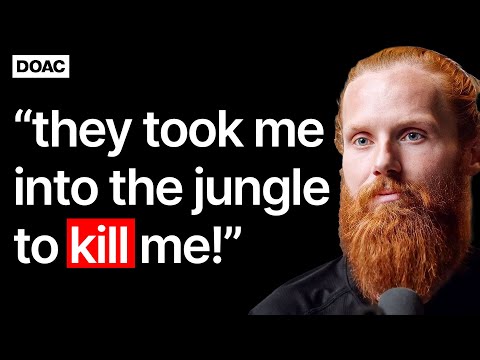
Russ Cook (Hardest Geezer): I Haven't Told The Whole Truth About Africa!
Steven Bartlett (host), Russ Cook (guest), Narrator, Russ Cook's partner (guest), Russ Cook's father (guest), Narrator, Narrator
In this episode of The Diary of a CEO, featuring Steven Bartlett and Russ Cook, Russ Cook (Hardest Geezer): I Haven't Told The Whole Truth About Africa! explores from Rock Bottom To Africa’s Edge: Hardest Geezer Finally Opens Up Russ Cook recounts his journey from depressed, addicted, and estranged 19‑year‑old to becoming the first person to run the length of Africa, revealing the emotional and logistical chaos behind the apparent heroics.
From Rock Bottom To Africa’s Edge: Hardest Geezer Finally Opens Up
Russ Cook recounts his journey from depressed, addicted, and estranged 19‑year‑old to becoming the first person to run the length of Africa, revealing the emotional and logistical chaos behind the apparent heroics.
He explores how a tough, undemonstrative upbringing, years of gambling and drinking, and a desperate search for guidance drove him toward extreme endurance challenges from Asia‑to‑London runs to being buried alive.
The conversation exposes the near‑kidnapping in the Congo, armed robbery, team breakdowns, and the cost of turning a solitary pursuit into a global spectacle that transformed his relationship with his parents and partner.
Throughout, Russ emphasizes personal responsibility, progressive exposure to hardship, and the power of purpose and relationships—showing how extreme goals can rebuild a life but also create new psychological and practical challenges.
Key Takeaways
Extreme change starts with brutal self-responsibility rather than external blame.
At 18–19, Russ was broke, gambling online roulette, binge drinking, overweight, and waking up crying before work, blaming parents, bosses, and circumstances. ...
Get the full analysis with uListen AI
Small, visible progress can become a template for transforming your whole life.
Going from barely being able to run around the block to finishing a marathon showed Russ a simple cause-and-effect: consistent effort leads to tangible improvement. ...
Get the full analysis with uListen AI
Lack of emotional tools in families often produces avoidant, hyper-independent adults.
Russ’s parents were hardworking but undemonstrative—no ‘I love yous’, little affection, and poor communication about feelings or life direction. ...
Get the full analysis with uListen AI
Logistics and team selection matter as much as raw grit in big missions.
Russ admits that for Africa he massively over-indexed on content creation and under-invested in logistics and local expertise. ...
Get the full analysis with uListen AI
Real resilience is cumulative: surviving prior crises changes how you respond to new ones.
By the time their truck broke down 250km from the nearest road in the Sahara, the team barely panicked. ...
Get the full analysis with uListen AI
Near-death clarity often reorders priorities around relationships and unresolved resentments.
On the seven-hour motorbike ride into the Congolese jungle, convinced he might be killed, Russ thought about the things he’d failed to repair—particularly with his parents. ...
Get the full analysis with uListen AI
Viral attention and success create a new class of problems, especially for solitary people.
Russ loves solitude—running alone, sitting outside a Tesco with snacks, minimal social noise. ...
Get the full analysis with uListen AI
Notable Quotes
“No one was gonna come and save me. It just had to be me.”
— Russ Cook
“Keeping it in doesn’t mean it stays inside. It just expresses itself in other ways.”
— Steven Bartlett
“I assumed after about an hour and a half that I was like, ‘OK, well I am getting kidnapped then.’”
— Russ Cook
“I’ve probably wasted a lot of years holding onto things that weren’t necessary… life’s too short for that.”
— Russ Cook
“All of my support team were there basically to facilitate me running… it would be nice to do things for other people more than just everyone doing things for me.”
— Russ Cook
Questions Answered in This Episode
In the DRC ordeal, what specific logistical or cultural preparation do you now believe could have most reliably prevented the near-kidnapping, and how would you design a ‘hardest-geezer-proof’ risk plan for someone attempting a similar route?
Russ Cook recounts his journey from depressed, addicted, and estranged 19‑year‑old to becoming the first person to run the length of Africa, revealing the emotional and logistical chaos behind the apparent heroics.
Get the full analysis with uListen AI
You described realizing on that motorbike that you’d wasted years on resentment toward your parents—what practical steps would you recommend to someone who recognizes similar pride and resentment but has no Emily to ‘build the bridge’ for them?
He explores how a tough, undemonstrative upbringing, years of gambling and drinking, and a desperate search for guidance drove him toward extreme endurance challenges from Asia‑to‑London runs to being buried alive.
Get the full analysis with uListen AI
Looking back, do you think the decision to prioritize content creators over logistics experts at the start was ethically questionable given the risks to your team, or was it a necessary gamble to make the mission viable at all?
The conversation exposes the near‑kidnapping in the Congo, armed robbery, team breakdowns, and the cost of turning a solitary pursuit into a global spectacle that transformed his relationship with his parents and partner.
Get the full analysis with uListen AI
You’ve said you want to help document other people’s big missions rather than just your own—what criteria would you use to choose which stories and individuals deserve that platform and investment of your time?
Throughout, Russ emphasizes personal responsibility, progressive exposure to hardship, and the power of purpose and relationships—showing how extreme goals can rebuild a life but also create new psychological and practical challenges.
Get the full analysis with uListen AI
Now that fame is actively clashing with your love of anonymity and solitude, would you ever consider deliberately ‘disappearing’ from public life for a period, and what would need to be true (financially, emotionally) for that to feel like a responsible choice rather than an escape?
Get the full analysis with uListen AI
Transcript Preview
When I say day 102, does it bring back any memories?
Yeah. It's the only YouTube video that I didn't release. My name is Russ Cook, and I'm attempting to become the first person ever to run the entire length of Africa. It was probably the hardest part of my whole life.
What happened?
So going down this dirt path, and two blokes on a motorbike pull up. I knew that if I'm on the bike for longer than half an hour, it's bad news. Ended up spending seven hours on a motorbike going into the jungle. I was getting kidnapped.
Your partner told us that she thought you had died.
I mean, I thought I was gonna die as well.
Were you thinking about people back home? Russ, I don't think many people know that you did all this stuff before Africa. At 22 years old, you become the first person to run from Asia to London. You buried yourself alive for seven days. You pulled the car as well, which is pretty fucking crazy. What were you looking for?
God, that's one hell of a question, man. Things had got pretty bad. I wasn't speaking to my family. I was drinking and gambling. I would wake up throughout the week just bursting into tears crying.
You had dark thoughts?
Yeah. But ultimately, you know, no one was gonna come and save you. It just had to be me. And I thought Africa would be the best adventure ever.
But 8:30, you start pissing blood.
I knew it was bad. It'd probably end.
You get robbed at gunpoint.
They got passports, money.
And then a falling out amongst the team. You've not talked about this in detail either.
I just blew up, shouting at everyone, throwing chairs.
What happened?
Well-
Congratulations, Diary of a CEO gang. We've made some progress. 63% of you that listen to this podcast regularly don't subscribe, which is down from 69%. Our goal is 50%. So if you've ever liked any of the videos we've posted, if you like this channel, can you do me a quick favor and hit the subscribe button? It helps this channel more than you know. And the bigger the channel gets, as you've seen, the bigger the guests get. Thank you, and enjoy this episode. Russ, you know, you're someone that has achieved and has pursued really anomalous feats in their life, feats that most of us as Muggles would never have the insanity-
(laughs)
... to, to take on. So I was, I was so curious to understand from your perspective, what are the dominoes that fell in your life that led you to be the guy that sits here, that everyone around the country and around the world is perplexed and astonished and inspired by?
Hmm.
Where does it start?
God, that's one hell of a question, man. Uh, I think really I had quite a normal upbringing. And maybe that's like the basis for why I ended up doing all this kind of stuff. Um, yeah, like Dad, uh, my early memories of like my dad were he was a very hardworking man. He cut metal for a living. And didn't really see that much of him when I was young. He would be out working 13, 14 hours a day, come home, metal dust all over him. Mum would look after me and my brothers, and, um, I think he kind of instilled the, like that hardworking mentality in me. And you know, a lot of the, a lot of the dominoes fell from that really.
Install uListen to search the full transcript and get AI-powered insights
Get Full TranscriptGet more from every podcast
AI summaries, searchable transcripts, and fact-checking. Free forever.
Add to Chrome