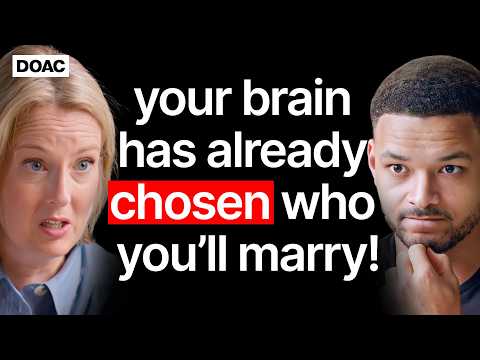
World Expert on Love: Your Brain Already Picked Your Partner (But They’re Lying About Monogamy)
Dr Anna Machin (guest), Steven Bartlett (host), Narrator, Narrator
In this episode of The Diary of a CEO, featuring Dr Anna Machin and Steven Bartlett, World Expert on Love: Your Brain Already Picked Your Partner (But They’re Lying About Monogamy) explores love, Monogamy, and Fathers: The Neuroscience Reshaping Modern Relationships Oxford evolutionary anthropologist Dr. Anna Machin explains how human love is wired in the brain, why strict sexual monogamy is a cultural construct, and why polyamory can be just as satisfying as monogamy. She details the unconscious and conscious stages of attraction, including how women literally smell genetic compatibility and why body ratios matter. A major focus is her decades of research on fatherhood, showing that engaged fathers – biological or not – are neurologically primed to parent and are critical for children’s social, emotional, and mental health outcomes. The conversation also explores attachment styles, neurodiversity (ADHD/autism) in relationships, emerging “love drugs,” and the risks of outsourcing intimacy to AI.
Love, Monogamy, and Fathers: The Neuroscience Reshaping Modern Relationships
Oxford evolutionary anthropologist Dr. Anna Machin explains how human love is wired in the brain, why strict sexual monogamy is a cultural construct, and why polyamory can be just as satisfying as monogamy. She details the unconscious and conscious stages of attraction, including how women literally smell genetic compatibility and why body ratios matter. A major focus is her decades of research on fatherhood, showing that engaged fathers – biological or not – are neurologically primed to parent and are critical for children’s social, emotional, and mental health outcomes. The conversation also explores attachment styles, neurodiversity (ADHD/autism) in relationships, emerging “love drugs,” and the risks of outsourcing intimacy to AI.
Key Takeaways
Strict sexual monogamy is not our evolved default
Humans are socially monogamous (living in pairs/families) far more than we are sexually monogamous. ...
Get the full analysis with uListen AI
Attraction starts unconsciously in the limbic brain before the ‘brain’ kicks in
The first stage of attraction happens in the ancient limbic system: you absorb visual, olfactory, and movement cues, and your brain runs an unconscious ‘biological market value’ algorithm. ...
Get the full analysis with uListen AI
Dating apps handicap your evolved attraction system and fuel endless choice
Apps provide minimal sensory data, so the brain can’t run its full unconscious algorithm. ...
Get the full analysis with uListen AI
Polyamory can be as satisfying as monogamy when practiced transparently
Large-scale satisfaction scales show no significant difference in wellbeing or relationship satisfaction between people in consensual non-monogamous (including polyamorous) relationships and those in monogamous ones. ...
Get the full analysis with uListen AI
Fathers are biologically primed and crucial for children’s social survival
Human fathering is rare in mammals (about 5% of species) and evolutionarily costly, so it exists because it confers a major advantage. ...
Get the full analysis with uListen AI
A ‘father’ is whoever does the job, not whoever shares DNA
Biology is not the defining feature of fatherhood; interaction is. ...
Get the full analysis with uListen AI
Attachment styles and neurodiversity profoundly shape relationship patterns – but can change
Romantic attachment styles (secure, preoccupied, fearful-avoidant, dismissing-avoidant) are forged largely in the first two years by caregiving and brain development, then reinforced (or revised) in later relationships. ...
Get the full analysis with uListen AI
Notable Quotes
“We are not a monogamous species. It's a social construct.”
— Dr. Anna Machin
“Love sits at the center of what it is to be human. If you strip everything else away… the next thing you need are your relationships.”
— Dr. Anna Machin
“We have the wrong idea about fathers. The way our culture deals with fathers, treats fathers, is wrong.”
— Dr. Anna Machin
“Human fatherhood is rare. We are one of only 5% of mammals that have investing fathers, and we're the only ape.”
— Dr. Anna Machin
“Your relationships are the biggest factor in your health, wellbeing and longevity — above not smoking, exercising, or eating well.”
— Dr. Anna Machin
Questions Answered in This Episode
If sexual monogamy is evolutionarily ‘a bad idea’, how should couples who *want* to remain monogamous practically protect their relationship without living in denial about underlying drives?
Oxford evolutionary anthropologist Dr. ...
Get the full analysis with uListen AI
You showed that fatherhood lowers testosterone permanently as long as there is contact with the child; what specific long-term health or behavioral effects (positive or negative) have you observed in men decades into fatherhood?
Get the full analysis with uListen AI
Given that women can smell MHC compatibility but men cannot, do you think MHC-based matchmaking services or tests should ever play a role in modern partner selection, or is that too reductionist and potentially eugenic?
Get the full analysis with uListen AI
For people with ADHD who recognize they are ‘addicted to the chase’, what concrete strategies or therapeutic approaches have you seen work best to help them sustain fulfilling long-term relationships without suppressing their need for novelty?
Get the full analysis with uListen AI
You argue that AI companions cannot currently trigger the same limbic and synchrony effects as humans; what empirical markers (e.g., specific brain activation patterns or physiological coupling) would you consider non-negotiable evidence before society accepts AI as a legitimate substitute for human caregiving or companionship?
Get the full analysis with uListen AI
Transcript Preview
We are not a monogamous species. It's a social construct. And I get attacked for saying things like this, but sexual monogamy, from an evolutionary point of view, is not a good idea. That's why we have a reasonably high rate of people who have extramarital affairs.
So do you think we're all somewhat pretending to be monogamous? Who do you think struggles with it more, men or women? And you said that there's not a difference in wellbeing and satisfaction-
No. Mm-mm.
... between polyamory or monogamy.
Absolutely none.
How do you know this?
Because we've done studies on it, and I've committed the last two decades of my life to understand the neuroscience of love.
Dr. Anna Machin is the Oxford-trained evolutionary anthropologist. Using science to decode attraction. Attachment styles. Love addiction. And now, the crucial roles of the father.
So here's the thing, when we look for a partner, we don't know we're doing it, and it involves two very distinct areas of the brain. So there's the unconscious stage, that's where you take in loads of sensory information about them. So for example, if you're a woman, you can smell genetic compatibility.
Wait, so men can't smell women, but women can smell men?
Well, you can smell them, but it's not gonna give you any information about genetic compatibility. So your brain is gonna help you assess whether they're any good for you. If you get a good ping, certain chemicals at the very core of the brain take away the fear, it gives you the motivation. Now, human love is so complicated. So for example, the chemistry that underpins love is also involved in neurodiversity.
So if I have ADHD or autism, how am I more likely to struggle in love?
This is really, really important. First of all...
Dr. Machin, why are you talking about fatherhood?
The way our culture treats fathers is wrong. The myths we carry about fathers are wrong. Men have a very specific role in child development, and I wasn't expecting to find this when I first started, but it's fundamental for a child to thrive and survive, and be successful. So, what we're finding is-
This has always blown my mind a little bit: 53% of you that listen to this show regularly haven't yet subscribed to the show. So could I ask you for a favor before we start? If you like the show and you like what we do here, and you wanna support us, the free, simple way that you can do just that is by hitting the subscribe button. And my commitment to you is, if you do that, then I'll do everything in my power, me and my team, to make sure that this show is better for you every single week. We'll listen to your feedback, we'll find the guests that you want me to speak to, and we'll continue to do what we do. Thank you so much. Dr. Anna Machin, what is the, the mission you've so far committed your life to? And, and I guess adding to that, why?
Install uListen to search the full transcript and get AI-powered insights
Get Full TranscriptGet more from every podcast
AI summaries, searchable transcripts, and fact-checking. Free forever.
Add to Chrome