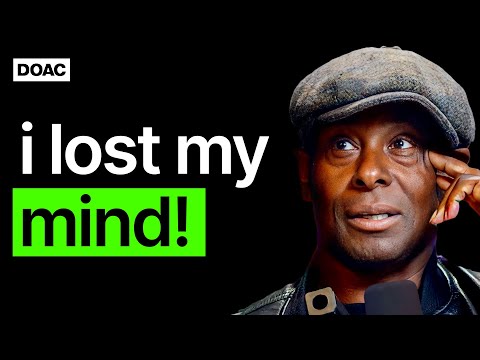
David Harewood: The Chilling Story Of How A Hollywood Star Lost His Mind | E185
David Harewood (guest), Steven Bartlett (host), Narrator
In this episode of The Diary of a CEO, featuring David Harewood and Steven Bartlett, David Harewood: The Chilling Story Of How A Hollywood Star Lost His Mind | E185 explores david Harewood On Racism, Psychosis, And Rebuilding A Shattered Identity Actor and director David Harewood recounts his journey from a racist British childhood and fractured identity to superstardom in Homeland, a devastating psychotic breakdown, and eventually becoming a leading voice on race and mental health.
David Harewood On Racism, Psychosis, And Rebuilding A Shattered Identity
Actor and director David Harewood recounts his journey from a racist British childhood and fractured identity to superstardom in Homeland, a devastating psychotic breakdown, and eventually becoming a leading voice on race and mental health.
He explains how growing up as a Black child in 60s–70s England, his father’s sectioning, systemic racism in theatre and media, and conflicting expectations of “Blackness” all contributed to a fragile sense of self that collapsed in his early 20s.
Harewood gives a detailed, chilling account of his psychosis—hearing the voice of Martin Luther King, believing he was closing the gap between good and evil, and being sectioned after police intervention—and how revisiting his medical records decades later forced him to confront buried trauma.
He reflects on therapy, the power and danger of psychosis, why acting feels like the only fully safe space, and how publicly telling his story has both healed him and exposed systemic failures, especially in how Black people are criminalized during mental health crises.
Key Takeaways
Early and chronic racism quietly loads the system with anxiety and shame.
Harewood describes bricks through his family window, monkey chants at football matches, random street abuse, and being the only Black family on the street. ...
Get the full analysis with uListen AI
A fractured or externally defined identity is a major vulnerability for breakdown.
He grew up with almost no positive Black images and was told things like “you’re not Black, you’re normal,” so he constructed himself around assimilation and naivety about race. ...
Get the full analysis with uListen AI
Psychosis can feel purposeful, even exhilarating, before it becomes life‑threatening.
Harewood explains the manic build‑up—weeks of little sleep, heavy drinking, overthinking, and a sense of ‘fun’ experimentation with reality. ...
Get the full analysis with uListen AI
Black people are over‑represented and often over‑medicated in psychiatric systems.
Citing research, Harewood notes lower rates of psychosis in Africa versus higher rates among Black populations in Western countries, suggesting environmental and racial-stress factors. ...
Get the full analysis with uListen AI
Telling the truth publicly can be both destabilizing and profoundly liberating.
A casual 2017 tweet about having had a breakdown exploded into media interest, leading to a BBC documentary and his memoir. ...
Get the full analysis with uListen AI
Acting provides control and safety that ‘real life’ often lacks.
Harewood says acting is the only space he feels 100% confident; everyone knows their lines and marks, unlike unpredictable life. ...
Get the full analysis with uListen AI
Transforming pain into purpose can reshape both career and legacy.
Harewood has moved from vulnerability into a ‘healing period,’ using his experiences to make documentaries, write books, and start a production company aimed at ‘cracking open the universe’—creating complex roles and stories that don’t yet exist. ...
Get the full analysis with uListen AI
Notable Quotes
“I did everything that voice told me to do that night. Had that voice told me to jump off Thames Bridge, I would’ve done it.”
— David Harewood
“I grew up in a time when there weren’t any images of myself, so I couldn’t really structure my identity around a solid identity.”
— David Harewood
“You might go three weeks without it and then, bang, a casual Wednesday afternoon, middle of the day, ‘nigger.’ And suddenly you’re right back to being scared.”
— David Harewood
“Patient believes he has merged hearts with a young Black boy. And I just thought, ‘What is that?’… I’d sort of lost touch with my identity.”
— David Harewood
“Acting is the only space I feel 100% confident in, because everyone knows their lines… On stage it’s a controlled environment; life is uncontrollable.”
— David Harewood
Questions Answered in This Episode
You describe psychosis as initially exhilarating—if you could design early‑warning education for young people, what specific sensations or thought patterns would you tell them to watch for before it tips into danger?
Actor and director David Harewood recounts his journey from a racist British childhood and fractured identity to superstardom in Homeland, a devastating psychotic breakdown, and eventually becoming a leading voice on race and mental health.
Get the full analysis with uListen AI
When you read in your medical notes, ‘Patient believes he has merged hearts with a young Black boy,’ what did you ultimately come to understand that metaphor meant about your race and identity?
He explains how growing up as a Black child in 60s–70s England, his father’s sectioning, systemic racism in theatre and media, and conflicting expectations of “Blackness” all contributed to a fragile sense of self that collapsed in his early 20s.
Get the full analysis with uListen AI
You’ve suggested your father’s resentment at Britain may have contributed to his breakdown; what concrete things—policy‑wise or culturally—do you think could have reduced that burden for the Windrush generation and their children?
Harewood gives a detailed, chilling account of his psychosis—hearing the voice of Martin Luther King, believing he was closing the gap between good and evil, and being sectioned after police intervention—and how revisiting his medical records decades later forced him to confront buried trauma.
Get the full analysis with uListen AI
Given your experience of being over‑tranquilized and effectively criminalized during crisis, what practical changes would you like to see in how police and mental health services handle Black people in acute psychosis?
He reflects on therapy, the power and danger of psychosis, why acting feels like the only fully safe space, and how publicly telling his story has both healed him and exposed systemic failures, especially in how Black people are criminalized during mental health crises.
Get the full analysis with uListen AI
If you could redesign drama school training for Black actors today, how would you balance classical European repertoire with work that actively explores Black identity, so that students don’t walk into the industry as unprepared for racial reality as you felt you were?
Get the full analysis with uListen AI
Transcript Preview
I did everything that voice told me to do that night. Had that voice had told me to jump off Thames Bridge, I would've done it. Please welcome David Harewood. (applause) Propelled to super stardom in hit US drama, Homeland. One of our most influential voices on race and mental health.
I remember reading about a moment where you come home, you find your father's typewriter with one word written on the typewriter.
Mm. It just said, "Illness." And I didn't quite know what it was, but I knew something was off. I hadn't seen Dad for a while. And then one morning I got up and my mum said, "Don't go into the kitchen," and go straight to school out the front door. That night, that's when my mum told me that Dad had been... (music stops)
David Harewood was the first Black actor to play this part.
The hostility that I was met with as a young, Black actor was ferocious. Newspapers, reviews just dismissing me. "He looks more like Mike Tyson than Romeo. What's he doing on the stage?" So I really did feel like I was an anomaly. The whole thing, the stress, the smoke, the overthinking, just ended up making me spiral. That's what led to me just falling into psychosis. I was lying in bed and I just heard this voice in my head. He said he was Martin Luther King. "Even though I'm speaking to you from beyond the grave, I need you to close the gap between good and evil. So you're gonna sacrifice yourself tonight and you're gonna be an angel." And that was the night I was eventually sectioned. I just remember lots of flashing lights and then being in the back of a police wagon. If that order continued, I'm not even sure I would be here today.
Before this episode begins, I just want to say a huge thank you to all of our new subscribers. 74% of you that watch this channel didn't subscribe before, and we're now down to about 71%. So, that helps us in a number of ways that are quite hard to explain, but simply, the bigger the channel gets, the bigger the guests get. So if you haven't yet subscribed to The Diary of a CEO, if I could have any favors from you, if you've ever watched this show and enjoyed it, it's just to, to please hit the subscribe button. Without further ado, I'm Steven Bartlett, and this is The Diary of a CEO. I hope nobody's listening, but if you are, then please keep this to yourself. (upbeat music) David, what do I have to understand about your very earliest years to understand the man you are, the perspective you have, and the work you do today? What is the most important context?
Well, that's an interesting question. What do I need to kn- what do you need to know about me then? Um, that I was probably naive, open, innocent, uh, and probably more, um... probably more conflicted than I thought I was. I, I was a vessel, and into that vessel was just been poured so much, I'll say false information, wrong information, that, um, at some point it had to smash, break. I grew up at a time when there weren't many Black people on television, and there weren't many Black images, that, on television or anywhere. And I think, I think that is s- I think that seriously... I wouldn't say put me at a disadvantage, but I, I, I grew, I grew up with a false sense of myself, and that, that false, false picture, uh, has only recently emerged. Does that make sense?
Install uListen to search the full transcript and get AI-powered insights
Get Full TranscriptGet more from every podcast
AI summaries, searchable transcripts, and fact-checking. Free forever.
Add to Chrome