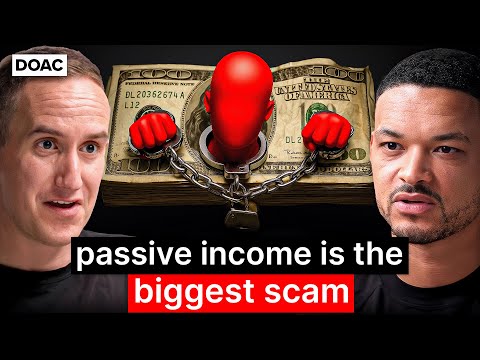
The Savings Expert: Passive Income Is A Scam! Post-Traumatic Broke Syndrome Is Controlling Millions!
Steven Bartlett (host), Morgan Housel (guest), Guest (secondary, in-room conversation) (guest), Narrator, Narrator
In this episode of The Diary of a CEO, featuring Steven Bartlett and Morgan Housel, The Savings Expert: Passive Income Is A Scam! Post-Traumatic Broke Syndrome Is Controlling Millions! explores passive Income Myths, Money Trauma, And The True Art Of Spending Morgan Housel argues that most of what we believe about money, wealth and ‘passive income’ is dangerously misleading, and that our spending is primarily a psychological exercise, not a mathematical one.
Passive Income Myths, Money Trauma, And The True Art Of Spending
Morgan Housel argues that most of what we believe about money, wealth and ‘passive income’ is dangerously misleading, and that our spending is primarily a psychological exercise, not a mathematical one.
He reframes money as a tool for independence and purpose rather than status, showing how envy, social comparison, and childhood money trauma drive both compulsive spending and compulsive saving.
Housel and host Steven Bartlett explore how expectations, contentment, and competition shape our happiness far more than income levels, and why managing what we want is as important as increasing what we have.
The conversation lays out a practical philosophy: build savings as “purchased independence,” spend in ways that deepen relationships and purpose, and stop outsourcing your life goals to other people’s highlight reels.
Key Takeaways
Passive income is largely a myth; wealth comes from sacrifice or wanting less.
Housel dismisses the popular dream of effortless passive income. ...
Get the full analysis with uListen AI
Your spending is mostly psychology—status signaling versus genuine utility.
Housel urges people to distinguish between buying for utility and buying for status. ...
Get the full analysis with uListen AI
Money trauma drives both overspending and over‑saving, and both are addictions.
Using Tiffany Aliche’s phrase “post‑traumatic broke syndrome,” Housel explains how growing up poor can lead either to flaunting wealth as a trophy or to an inability to spend at all. ...
Get the full analysis with uListen AI
The most valuable thing money can buy is independence.
Housel reframes saving as “purchasing independence. ...
Get the full analysis with uListen AI
Happiness from money depends on who you already are and what you expect.
Research he cites shows that more money amplifies your baseline: happy, content people can get happier with more money; chronically anxious or depressed people change very little. ...
Get the full analysis with uListen AI
Social comparison wildly distorts our sense of wealth, success, and fairness.
Life feels like a competition, so most people judge themselves relative to neighbors, peers, or people they see online. ...
Get the full analysis with uListen AI
A good life is built on independence plus purpose—not maximum net worth.
Housel’s tentative “formula for a pretty good life” is independence (doing what you want, when, with whom) plus purpose (something larger than yourself—family, work, community, faith, etc. ...
Get the full analysis with uListen AI
Notable Quotes
“There’s two ways to get wealthier: you can sacrifice more, or you can want less. Passive income is not part of that equation.”
— Morgan Housel
“Money should be a tool that you use to become a better version of yourself… but when it’s controlling your personality, it’s no different than any other addiction.”
— Morgan Housel
“If nobody was watching, how would I live? The truth is, virtually nobody is watching—except the people who really love you.”
— Morgan Housel
“All wealth is what you have minus what you want. My grandmother lived on $1,700 a month, and she was happier than some billionaires.”
— Morgan Housel
“Happiness is always a five‑minute emotion. What we’re actually chasing is contentment—the feeling of, ‘I’m good. I don’t want anything more.’”
— Morgan Housel
Questions Answered in This Episode
You argue there are only two ways to get wealthier: sacrifice more or want less. For someone who feels they’re already sacrificing heavily, how can they practically begin reducing what they want without feeling like they’re ‘giving up’ on ambition?
Morgan Housel argues that most of what we believe about money, wealth and ‘passive income’ is dangerously misleading, and that our spending is primarily a psychological exercise, not a mathematical one.
Get the full analysis with uListen AI
In the case of ‘post‑traumatic broke syndrome,’ what concrete steps would you recommend to someone who knows their childhood poverty is making them hoard money and refuse to enjoy it, even in retirement?
He reframes money as a tool for independence and purpose rather than status, showing how envy, social comparison, and childhood money trauma drive both compulsive spending and compulsive saving.
Get the full analysis with uListen AI
You’ve said the richest people often discover that status purchases didn’t give them what they expected. Can you share a specific example of a high‑status purchase you made that left you flat, and how that changed your spending rules going forward?
Housel and host Steven Bartlett explore how expectations, contentment, and competition shape our happiness far more than income levels, and why managing what we want is as important as increasing what we have.
Get the full analysis with uListen AI
Your formula for a good life is independence plus purpose. For someone in a low‑paid but highly meaningful job (e.g., teacher, nurse) who feels financially trapped, how should they think about balancing a potential career change for higher pay against the risk of losing their purpose?
The conversation lays out a practical philosophy: build savings as “purchased independence,” spend in ways that deepen relationships and purpose, and stop outsourcing your life goals to other people’s highlight reels.
Get the full analysis with uListen AI
You’re optimistic that today’s political and social media polarization might be a cyclical bottom. What signs or leading indicators would you look for over the next decade to confirm that we are actually moving into a healthier phase rather than sliding further into fragmentation?
Get the full analysis with uListen AI
Transcript Preview
People talk a lot about passive income.
Which is not a thing. Look, there's two ways to get wealthier, and passive income is not part of that equation. But what's really important for people is how we should spend money, 'cause I've written about money and finance and investing for 20 years. And I can tell you, the correlation between how much you spend and how happy you are, it can exist, but it is not as simple as you think. Morgan Housel is the legendary financial guru.
Revealing that everything we've been told about saving and spending money...
Could be our biggest downfall, and here's why. If you're unhappy with your life, it is a very easy assumption to make that if you had more money, a bigger house, a better car, wh- whatever it might be, things would be better. And it's a lie we tell ourselves, of course, because here's the truth. So much of spending is a psychological itch that you're trying to scratch, and that manifests in so many different ways. For example, life is a competition. It doesn't matter how well I'm doing. It matters how well I'm doing relative to you, and the most tangible way to do that is through material stuff.
I was reading some funny stats. They say that if you win the lottery, the probability of your neighbor going bankrupt increases.
It's an amazing statistic. So be careful who you socialize with, because you're going to anchor to them as a baseline level of success and happiness.
So is it wrong to buy a Rolex?
Absolutely not. But when it's controlling your personality, it's no different than any other addiction, where it's forcing you to do things that you otherwise don't want to do.
What about people who don't seem to spend anything?
It's just as dangerous. Like, there's something called post-traumatic broke syndrome, and I'll talk about that. But I guarantee you that everyone can spend money in a way it's gonna make them happier.
So if I wanted to make a framework to know how to spend my money, where do I start? But also, based on everything you know about money, if I want to get complete financial freedom-
What's-
... what's the five things that I should be thinking about?
The first thing that I think is most important is...
I see messages all the time in the comments section that some of you didn't realize you didn't subscribe. So, if you could do me a favor and double-check if you're a subscriber to this channel, that would be tremendously appreciated. It's the simple, it's the free thing that anybody that watches this show frequently can do to help us here, to keep everything going in this show, in the trajectory it's on. So please do double-check if you've subscribed, and, uh, thank you so much. Because in a strange way, you are- you're part of our history, and you're on this journey with us, and I appreciate you for that. So yeah, thank you. Morgan, everybody loves to talk about investing. They love to talk about saving money. But I've never heard anybody emphasize the importance of spending money. You've written this book, The Art of Spending, so it begs the question, why would someone like you, who sells tens of millions of copies of their books when they write about something, and really, really cares about the art of writing, commit themselves to writing a book about the art of spending when you couldn't, when you could have written anything that you wanted to and it would have been a success?
Install uListen to search the full transcript and get AI-powered insights
Get Full TranscriptGet more from every podcast
AI summaries, searchable transcripts, and fact-checking. Free forever.
Add to Chrome