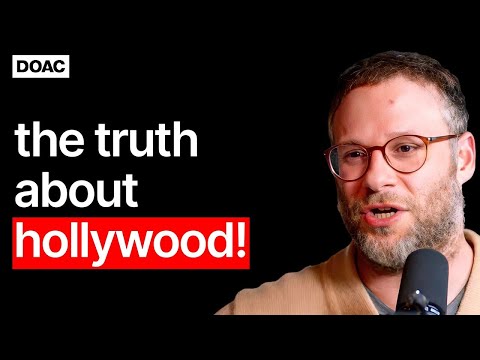
Seth Rogen Opens Up About His Self-Doubts & Struggles That Nobody Sees!
Steven Bartlett (host), Seth Rogen (guest), Narrator
In this episode of The Diary of a CEO, featuring Steven Bartlett and Seth Rogen, Seth Rogen Opens Up About His Self-Doubts & Struggles That Nobody Sees! explores seth Rogen Reveals Creative Insecurities, Relentless Hustle, And Real Priorities Seth Rogen reflects on his unconventional path from anxious, movie-obsessed kid in Vancouver to globally recognized writer, actor, and producer, emphasizing how early support, obsession with movies, and relentless work shaped his career. He speaks candidly about years of unemployment, constant self-doubt, and the emotional devastation of harsh criticism, even at the height of success.
Seth Rogen Reveals Creative Insecurities, Relentless Hustle, And Real Priorities
Seth Rogen reflects on his unconventional path from anxious, movie-obsessed kid in Vancouver to globally recognized writer, actor, and producer, emphasizing how early support, obsession with movies, and relentless work shaped his career. He speaks candidly about years of unemployment, constant self-doubt, and the emotional devastation of harsh criticism, even at the height of success.
Rogen shares how financial insecurity initially fueled his ambition, but how purpose, enjoyment of the craft, and collaboration with long‑time partners now drive him more than money or fame. He explains his choice not to have children and how that decision, along with a strong marriage, community, and hobbies like ceramics, underpins his current happiness and productivity.
He also discusses his wife's mother's battle with early-onset Alzheimer’s, how that trauma led them to build an impactful charity, and what people misunderstand about the disease. Throughout, he offers grounded, practical advice to creatives: don’t quit, work harder than others, be someone people like to work with, and make the things you’d be jealous someone else made.
Key Takeaways
Starting early with real work creates a compounding advantage.
Rogen began doing standup and writing screenplays around 12, co-writing Superbad with Evan Goldberg in high school. ...
Get the full analysis with uListen AI
The only universal predictor of creative success is not quitting.
After Freaks and Geeks and Undeclared, Rogen was unemployed for about three years, repeatedly rejected as an actor and writer while studios passed on Superbad and Pineapple Express. ...
Get the full analysis with uListen AI
Harsh criticism is emotionally devastating but survivable—and often misunderstood by critics.
Rogen describes negative reviews (for example Green Hornet and especially The Interview) as deeply personal, institutionally amplified rejections of his personal expression that people carry for decades. ...
Get the full analysis with uListen AI
Work ethic and being easy to work with significantly increase your ‘luck.’
He frames Hollywood as inherently competitive: there are far more people than jobs. ...
Get the full analysis with uListen AI
Make the thing you’d be jealous someone else made, not what you think ‘the market’ wants.
Rogen’s guiding creative heuristic is simple: if he saw the project in the world made by someone else, would he be psyched and jealous? ...
Get the full analysis with uListen AI
Life design choices—like not having kids—can significantly change capacity, focus, and happiness.
Rogen and his wife consciously chose not to have children, a decision he says gives them more time, energy, and flexibility for work, hobbies, and each other. ...
Get the full analysis with uListen AI
Authentic causes come from lived experience and create deeper impact.
Rogen only found a cause that felt real when his wife’s mother developed early-onset Alzheimer’s. ...
Get the full analysis with uListen AI
Notable Quotes
“Hollywood, it's not a fair industry. It is not fair who makes it.”
— Seth Rogen
“If you don't quit, you might make it. And if you quit, you definitely won't.”
— Seth Rogen
“I think if most critics knew how much it hurt the people that they are writing about, they would second guess the way they write these things.”
— Seth Rogen
“It is devastating when you are being, like, institutionally told that your personal expression was bad.”
— Seth Rogen
“Who the fuck knows what other people want?”
— Seth Rogen
Questions Answered in This Episode
You describe The Interview as more personally painful than Green Hornet because people questioned the kind of person who would make it—what, in hindsight, would you change about that project, if anything, to keep the risk but reduce the collateral damage?
Seth Rogen reflects on his unconventional path from anxious, movie-obsessed kid in Vancouver to globally recognized writer, actor, and producer, emphasizing how early support, obsession with movies, and relentless work shaped his career. ...
Get the full analysis with uListen AI
You and Evan seemed to intuitively understand story structure as teenagers writing Superbad—if you had to reverse‑engineer that now, what specific beats or design choices in Superbad still impress you when you look at it as a seasoned producer?
Rogen shares how financial insecurity initially fueled his ambition, but how purpose, enjoyment of the craft, and collaboration with long‑time partners now drive him more than money or fame. ...
Get the full analysis with uListen AI
You’re very open about not wanting kids and feeling happier for it; how do you handle situations where that choice clashes with industry expectations, social circles, or roles that assume a more traditional family narrative?
He also discusses his wife's mother's battle with early-onset Alzheimer’s, how that trauma led them to build an impactful charity, and what people misunderstand about the disease. ...
Get the full analysis with uListen AI
With HFC, you discovered a huge, underserved group of young caregivers dealing with Alzheimer’s—what are the most practical, under-discussed supports (policies, tools, or habits) you think would make their day‑to‑day lives materially better?
Get the full analysis with uListen AI
You say your biggest fear is making something boring rather than something that fails—can you describe a moment in development where you realized a project was drifting toward ‘safe and boring’ and what concrete changes you made to pull it back into risky territory?
Get the full analysis with uListen AI
Transcript Preview
Hey, there. Welcome. (laughs)
(laughs) Hey, hey, hey, hey.
Seth Rogen!
Writer, producer, and actor you know from Pineapple Express. Knocked Up. And Superbad. They loved it. (laughs) (crowd cheering) Hollywood, it's not a fair industry. It is not fair who makes it. Any given phone call is one that is, like, making your life or one that is yet another door slamming in your face. We had finished Superbad, and then we wrote Pineapple Express. No one wanted to make it. (laughs) Bulls- But if you don't quit, you might make it.
People would obviously look at you and assume that you have zero self-doubt because you've been so successful in what you've done. But what's your journey been with self-doubt?
I'm at the point, it's funny, in my career where, like, not a lot of people are in a position to, like, yell at me. But I will have a cultural institution tell everyone that I suck. (laughs) That will add self-doubt.
Green Hornet, you received critical reviews for that. Like, what's that phase like?
Any opening weekend, honestly, and any time I have a thing coming out, it sucks. I think if most critics knew how much it hurt the people that they are writing about, they would second guess the way they write these things. (laughs) Like, it's devastating on something that people carry with them literally their entire lives.
Before we get into this episode, just wanted to say thank you, first and foremost, for being part of this community. Um, the team here at the Diary of a CEO is now almost 30 people, and that's literally because you watch, and you subscribe, and you, um, leave comments, and you like the videos that th- this show's been able to grow. And it's the greatest honor of my life to sit here with these incredible people and just selfishly ask some questions that I'm pondering over or worrying about in my life. But this is just the beginning for the Diary of a CEO. We've got big, big plans to scale this show, um, to every corner of the world and to, to, to diversify our guest selection. And that's enabled by you, by a simple thing that you guys do, which is to watch. So, if there's one thing you could do to help this show and to help us continue to do what we do, it's just to hit the subscribe button. If you like this show, if you like what we do here, if you watch these episodes, please just hit that subscribe button. It means the world. Let's get on with it. (instrumental music) Seth, you've had an incredible twisting, turning career. And I have to say, when I was reading about your earliest years, an unexpected one in many respects.
To me, too. (laughs)
(laughs) What, what do I need to know about, um, about you, where you came from, how you were raised to understand the man that you are?
Install uListen to search the full transcript and get AI-powered insights
Get Full TranscriptGet more from every podcast
AI summaries, searchable transcripts, and fact-checking. Free forever.
Add to Chrome