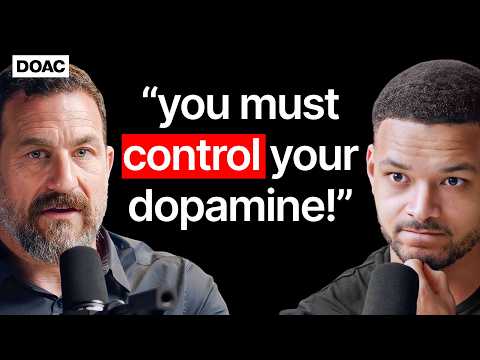
Andrew Huberman: You Must Control Your Dopamine! The Shocking Truth Behind Cold Showers!
Andrew Huberman (guest), Narrator, Steven Bartlett (host), Narrator, Narrator, Narrator
In this episode of The Diary of a CEO, featuring Andrew Huberman and Narrator, Andrew Huberman: You Must Control Your Dopamine! The Shocking Truth Behind Cold Showers! explores andrew Huberman Reveals Dopamine, Discipline, Addiction, And Healing Through Friendship Andrew Huberman shares how dopamine actually works in motivation, addiction, and burnout, and explains why managing peaks and troughs is crucial for performance and mental health. He traces his personal transformation from a depressed, ‘feral’ teenager in treatment and street skate culture to a Stanford neuroscientist and global educator, emphasizing neuroplasticity and self‑parenting. Huberman and host Steven Bartlett explore how habits form and change, why porn and overstimulation are so damaging, and how tools like sleep, NSDR, sunlight, cold showers, and nutrition can reset the brain. The conversation becomes deeply personal as Huberman describes recent public attacks, the pain of failed relationships, and how simple, reliable friendship—like a daily ‘good morning’ text—may be the most powerful protocol of all.
Andrew Huberman Reveals Dopamine, Discipline, Addiction, And Healing Through Friendship
Andrew Huberman shares how dopamine actually works in motivation, addiction, and burnout, and explains why managing peaks and troughs is crucial for performance and mental health. He traces his personal transformation from a depressed, ‘feral’ teenager in treatment and street skate culture to a Stanford neuroscientist and global educator, emphasizing neuroplasticity and self‑parenting. Huberman and host Steven Bartlett explore how habits form and change, why porn and overstimulation are so damaging, and how tools like sleep, NSDR, sunlight, cold showers, and nutrition can reset the brain. The conversation becomes deeply personal as Huberman describes recent public attacks, the pain of failed relationships, and how simple, reliable friendship—like a daily ‘good morning’ text—may be the most powerful protocol of all.
Key Takeaways
Manage dopamine peaks to avoid deep troughs, burnout, and compulsive cycles.
Dopamine functions like a ‘wave pool’ with a finite reservoir. ...
Get the full analysis with uListen AI
Neuroplasticity persists throughout life, but adults must create strong ‘state shifts’ to change.
Contrary to the ‘old dog’ myth, the human brain can rewire at any age via neuroplasticity—strengthening and weakening synapses, and sometimes adding new neurons. ...
Get the full analysis with uListen AI
To change ‘who you are’, attack the story, not just the behavior.
Habits often persist because they’re embedded in identity narratives (“I’m just a messy person”). ...
Get the full analysis with uListen AI
Use daily protocols—NSDR, sunlight, movement, and smart caffeine—to stabilize energy and focus.
Huberman’s practical ‘stack’ for productivity and mental health: (1) Get sufficient sleep for your individual need; (2) If under‑slept, do 10–30 minutes of NSDR/Yoga Nidra in the morning to replenish dopamine and restore alertness; (3) Hydrate with 16–32 ounces of water; (4) Get bright outdoor light in your eyes soon after waking (even through cloud cover) to anchor circadian rhythms, boost cortisol at the right time, and improve night‑time sleep; (5) Add some early movement (walk, skipping rope, workout) and then caffeine, timed so it doesn’t interfere with sleep. ...
Get the full analysis with uListen AI
You can radically change your relationship with food—cravings are plastic, not fixed.
Highly processed, sugar‑dense foods hijack the dopamine system, driving ‘wanting more’ rather than true enjoyment. ...
Get the full analysis with uListen AI
Intense pornography use can rewire arousal in maladaptive ways and is best approached with abstinence or strict reduction.
High‑intensity, novel porn (multiple partners, extreme genres) triggers unusually large dopamine surges, especially when paired with masturbation and orgasm, followed by prolactin‑mediated troughs. ...
Get the full analysis with uListen AI
Friendship and simple daily connection may be the most powerful ‘protocol’ for mental health.
Huberman describes being ‘rescued’ in his worst moments by friends who literally showed up and sat with him, and he now sees friendship as vital as any biological protocol. ...
Get the full analysis with uListen AI
Notable Quotes
“Most all addiction, most all compulsive behavior can be cured, essentially, through a period of abstinence lasting somewhere between 30 and 60 days.”
— Andrew Huberman
“Dopamine is not about pleasure. It’s about the motivation to seek rewards.”
— Andrew Huberman
“You absolutely can teach an old dog or human new tricks.”
— Andrew Huberman
“Stories are very powerful and very dangerous… One of the most powerful things is to understand that neuroplasticity really involves taking an existing story and dismantling some component of it.”
— Andrew Huberman
“Friendship is super powerful… they sat with me, picked me up, and they reminded me who I am.”
— Andrew Huberman
Questions Answered in This Episode
You emphasized that most addictions can be reset with 30–60 days of abstinence; what specific strategies would you recommend for someone trying to complete that period with pornography, where triggers are everywhere and social isolation is high?
Andrew Huberman shares how dopamine actually works in motivation, addiction, and burnout, and explains why managing peaks and troughs is crucial for performance and mental health. ...
Get the full analysis with uListen AI
When you talk about being in a ‘dopamine trough’, what are the most reliable signals—subjective or physiological—that someone can use to know they’re in a recovery phase and shouldn’t chase more stimulation?
Get the full analysis with uListen AI
You argued that intense, novel pornography reshapes arousal thresholds and relationships; what would a practical, science-based re‑entry plan into healthy sexual intimacy look like for someone who’s been abstinent from porn for several months?
Get the full analysis with uListen AI
You were very candid about staying in relationships ‘far too long’ and struggling to call time of death; based on what you now know, how would you advise your younger self to distinguish between a relationship worth fighting for and one where that same persistence becomes self‑harm?
Get the full analysis with uListen AI
You described friendship as perhaps the most powerful protocol and recommended daily ‘good morning’ texts; how should someone who is deeply introverted, socially anxious, or has a history of betrayal approach initiating these connections without overwhelming their own nervous system?
Get the full analysis with uListen AI
Transcript Preview
I'll tear up if I talk about it because things were going well in my life and then one day, just crack, everything came crashing down. And, um... And I've learned that friendship is super powerful. I had people descending on my home to be with me. You know, one day I just, like, look up and Lex is in the room, and they sat with me, picked me up, and they reminded me who I am, and, um, you know, I- I've just such immense gratitude for- for that. Dr. Andrew Huberman is a world-renowned neuroscientist, Stanford professor, and podcaster. Revolutionizing how we understand the brain.
And how we can adopt change, break bad habits, and achieve peak performance.
Growing up, I was scared, depressed and confused. My parents split up. I was getting in multiple fights. I found myself locked up in this residential treatment program. And I realized that I need to take control of my life.
I'm so intrigued by that because so many people feel stuck in their lives. So how does someone even make those life-changing decisions?
Well, there are so many zero cost tools that can change your brain. We can go through all of them. So...
I want to talk about dopamine and this graph.
The dopamine is kind of like a wave pool. In every domain of life, whether or not it's food, exercise, for some people it's work or sex, if you push things to the max, you're going to feel depleted and under stimulated afterwards and you need so much more energy to get the same output, and when you're in that dopamine depleted state, typically what people do is they try and access things that are going to reactivate the dopamine circuitry and all it does is drive them further and further into that trough.
So how do you fix that?
So it's hard to exit, but start with-
This is a sentence I never thought I'd say in my life. Um, we've just hit seven million subscribers on YouTube and I want to say a huge thank you to all of you that show up here every Monday and Thursday to watch our conversations. Um, from the bottom of my heart, but also on behalf of my team who you don't always get to meet, there's almost 50 people now behind The Diary of a CEO that worked to put this together. So from all of us, thank you so much. Um, we did a raffle last month and we gave away prizes for people that subscribed to the show up until seven million subscribers, and you guys loved that raffle so much that we're going to continue it. So every single month we're giving away money can't buy prizes, including meetings with me, invites to our events, and a thousand pound gift vouchers to anyone that subscribes to The Diary of a CEO. There's now more than seven million of you. So if you make the decision to subscribe today, you can be one of those lucky people. Thank you from the bottom of my heart. Let's get to the conversation. Andrew, at the very heart of what you do, at the very, very heart, if I, if I look to all that you've produced and I had to encapsulate it into just one or two sentences that encapsulates your mission statement, what would that be?
Install uListen to search the full transcript and get AI-powered insights
Get Full TranscriptGet more from every podcast
AI summaries, searchable transcripts, and fact-checking. Free forever.
Add to Chrome