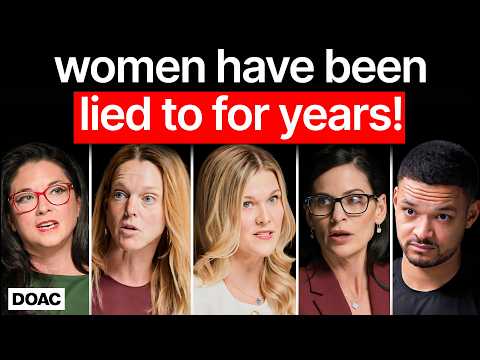
Hormone & Fertility Experts: We've Been Lied To About Women's Health! If This Happens, Call A Doctor
Steven Bartlett (host), Dr Natalie Crawford (guest), Dr Vonda Wright (guest), Dr Stacy Sims (guest), Narrator, Narrator, Dr Mary Claire Haver (guest), Dr Mary Claire Haver (guest), Dr Natalie Crawford (guest), Dr Natalie Crawford (guest), Steven Bartlett (host), Steven Bartlett (host), Dr Natalie Crawford (guest), Steven Bartlett (host), Steven Bartlett (host), Dr Stacy Sims (guest), Dr Vonda Wright (guest), Dr Stacy Sims (guest), Dr Natalie Crawford (guest), Dr Vonda Wright (guest)
In this episode of The Diary of a CEO, featuring Steven Bartlett and Dr Natalie Crawford, Hormone & Fertility Experts: We've Been Lied To About Women's Health! If This Happens, Call A Doctor explores four Top Experts Expose Hidden Crisis In Women's Hormone Health Four leading experts in fertility, sports medicine, orthopedics, and menopause reveal how profoundly women’s health has been overlooked in research, education, and clinical care. They explain why female physiology is not just a smaller version of male physiology and how that misunderstanding harms women across their lifespan—from puberty to menopause.
Four Top Experts Expose Hidden Crisis In Women's Hormone Health
Four leading experts in fertility, sports medicine, orthopedics, and menopause reveal how profoundly women’s health has been overlooked in research, education, and clinical care. They explain why female physiology is not just a smaller version of male physiology and how that misunderstanding harms women across their lifespan—from puberty to menopause.
The conversation covers menstrual cycles as a vital sign, PCOS, endometriosis, contraception, fertility planning, perimenopause, and menopause, highlighting how underfunding, bias, and stigma delay diagnoses and limit treatment options. They repeatedly link hormones with brain, bone, muscle, cardiovascular, and mental health.
Throughout, they emphasize that many symptoms women normalize or minimize—cycle irregularity, pain, mood changes, fatigue, and loss of libido—are early warning signs of hormonal or metabolic dysfunction, not personal weakness.
They argue that women and clinicians can dramatically improve outcomes through better education, earlier investigation, lifestyle changes targeting inflammation and insulin resistance, and informed use of hormone therapies when appropriate.
Key Takeaways
Irregular or Missing Periods Are A Major Red Flag, Not A Quirk
The panel repeatedly stresses that a predictable menstrual cycle is a key indicator of whole‑body health, not just fertility. ...
Get the full analysis with uListen AI
Women Are Not "Small Men": Physiology, Disease, And Drug Data Differ
Historically, medicine and research were built on male bodies; women were largely excluded from clinical trials until 1993. ...
Get the full analysis with uListen AI
PCOS Is A Lifelong Metabolic Condition, Not Just A Fertility Label
PCOS is not something women 'cause' through lifestyle; it's a genetically and developmentally driven condition where the ovary retains more eggs and becomes insulin‑resistant. ...
Get the full analysis with uListen AI
Endometriosis Pain Is Real, Common, And Often Dismissed For Years
Endometriosis is a chronic inflammatory and immune‑mediated disease where endometrial‑like tissue implants throughout the abdominal cavity, fed by estrogen and causing scarring, organ distortion, and often infertility. ...
Get the full analysis with uListen AI
Contraceptives Have Systemic Effects—Women Need Full, Long‑Term Information
Pills, IUDs, implants, and rings are highly effective for contraception and sometimes symptom relief (e. ...
Get the full analysis with uListen AI
Fertility Declines Earlier Than Most People Realize—Planning Is Essential
Women are born with all the eggs they will ever have; they lose millions before birth and puberty, and only ovulate ~400 in a lifetime. ...
Get the full analysis with uListen AI
Perimenopause And Menopause Are Critical Health Transitions, Not Just Hot Flashes
Perimenopause—the 7–10 years before menopause—is driven by dwindling, stubborn egg reserves and a misfiring brain–ovary communication loop, causing erratic highs and lows of estrogen and progesterone. ...
Get the full analysis with uListen AI
Notable Quotes
“Our monthly cycle is so much more than getting ready to have a baby.”
— Dr. Stacy Sims
“Of the $450 billion spent on research in this country alone, less than 1% is spent on women over 40.”
— Dr. Vonda Wright
“It takes women seven to ten years to get a diagnosis of endometriosis after symptoms start.”
— Dr. Natalie Crawford
“Women are living 20% more of our lives versus our male counterparts in poor health with chronic disease or mental health disorders.”
— Dr. Vonda Wright
“I was a terrible menopausal doctor.”
— Dr. Mary Claire Haver
Questions Answered in This Episode
Given that many hormonal contraceptives suppress natural estradiol and ovulation during peak bone‑building years, how would you design a 'best‑of‑both‑worlds' contraceptive strategy for a 16–25‑year‑old who wants reliable birth control without compromising long‑term bone and metabolic health?
Four leading experts in fertility, sports medicine, orthopedics, and menopause reveal how profoundly women’s health has been overlooked in research, education, and clinical care. ...
Get the full analysis with uListen AI
You mentioned that 50% of women with unexplained infertility have endometriosis, yet diagnosis often takes 7–10 years—what specific diagnostic pathway (imaging, lab markers, surgical thresholds) would you recommend if a 20‑something presents with severe period pain and 'IBS‑like' symptoms?
The conversation covers menstrual cycles as a vital sign, PCOS, endometriosis, contraception, fertility planning, perimenopause, and menopause, highlighting how underfunding, bias, and stigma delay diagnoses and limit treatment options. ...
Get the full analysis with uListen AI
In perimenopause, you described small‑dose estradiol as more effective than SSRIs for some mood disturbances—what lab values, symptom clusters, or contraindications would help a clinician decide between starting estrogen vs. an antidepressant, or using them in combination?
Throughout, they emphasize that many symptoms women normalize or minimize—cycle irregularity, pain, mood changes, fatigue, and loss of libido—are early warning signs of hormonal or metabolic dysfunction, not personal weakness.
Get the full analysis with uListen AI
For a woman with PCOS who’s been managed for years only with the pill and Metformin, what precise lifestyle prescription would you write—macronutrient targets, weekly training structure, sleep goals—to improve insulin resistance and reduce long‑term cardiovascular risk?
They argue that women and clinicians can dramatically improve outcomes through better education, earlier investigation, lifestyle changes targeting inflammation and insulin resistance, and informed use of hormone therapies when appropriate.
Get the full analysis with uListen AI
You criticized the '12 months without a period' rule for diagnosing menopause as outdated; if you were rewriting clinical guidelines from scratch, what operational definition of perimenopause and menopause would better match ovarian biology and prevent the current decade‑long treatment gap?
Get the full analysis with uListen AI
Transcript Preview
If someone's menstrual cycle is irregular, should they be concerned?
Yes. Yes. Yes. Yes. Your body's meant to work like clockwork.
And our monthly cycle is so much more than getting ready to have a baby.
Especially when we're looking at exercise. And it's important to say if you don't have a period, it's very harmful to long-term health.
Brain health.
Mental health. Low energy.
Mood. And libido. And I don't want the younger generations to have to go through the stuff that we've gone through.
No.
So it's an important discussion that we need to have.
We are joined by four leading female health experts from very different fields.
To have a crucial conversation about women's health. With over 80 years combined experience, they're sharing the truth about what every woman and every man needs to hear.
We asked 1,000 women to submit their questions ahead of this conversation, and I got so many questions around fertility, understanding hormones, PCOS, birth control pill, miscarriage.
And I'll say this, Steven, it's because we haven't had these discussions publicly. When we look at funding in women's health, it's horrible.
Like less than 1% is spent on women over 40.
Women are living 20% more of our lives with chronic disease or mental health disorders.
I mean, 50% of patients with unexplained infertility have endometriosis, but yet it takes women seven to 10 years to get a diagnosis after symptoms start. But also, there are things that we do that will inherently harm our fertility because we're not taught this, and it predisposes you to many medical problems later in life.
And patients will say, "But I have a really high pain tolerance."
Yes.
Like it's a badge.
And so they gaslight themselves.
And that's what we're all trying to fight here. But there are a lot of things we can do to deal with this.
And then I wanna talk about menopause.
So in medical school, menopause just gets shoved into a tiny box.
This is a scary statistic. So... Oh my God.
It's crazy.
I just think it's insane.
This is why we need to create change.
This might be one of the most important conversations we ever have on The Diary of a CEO because women's health has long been a total mystery to so many people, and so many people are struggling with all of the issues that we're gonna talk about today with their menstrual cycles, PCOS, endometriosis, with diet, with understanding how to exercise as a woman. It's probably never gonna be the case again that these four individuals that are at the very top of women's health in their fields will be in the same place at the same time having this conversation. We structured this conversation into two parts. They cover completely different subjects, but they're fundamentally interlinked. For me, the understanding that I got from this conversation at this table with these four women has fundamentally changed my life. It's gonna change how I deal with my romantic partner, my sister, my team members that I work with every single day. And funnily enough, because it's a conversation I wouldn't have clicked as a man, it turned out to be the conversation that I needed the most. And I don't think I've ever said this before, but if there was ever an episode to share with a loved one, then this is that episode. Please share this episode with as many women as you can, but also with as many men as you can. Ladies, we should start with some introductions. Could you give me a brief introduction, Stacey, as it relates to your perspective and your experience and what your sort of bias is as it comes to this debate? When I say bias, I mean your, your, your experience and your, your research that you're lending to this conversation today.
Install uListen to search the full transcript and get AI-powered insights
Get Full TranscriptGet more from every podcast
AI summaries, searchable transcripts, and fact-checking. Free forever.
Add to Chrome