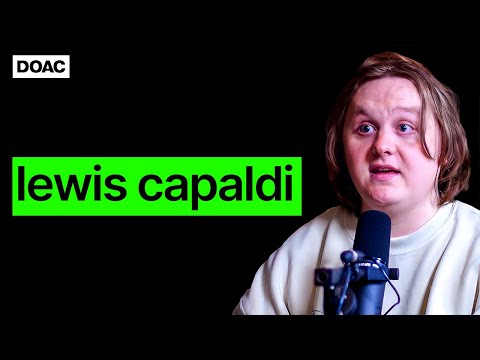
Lewis Capaldi: The Untold Story Of Becoming A Global Superstar At 22 | E178
Lewis Capaldi (guest), Steven Bartlett (host), Narrator, Narrator
In this episode of The Diary of a CEO, featuring Lewis Capaldi and Steven Bartlett, Lewis Capaldi: The Untold Story Of Becoming A Global Superstar At 22 | E178 explores lewis Capaldi Confronts Fame, Anxiety, and Identity Behind the Hits Lewis Capaldi discusses his journey from pub gigs in Scotland to global superstardom by 22, revealing how early family trauma, anxiety, and hypochondria shaped both his personality and his music. He explains how fame massively amplified pre‑existing anxiety, culminating in panic attacks, Tourette’s tics, and a near-collapse during his first arena tour. Capaldi details how therapy, medication, and radical honesty about his struggles have helped him regain control while still fearing the pressure and expectations around his second album. Throughout, he contrasts his self-deprecating public persona with the serious, emotionally raw songwriter behind the scenes, and wrestles openly with impostor syndrome, relationships, and what actually makes him happy.
Lewis Capaldi Confronts Fame, Anxiety, and Identity Behind the Hits
Lewis Capaldi discusses his journey from pub gigs in Scotland to global superstardom by 22, revealing how early family trauma, anxiety, and hypochondria shaped both his personality and his music. He explains how fame massively amplified pre‑existing anxiety, culminating in panic attacks, Tourette’s tics, and a near-collapse during his first arena tour. Capaldi details how therapy, medication, and radical honesty about his struggles have helped him regain control while still fearing the pressure and expectations around his second album. Throughout, he contrasts his self-deprecating public persona with the serious, emotionally raw songwriter behind the scenes, and wrestles openly with impostor syndrome, relationships, and what actually makes him happy.
Key Takeaways
Early emotional environments silently shape anxiety and behavior later in life.
Capaldi links his childhood hypochondria and obsessive worry to early exposure to death and grief: his grandmother died of cancer and his aunt died by suicide before he was four (around 1090–1300s). ...
Get the full analysis with uListen AI
Health anxiety is debilitating, not just ‘being dramatic’ about illness.
Capaldi describes years of being convinced he was dying despite virtually no serious medical history (around 2600–3400s). ...
Get the full analysis with uListen AI
Fame can intensify pre-existing vulnerabilities rather than create them from scratch.
He notes he always had anxiety, but had his first full-blown panic attacks only after becoming famous (around 3400–3800s). ...
Get the full analysis with uListen AI
Therapy works best as ongoing mental ‘maintenance,’ not a last resort.
Capaldi has tried multiple therapists and modalities (CBT and more exploratory therapy), emphasizing that you often need to ‘shop around’ like dating (around 5200–6000s). ...
Get the full analysis with uListen AI
Authenticity and self-awareness built his brand more effectively than traditional polish.
Initially told to be mysterious and ‘cool’ like The 1975, Capaldi eventually dropped the act and used social media just to amuse himself and his friends (around 8400–9300s). ...
Get the full analysis with uListen AI
Relentless goalpost-shifting in the music industry fuels impostor syndrome and burnout.
He describes the industry mentality: after a #1 single, the question becomes, “Can you do it again? ...
Get the full analysis with uListen AI
The part you love can get buried when your passion becomes your job.
Capaldi admits he hates recording albums, music videos, and photoshoots and only tolerates them because playing live is “unparalleled” (around 4300–4700s). ...
Get the full analysis with uListen AI
Notable Quotes
“I never had a panic attack until after getting famous.”
— Lewis Capaldi
“Playing live is this fucking unparalleled thing... the only reason I do all that other shit.”
— Lewis Capaldi
“I have never been more insecure and unsure of myself than after I did really well.”
— Lewis Capaldi
“No one is trained to fucking have millions of people looking at you.”
— Lewis Capaldi
“The only thing that’s stopping it from being fun is my mind.”
— Lewis Capaldi
Questions Answered in This Episode
You described your first arena tour as the ‘worst two weeks’ of your life—if you could redesign a future arena tour around your mental health needs, what specific changes would you make to the schedule, staging, and expectations?
Lewis Capaldi discusses his journey from pub gigs in Scotland to global superstardom by 22, revealing how early family trauma, anxiety, and hypochondria shaped both his personality and his music. ...
Get the full analysis with uListen AI
Now that you know your shoulder twitch and vocal noises are Tourette’s, has that diagnosis changed how you approach performing live or how you talk to fans when tics show up on stage?
Get the full analysis with uListen AI
You said music as a job has started to strip some joy from what used to be a pure hobby—if you had to build a weekly routine that rekindles that hobby feeling, what would it actually look like hour by hour?
Get the full analysis with uListen AI
You’re very open about anxiety and panic attacks, yet you also admitted keeping emotional walls up in romantic relationships—what would it realistically take for someone to earn access to the parts of you you never show in interviews?
Get the full analysis with uListen AI
Looking back at the trend of labels telling artists to ‘be like Lewis Capaldi’ online, where do you think the line is between healthy influence and harmful imitation when it comes to authenticity as a marketing strategy?
Get the full analysis with uListen AI
Transcript Preview
No one has ever asked me the questions that you've asked me today.
Lewis Capaldi! (audience cheering)
It's getting kind of used to being someone you loved. Releasing new music first time in, like, three years. This time I'm shitting myself.
Why?
'Cause I've no regrets. (audience cheering)
I remember that video of you doing your... (laughs) you found out your net worth.
Oh, yeah, yeah. That's 10 fucking million quid sitting about somewhere. Where the fuck is it?
No label would ever tell you that is the strategy to become successful.
You can fully just put a picture of you with a towel wrapped around your head and these stupid glasses on with your top off on a big massive poster on the tube. It's less about being, like, a polished fucking-
Yeah.
... pop star or whatever. People see through that shit.
You are living an extraordinarily un-human life. What is the reality?
I have really bad anxiety. It never reached a tipping point until after getting famous. I fucking hate recording albums, despise doing music videos. I only do all that stuff because playing live is this fucking unparalleled thing that you can't compare to anything else. So, like, when that was making me feel shame, I was like, "Fuck, I dunno if I can do any of this shit anymore." My dad gave me a lift home from the airport one night, and I was twitching like fuck to the point where he started crying in the car. Couldn't concentrate on work I was doing 'cause I was so convinced that I was gonna die.
What is the question that no one asks you that would reveal the most untapped answer?
I think-
Before this conversation starts, I've got a favor to ask from you. 74% of people that watch this podcast frequently haven't yet hit the subscribe button, and 9% of people haven't yet hit the bell to turn notifications on. The bigger this platform gets, the bigger the guests get. So if you could do me one favor, if you've ever enjoyed this podcast, please hit the subscribe button and turn notifications on. Without further ado, I'm Steven Bartlett, and this is the Diary of a CEO. I hope nobody's listening, but if you are, then please keep this to yourself. Lewis.
Hello.
When you look back, and I was reading about your childhood, I found it really fascinating. When you look back at those, um, early, early, early dots that you... I think sometimes in hindsight we can connect and go, "Ah, that was the reason I became the person I am today." Or, "That was a really significant early moment."
Mm-hmm.
What were those first early dots that you connect and go, "That's why I ended up where I am today"?
Um, I think for me, it's probably... The first one I can remember is, like, being, I remember just being on holiday in France. We used to go on these mad, like, caravan holidays in France. Me and my mum and my dad and my two older brothers and my older sister. And there was like... I dunno, for some reason I had become obsessed with Queen. I must've been like four years old. Um, but, like, we got, like, a CD in the... Like, one of, you know, remember those free CD newspapers, like-
Install uListen to search the full transcript and get AI-powered insights
Get Full TranscriptGet more from every podcast
AI summaries, searchable transcripts, and fact-checking. Free forever.
Add to Chrome