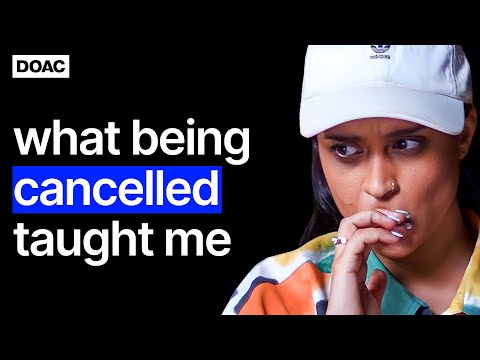
Lilly Singh: My Deepest Insecurities Led To My Greatest Achievements | E136
Steven Bartlett (host), Lilly Singh (guest), Narrator
In this episode of The Diary of a CEO, featuring Steven Bartlett and Lilly Singh, Lilly Singh: My Deepest Insecurities Led To My Greatest Achievements | E136 explores lilly Singh Turns Insecurity, Disruption, And Failure Into Fierce Self-Belief Lilly Singh traces how being born a “disappointment” in a traditional Indian family created a lifelong chip on her shoulder that fueled her obsession with power, influence, and achievement. She explains how YouTube success, late-night TV, and constant ‘firsts’ were driven by insecurity, disruptive instincts, and ego as much as by purpose. The late-night show became a painful lesson in misalignment, burnout, public criticism, and anxiety, ultimately forcing her to question her identity, labels, and definition of success. Through the pandemic and deep inner work, she rebuilt her foundation around self-worth, spirituality, breathwork, and a new philosophy captured in her book “Be a Triangle,” aiming now for aligned creativity rather than external validation.
Lilly Singh Turns Insecurity, Disruption, And Failure Into Fierce Self-Belief
Lilly Singh traces how being born a “disappointment” in a traditional Indian family created a lifelong chip on her shoulder that fueled her obsession with power, influence, and achievement. She explains how YouTube success, late-night TV, and constant ‘firsts’ were driven by insecurity, disruptive instincts, and ego as much as by purpose. The late-night show became a painful lesson in misalignment, burnout, public criticism, and anxiety, ultimately forcing her to question her identity, labels, and definition of success. Through the pandemic and deep inner work, she rebuilt her foundation around self-worth, spirituality, breathwork, and a new philosophy captured in her book “Be a Triangle,” aiming now for aligned creativity rather than external validation.
Key Takeaways
A ‘chip on your shoulder’ can be fuel—but must be understood, not denied.
Lilly was born into a context where her birth as a second daughter in an Indian family literally wasn’t considered worth phoning home about. ...
Get the full analysis with uListen AI
Obsession plus number-based validation is a dangerous but potent career driver.
Once Lilly began making YouTube videos, her all‑or‑nothing personality kicked in: she manually tracked views and subscribers in spreadsheets, relentlessly optimized content, and chased growth. ...
Get the full analysis with uListen AI
You cannot grow and also stay the same; growth requires letting go of old identities.
Lilly describes feeling trapped on YouTube—still dressing up as her parents and serving the algorithm—long after her creative interests had shifted. ...
Get the full analysis with uListen AI
Taking misaligned ‘dream opportunities’ can lead to burnout, anxiety, and identity crises.
She initially said no to the late-night show because hosting was never her dream, then accepted when the historic nature and ego appeal of being “the first” kicked in. ...
Get the full analysis with uListen AI
Don’t take harsh criticism from people who’ve never stepped into your arena.
Lilly distinguishes between feedback from late-night veterans and pile‑ons from viewers who’ve never set foot on a set. ...
Get the full analysis with uListen AI
Redefining success around being ‘enough’ clarifies real ambition and kills fake goals.
For years, she defined herself by roles and accolades—YouTube star, late-night host, Forbes lists—assuming that feeling ‘enough’ would kill her drive. ...
Get the full analysis with uListen AI
Inner work, breathwork, and a simple ‘foundation’ model can stabilize you beyond external chaos.
The pandemic stripped away Lilly’s work and exposed how empty she felt without projects, triggering an identity crisis. ...
Get the full analysis with uListen AI
Notable Quotes
“I was born into the reality of being a disappointment right away, being the second daughter in an Indian family.”
— Lilly Singh
“I wanted to be powerful and have influence because I wanted to prove people wrong.”
— Lilly Singh
“You cannot expect to grow and also stay the same.”
— Lilly Singh
“I don’t think the thing was good… I was proud of the headline, but none of the work could back it up, and that broke my heart every day.”
— Lilly Singh
“My mom did not grow up with queer culture… for me to expect her to operate from a place of my lived experience, how was that math ever gonna add up?”
— Lilly Singh
Questions Answered in This Episode
You described your late-night show as something you were proud of in headlines but not in execution; if you could redesign that opportunity from scratch with full creative control, what would a truly ‘Lilly’ late-night format look like, down to structure and tone?
Lilly Singh traces how being born a “disappointment” in a traditional Indian family created a lifelong chip on her shoulder that fueled her obsession with power, influence, and achievement. ...
Get the full analysis with uListen AI
Your ‘disruptor’ identity has clearly opened doors, but also led to exhaustion and anxiety; how do you now decide which systems are worth disrupting and which you’re willing to simply navigate without changing?
Get the full analysis with uListen AI
You spoke about that one unreviewed episode with Jessica Alba as a turning point in your anxiety; looking back, what specific safety nets or decision rules would you build into future projects to prevent a single oversight from spiraling into self-blame and panic?
Get the full analysis with uListen AI
In the writers’ rooms and pitch meetings where you’re still one of the few women of color, what are the non-negotiable cultural nuances or story elements you refuse to compromise on now, even if it means a project doesn’t get greenlit?
Get the full analysis with uListen AI
Your triangle foundation—self, universe, distraction, design—came from stripping away external noise during the pandemic; if a young creator today is drowning in constant online noise and brand-building pressure, what is the very first, concrete step you’d have them take this week to start building their own ‘triangle’?
Get the full analysis with uListen AI
Transcript Preview
Could you do me a quick favor if you're listening to this? Please hit the follow or subscribe button. It helps more than you know, and we invite subscribers in every month to watch the show in person.
I wanted to be powerful and have influence because I wanted to prove people wrong. You can't surf the internet for very long without stumbling upon Lilly Singh. Lilly Singh. Lilly Singh! I was born into the reality of being a disappointment right away. There were rules about being a woman. My mom did not grow up with queer culture, so for me to expect her to operate from a place of my lived experience, how was that math ever gonna add up? Welcome to the first episode of A Little Late with Lilly Singh.
You got given a, a late night sh- when I said that, you said, "I'm so sorry." Tell me why you said that.
'Cause I don't think the thing was good. The community that I did this show for is pissed at me because I nervously made a joke out of context, and that broke my heart every day.
Did you have anxiety at the time?
I developed it during season one of the show. Is the struggle worth it? For me, yes it is. I believe in what I believe so much more than the hurt that I feel.
So without further ado, I'm Steven Bartlett, and this is the Diary of a CEO USA Edition. I hope nobody's listening, but if you are, then please keep this to yourself. Lilly, thank you for being here. It's a real honor, and, um, we've got a mutual friend in Jay Shetty-
Yes.
... who's really spoken so incredibly highly of you. And then when I got a chance to delve into your story, I became pretty fascinated by many things. I wanna start, 'cause I always, I always believe that the foundation of everybody that I sit here with, and also myself, having studied some childhood psychology, is their childhood. So I guess the question I had for you is, when you think about 10-year-old Lilly-
Mm-hmm.
... and the lessons she had learnt by that age about the world and life, what were those lessons and where did she learn them from?
The lessons at the age of 10 I don't think were necessarily beneficial ones. Um, I was born into the reality of being a disappointment right away, being the second daughter in an Indian family. I was told (laughs) in my adult, adult life that my grandparents, great-grandparents in India didn't find out about my birth for about two weeks, because they had said, "If it's not a son, it's not worth calling home about." So that really colored in a lot of my childhood, because whether it was ridiculous things like, "Oh, you know, girls aren't supposed to talk that much," ridiculous things like, "Girls aren't supposed to whistle," whatever girls weren't supposed to do was very apparent to me from a really young age. So the lessons I was taught that there were rules about being a woman. There was expectations about being a woman, and I had to f- fit that mold if I wanted to be, not, not even accepted, but if I wanted to make people proud, I think, more than anything. I think I, I never felt like I wasn't accepted, but if I wanted to be extraordinary in the eyes of people that were disappointed in me, I had to fit the mold. And so a lot of my upbringing was a little bit of this, uh, simultaneous, "I need to fit the mold," but then this rebellious side of me being like, "But I don't want to!"
Install uListen to search the full transcript and get AI-powered insights
Get Full TranscriptGet more from every podcast
AI summaries, searchable transcripts, and fact-checking. Free forever.
Add to Chrome