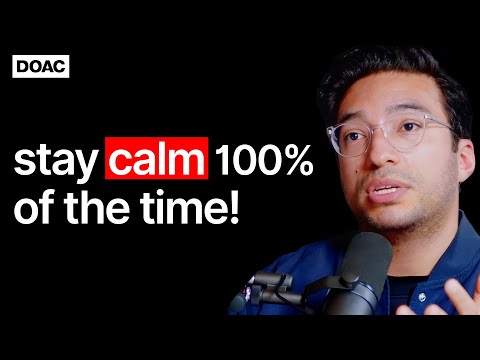
Unlock The Secrets Of Your Mind, Boost Productivity & Reduce Stress! - Yung Pueblo | E255
Yung Pueblo (Diego Perez) (guest), Steven Bartlett (host), Narrator
In this episode of The Diary of a CEO, featuring Yung Pueblo (Diego Perez) and Steven Bartlett, Unlock The Secrets Of Your Mind, Boost Productivity & Reduce Stress! - Yung Pueblo | E255 explores meditation, Healing, And Letting Go: Rewiring Success Without Suffering Diego Perez, known as Yung Pueblo, shares how anxiety, poverty, and near-fatal drug use led him to meditation, radical self-honesty, and a complete life reset.
Meditation, Healing, And Letting Go: Rewiring Success Without Suffering
Diego Perez, known as Yung Pueblo, shares how anxiety, poverty, and near-fatal drug use led him to meditation, radical self-honesty, and a complete life reset.
He explains how unprocessed experiences accumulate as conditioning, trapping us in emotional loops and self-sabotaging cycles in work, relationships, and self-worth.
Central to his approach is Vipassana meditation, slowing down, and building self-awareness to loosen rigid identity, reduce craving, and respond to life with equanimity.
The conversation explores how healing ourselves improves productivity, relationships, and even business, and why inner work is a prerequisite for sustainable success and a more compassionate world.
Key Takeaways
Healing starts with radical honesty and feeling your emotions instead of numbing them.
Perez realized his life-threatening drug use came from refusing to admit he didn’t feel good. ...
Get the full analysis with uListen AI
You don’t need to hit rock bottom to change; you need to stop doubting your capacity.
While his own turning point was a near–heart attack from drugs, Perez stresses that people over-dramatize transformation. ...
Get the full analysis with uListen AI
Meditation is a mental gym that builds awareness and emotional control, but it’s hard at first.
He compares learning to meditate to learning a language or lifting weights: everyone is bad at it initially because the mind only knows distraction. ...
Get the full analysis with uListen AI
Most suffering comes from craving—wanting plus tension—not from having goals.
Perez distinguishes healthy wanting from craving. ...
Get the full analysis with uListen AI
Self-love means doing the hard inner work to heal and free yourself, not treating yourself.
He rejects the consumer version of self-love (buying things, bubble baths) as mostly distraction. ...
Get the full analysis with uListen AI
To break stubborn life cycles, prioritize slowing down and observing rather than over-analyzing the past.
We repeat reactions formed by childhood and early experiences, but Perez warns against endlessly dissecting backstory (“peeling the onion forever”). ...
Get the full analysis with uListen AI
Inner work scales outward: healing individuals change relationships, business, and society.
His pseudonym ‘Yung Pueblo’ (“young people”) reflects his view that humanity is collectively immature—we still fail at basic childhood lessons like sharing, telling the truth, and not hurting each other. ...
Get the full analysis with uListen AI
Notable Quotes
“You don’t need to hit rock bottom to be the best version of yourself.”
— Yung Pueblo
“Healing happens in the present moment… those feelings coming up now are just echoes of the past.”
— Yung Pueblo
“If you spend your whole life looking outside, you could read every book in the world and still be absolutely miserable.”
— Yung Pueblo
“Craving is basically the combination of wanting and tension.”
— Yung Pueblo
“In a society based on speed and productivity, moving slowly is a radical act.”
— Yung Pueblo
Questions Answered in This Episode
You distinguish sharply between craving and healthy wanting—can you walk through a concrete example from your own career where you consciously shifted a goal from craving-driven to calm, goal-driven pursuit, and how that changed your behavior day-to-day?
Diego Perez, known as Yung Pueblo, shares how anxiety, poverty, and near-fatal drug use led him to meditation, radical self-honesty, and a complete life reset.
Get the full analysis with uListen AI
For someone who can’t commit to a 10-day silent retreat but is genuinely serious about inner work, what would a realistic 30-day ‘starter protocol’ look like that still honors the spirit of Vipassana without diluting it?
He explains how unprocessed experiences accumulate as conditioning, trapping us in emotional loops and self-sabotaging cycles in work, relationships, and self-worth.
Get the full analysis with uListen AI
You argue we don’t need to endlessly analyze our past to heal, yet many therapies are built on narrative; where do you see the line between useful understanding of our story and counterproductive rumination?
Central to his approach is Vipassana meditation, slowing down, and building self-awareness to loosen rigid identity, reduce craving, and respond to life with equanimity.
Get the full analysis with uListen AI
In your view, what are the most common ways ambitious people unconsciously use ‘productivity’ and ‘success’ to avoid facing their inner canyon, and how can they notice when their work has become sophisticated distraction rather than meaningful contribution?
The conversation explores how healing ourselves improves productivity, relationships, and even business, and why inner work is a prerequisite for sustainable success and a more compassionate world.
Get the full analysis with uListen AI
You’re investing in ‘compassionate design’ for tech—if you were redesigning a major social media platform from scratch, what three specific design decisions would you change first to reduce craving, comparison, and loneliness while still making it commercially viable?
Get the full analysis with uListen AI
Transcript Preview
People don't understand their capacity. You don't need to hit rock bottom to be the best version of yourself. What you just have to do is-
I love that.
Yung Pueblo, the expert in unlocking your true potential. He's a meditator and best-selling author whose work has impacted the lives of millions.
The world is incredibly challenging. The demands are intense. And whether you've experienced serious trauma or not, hard moments get accumulated into the mind. We're trapped in this tight little bubble by our past. It keeps us in a loop. You react very intensely with anger, with sadness, you feel anxiety, stress, but healing and letting go are possible.
How?
The best tool that we don't access is meditation.
If there's someone listening to this now and they go, "I don't meditate. I've tried it, didn't work," what is the pitch you'd make to them?
Steve Jobs and Sam Altman, high-performing people cultivate their minds and meditate. They stay cool under pressure, make more creative decisions. I can do more with less stress. It's essential for your mental health. When I grew up, I didn't want to admit to myself that I didn't feel good. Constantly trying to cope myself in pleasure by drinking as much as possible, doing tons of drugs where I almost lost my life. Everything was going terrible. But when I started meditating, everything changed. Requires this application of self-awareness to really unlock your happiness. You gotta see what you're doing to yourself. Meditating has been the biggest investment that I've made in my life.
In a specific way, how does your meditation look?
There's two main things. One is...
Before this episode starts, I have a small favor to ask from you. Two months ago, 74% of people that watch this channel didn't subscribe. We're now down to 69%. My goal is 50%. So if you've ever liked any of the videos we've posted, if you like this channel, can you do me a quick favor and hit the subscribe button? It helps this channel more than you know. And the bigger the channel gets, as you've seen, the bigger the guests get. Thank you and enjoy this episode. Yung Pueblo, Diego Perez, when you look at the body of work you've produced, and you look specifically at the, the writing, the content that you've put out into the world, what mission are you on? What is it you're trying to do? What effect are you trying to have on society at large?
I think the mission is really hoping to raise self-awareness around the fact that healing and letting go are possible. So, I got into this world really early on. I think, uh, it was 2011 when I started realizing that healing was even possible, and this was before wellness was even a giant sort of this giant world that it is today. And, um, to me, it was a shock. You know, when I grew up, I thought that if you were sick physically or mentally in some manner, you just had to deal with that for the rest of your life. You couldn't really fix that in any way, and when I started changing my habits, when I started changing what I was eating, when I started reassessing my friend group, and then eventually when I started meditating, the changes were so massive that I was so shocked by them that I wanted to really check in with myself and see that, is this real? And it was real. So, that just kind of pushed me into writing where I felt this sort of creative pull to- to share the little bit of that I- that I know, you know? And it- it was interesting because I know that I don't know everything. I'm not fully healed, I'm not fully wise. I have a long way to go. But hopefully some of the things that I'm reflecting on could inspire other people to do this serious work as well.
Install uListen to search the full transcript and get AI-powered insights
Get Full TranscriptGet more from every podcast
AI summaries, searchable transcripts, and fact-checking. Free forever.
Add to Chrome