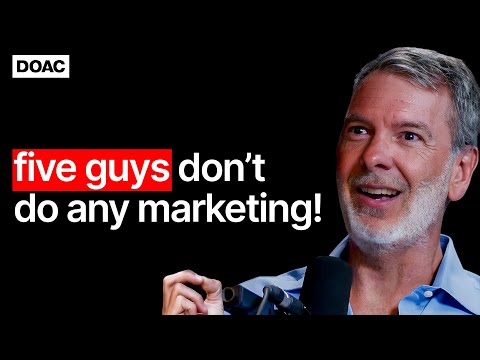
Five Guys CEO: How we built a burger empire WITHOUT ANY Marketing: John Eckbert | E168
John Eckbert (guest), Steven Bartlett (host), Narrator
In this episode of The Diary of a CEO, featuring John Eckbert and Steven Bartlett, Five Guys CEO: How we built a burger empire WITHOUT ANY Marketing: John Eckbert | E168 explores five Guys’ CEO: Obsessive Quality, Zero Ads, Radical Humanity Build Empire John Eckbert, CEO of Five Guys Europe, explains how the brand built a global burger empire without any traditional advertising by obsessing over product quality, simplicity, and word-of-mouth. He details the strategic UK expansion, including flagship locations and a strict focus on fresh, customizable burgers and fries as the sole offering. Eckbert also breaks down Five Guys’ operational culture: values-led hiring, negative selling of roles, heavy investment in training, and mystery shopping that replaces ad spend with frontline incentives. Throughout, he is strikingly vulnerable about divorce, losing day‑to‑day contact with his children, mental health, and how confronting his own blind spots reshaped his leadership and life.
Five Guys’ CEO: Obsessive Quality, Zero Ads, Radical Humanity Build Empire
John Eckbert, CEO of Five Guys Europe, explains how the brand built a global burger empire without any traditional advertising by obsessing over product quality, simplicity, and word-of-mouth. He details the strategic UK expansion, including flagship locations and a strict focus on fresh, customizable burgers and fries as the sole offering. Eckbert also breaks down Five Guys’ operational culture: values-led hiring, negative selling of roles, heavy investment in training, and mystery shopping that replaces ad spend with frontline incentives. Throughout, he is strikingly vulnerable about divorce, losing day‑to‑day contact with his children, mental health, and how confronting his own blind spots reshaped his leadership and life.
Key Takeaways
Build an exceptional product so good it compels word-of-mouth.
Five Guys spent nothing on advertising and relied entirely on customers tasting a “fucking fantastic” burger and fries and then telling friends. ...
Get the full analysis with uListen AI
Win through extreme focus and simplicity, not endless menu expansion.
Founders refused decades of pressure to add salads or chicken because it diluted their ability to make the best possible burger. ...
Get the full analysis with uListen AI
Use property and positioning as a ‘word-of-mouth accelerator’ instead of ads.
In the UK/EU, John and partner Charles Dunstone repositioned Five Guys from US B‑locations and strip malls into flagship, aspirational sites like Covent Garden and the Champs‑Élysées. ...
Get the full analysis with uListen AI
Culture and hiring are more important than traditional ‘levers’ like advertising.
With 8,600 staff and 225+ restaurants, John argues the frontline people literally are the brand. ...
Get the full analysis with uListen AI
Replace marketing spend with rigorous standards and direct incentives.
Every store is mystery-shopped twice a week on ~120 criteria across product, cleanliness, and service. ...
Get the full analysis with uListen AI
Protect core values but stay flexible on format and distribution.
The founding family initially banned delivery to protect food quality. ...
Get the full analysis with uListen AI
Vulnerability and self-awareness are powerful leadership tools, not liabilities.
John is candid about a devastating divorce, having his children move back to the US, and viewing work as an anchor amid anxiety. ...
Get the full analysis with uListen AI
Notable Quotes
“It can’t be good. If a customer takes a bite of a burger and goes, ‘Ah, that’s really good,’ that doesn’t move the dial. It has to be, ‘That’s fucking fantastic.’”
— John Eckbert
“Five Guys wasn’t successful because we put a slice of avocado on a burger. There was nothing trendy about Five Guys.”
— John Eckbert
“We inverted the equation and said, ‘Five Guys is a really hard job and it’s probably not for you,’ and then looked for the person who raised their hand.”
— John Eckbert
“Once you lose your integrity, everything else is easy.”
— John Eckbert
“If you allocate your mental health and your time on the things that you can’t control, you can drive yourself to distraction and eventually madness.”
— John Eckbert
Questions Answered in This Episode
You talked about the ‘negative sell’ for hiring at Five Guys; can you walk through the exact interview questions or scenarios you use to filter for those five core values in practice?
John Eckbert, CEO of Five Guys Europe, explains how the brand built a global burger empire without any traditional advertising by obsessing over product quality, simplicity, and word-of-mouth. ...
Get the full analysis with uListen AI
When you first pushed for delivery against the Murrells’ long-standing ‘no delivery’ rule, what specific data or arguments finally changed their minds—and were there any compromises you refused to make?
Get the full analysis with uListen AI
Mystery shopping twice a week and paying out millions in bonuses is a bold choice; have you seen any unintended consequences (gaming the system, stress, short-termism) and how have you adjusted the program?
Get the full analysis with uListen AI
You described feeling like an ‘indentured servant’ after the leave-to-remove ruling; looking back, is there anything you would advise another CEO in that position to do differently, either legally or emotionally?
Get the full analysis with uListen AI
You’ve said you’re not convinced you really know what love is in a romantic context; based on your therapy and introspection so far, what does a ‘loving’ CEO look like in a company setting without crossing into unhealthy over-responsibility or burnout?
Get the full analysis with uListen AI
Transcript Preview
You know, when Barack Obama left the White House to go pick up Five Guys- We're gonna go get some burgers. 41. ... that's what makes Five Guys a treat and special. Jon Egbert- The CEO of Five Guys Europe. Five Guys has a global cult following.
Five Guys burgers and fries, it was banging.
Covent Garden was the very first Five Guys outside of the US. We knew that we weren't gonna be advertising. We're entirely reliant on someone tasting a great burger and fry and then telling their neighbors or their friends. It has to be, "Whew, that's fucking fantastic."
That Covent Garden location sold more than any in the world.
It did, yeah, by far. I'm responsible for 225 restaurants now.
H- how do you stop getting a little bit sloppy and complacent?
We've actually gotten better. The key to that is... (music)
As the CEO of a business that's gone through such chaos, when was your hardest time?
So I had, uh, two young children. The fact is that there were m- moments when they woke up and needed both their parents and, and I wasn't there. Um... You'll hurt the people you care about in ways that you don't intend, in ways that you don't understand.
So without further ado, I'm Steven Bartlett, and this is The Diary of a CEO. I hope nobody's listening, but if you are, then please keep this to yourself. Jon, I've, I've read quite extensively through your story and, um, I guess my first question is, when you th- when you think back to your pre-twenties, right, what is the, what are the most important things from that era of your life that shaped your perspective and approach to the world and to business today?
Wow. Well, first, I grew up in a very counter-cultural, isolationist family. Um, so we didn't, we didn't watch TV. We didn't celebrate birthdays or holidays. And, um, I kinda got up at 5:00 AM to practice violin for an hour, um, before school, um, and had music lessons after school every day. Um, and, um, so it was very, um, different. Um, and I think I always... I think I grew up feeling different, with this kind of longing to have a sense of belonging. Um, and that was always something that I was looking for in my professional life, I think, um, as well. I would've been a fourth-generation doctor if I had gone into medicine. Um, and my father told me that the profession was changing and it wasn't so much about patients and, um, and doctors and kind of the relationship that can develop in terms of health and bringing your, you know, your health to your doctor and getting advice, and it was changing in America dramatically. And so he, he said, you know, "Don't, uh, don't do medi- you know, I'm not encouraging you to do medicine." So I knew I had to kind of find a different, um, role in life. And I, I read, um, Ayn Rand in high school, um, and not suggesting that, uh, that, uh, she's gotten everything right. But one, one interesting thing that she did propose was that there's, there could be something noble in business. Be- you know, being a successful entrepreneur could be a noble thing. And I- my... So the, the kind of orientation from my family was make sure that you do something important or, or, um, in your life. And that meant, you know, taking care of other people or doing something that was, um, had some greater purpose to it than kind of just making money. Um, but that seed of a thought that being in business could actually be a noble profession and you actually could do something important to make people's lives better, um, and take care of people in a different way in business was kind of, I think, an important penny to drop for me, um, when I was, when I was 18. Um, but yeah, it was a, it was a, it was a definitely a different upbringing than, than most, and that, that sense of belonging was something I've been searching for my whole life.
Install uListen to search the full transcript and get AI-powered insights
Get Full TranscriptGet more from every podcast
AI summaries, searchable transcripts, and fact-checking. Free forever.
Add to Chrome