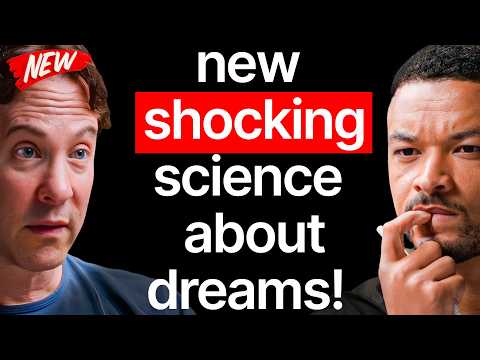
Stanford Neuroscientist: Can’t Remember Your Dreams? Your Brain May Be Warning You!
Steven Bartlett (host), Dr. David Eagleman (guest)
In this episode of The Diary of a CEO, featuring Steven Bartlett and Dr. David Eagleman, Stanford Neuroscientist: Can’t Remember Your Dreams? Your Brain May Be Warning You! explores neuroscientist explains brain plasticity, AI tradeoffs, and why we dream. Eagleman frames the mind as a "team of rivals"—competing neural networks whose moment-to-moment "votes" drive behavior—making self-control a matter of smart environment design, not mere willpower.
Neuroscientist explains brain plasticity, AI tradeoffs, and why we dream.
Eagleman frames the mind as a "team of rivals"—competing neural networks whose moment-to-moment "votes" drive behavior—making self-control a matter of smart environment design, not mere willpower.
Brain plasticity is lifelong but becomes less automatic with age because adults rely on stable internal models; intentional change comes from seeking novelty and the “frustrating-but-achievable” challenge zone.
Building “cognitive reserve” through continuous learning and rich social engagement can buffer cognitive decline, while retirement-like “coasting” and shrinking social circles increase risk for decline.
He argues AI should remove “vicious friction” (busywork) while preserving “virtuous friction” (effortful thinking), and that the competitive edge goes to people who collaborate critically with AI rather than copy-paste outputs.
Eagleman presents a theory of dreaming as a protective mechanism that “defends” visual cortex territory from takeover during darkness, supported by cross-species correlations between plasticity and REM sleep.
Key Takeaways
Treat self-control as governance, not a single “you.”
Eagleman’s “neural parliament” metaphor implies lapses aren’t moral failure but shifting coalitions; better outcomes come from designing contexts that help the “right party” win more often.
Get the full analysis with uListen
Use “Ulysses contracts” to constrain future you.
Make commitments that remove temptation or add accountability (e. ...
Get the full analysis with uListen
If you want to change, chase challenge—then rotate skills.
Plasticity responds to novelty and difficulty; once you’re good at something, you should “drop it” and start something new to keep building fresh neural pathways instead of coasting.
Get the full analysis with uListen
Prioritize socially complex time as brain training.
“Nothing is as hard for the brain as other people,” so conversation, conflict, coordination, and community chores function as constant cognitive workouts that build reserve.
Get the full analysis with uListen
Build cognitive reserve early, but keep building it forever.
Even as brain tissue degenerates with age, creating alternative “roadways and bridges” (new skills, new routines, new social roles) can preserve function despite pathology.
Get the full analysis with uListen
Use AI to delete busywork, not to skip thinking.
Offload “vicious friction” (copying spreadsheets, rote admin), but keep “virtuous friction” (strategy, reasoning, writing with intent) because that’s where learning and capability grow.
Get the full analysis with uListen
Make AI disagree with you on purpose.
Prompt for counterarguments (“tell me why I’m wrong”) and iterate; the benefit comes from engaging with critique privately and persistently, not from pasting the first fluent answer.
Get the full analysis with uListen
Expect human experiences to gain value as AI expands.
He predicts a renaissance in live, in-person events and care-based roles because humans will increasingly seek verified human presence, effort, and connection amid synthetic content.
Get the full analysis with uListen
Dreaming may be brain territory defense, not hidden meaning.
His theory proposes REM periodically “zaps” the visual cortex to prevent sensory takeover during darkness; dream narratives may be the brain’s storytelling overlay on random activation.
Get the full analysis with uListen
Notable Quotes
“You are a team of rivals. You’ve got all these neural networks that have different drives making different suggestions to you.”
— Dr. David Eagleman
“Nothing is as hard for the brain as other people.”
— Dr. David Eagleman
“There’s vicious friction in our lives and there’s virtuous friction.”
— Dr. David Eagleman
“We’ve all got Aristotle in our pocket now.”
— Dr. David Eagleman
“The purpose of dreaming is to defend the visual territory from takeover from the other senses.”
— Dr. David Eagleman
Questions Answered in This Episode
Eagleman says the brain changes less with age because it “doesn’t have to”—what are the clearest signs you’ve slipped into coasting, and how do you diagnose it early?
Eagleman frames the mind as a "team of rivals"—competing neural networks whose moment-to-moment "votes" drive behavior—making self-control a matter of smart environment design, not mere willpower.
Get the full analysis with uListen AI
What are the best real-world “Ulysses contracts” for modern temptations like social media, late-night snacking, and procrastination at work?
Brain plasticity is lifelong but becomes less automatic with age because adults rely on stable internal models; intentional change comes from seeking novelty and the “frustrating-but-achievable” challenge zone.
Get the full analysis with uListen AI
If “nothing is as hard for the brain as other people,” what kinds of social activities (debate clubs, volunteering, team sports, caregiving) build the most cognitive reserve and why?
Building “cognitive reserve” through continuous learning and rich social engagement can buffer cognitive decline, while retirement-like “coasting” and shrinking social circles increase risk for decline.
Get the full analysis with uListen AI
How would you design a weekly “challenge rotation” plan that maximizes plasticity without burning out—what’s the right dose of frustration?
He argues AI should remove “vicious friction” (busywork) while preserving “virtuous friction” (effortful thinking), and that the competitive edge goes to people who collaborate critically with AI rather than copy-paste outputs.
Get the full analysis with uListen AI
On AI: where exactly is the boundary between productive collaboration and learning-eroding outsourcing for knowledge workers?
Eagleman presents a theory of dreaming as a protective mechanism that “defends” visual cortex territory from takeover during darkness, supported by cross-species correlations between plasticity and REM sleep.
Get the full analysis with uListen AI
Transcript Preview
After many, many decades of people debating this, you might have figured out the reason why we dream.
Yes, and it's a simple answer. So if you go blind, the visual cortex at the back of the brain gets taken over by hearing and by touch and by other things. In fact, our colleagues at Harvard did an experiment where they blindfolded normally sighted people, and you could start seeing that takeover happening after sixty minutes. And that's when we realized, wow, the purpose of dreaming is to defend the visual territory from takeover from the other senses. But what fascinates me about brain plasticity and what I've devoted my career to is figuring out the way that we can be the sculptors of our own brains and how it gives us an opportunity to become the kind of person we would like to be.
And can we do that?
Yes. Here's the thing. Your brain peaked at the age of two. Okay, so at the beginning, you've got fluid intelligence, meaning you could learn anything. But now that you have grown up in this world, you've got crystallized intelligence, meaning you know how to drive a car, you know how to operate a cell phone, you know how to run a business. And so your brain doesn't require as much change, which means that the structure of the brain is always degenerating.
So what are the set of actions that will fundamentally change my brain and make me that type of person who's motivated and disciplined and who has high agency and attacks the world?
So this is something I've studied in my lab for decades now, and the key is that-
And what about AI and the social media debate as it relates to brain development?
Well, I happen to be a cyber optimist for young people. I think it's gonna make them much smarter than the generation that came before, and here's why.
Interesting. This is super interesting to me. My team give me this report to show me how many of you that watch this show subscribe, and some of you have told us, according to this, that you are unsubscribed from the channel randomly. So favor to ask all of you, please could you check right now if you've hit the subscribe button if you are a regular viewer of this show and you like what we do here. We're approaching quite a significant landmark on this show in terms of a subscriber number. So if there was one simple free thing that you could do to help us, my team, everyone here, to keep this show free, to keep it improving year over year and week over week, it is just to hit that subscribe button and to double-check if you've hit it. Only thing I'll ever ask of you. Do we have a deal? If you do it, I'll tell you what I'll do. I'll make sure every single week, every single month, as we fight harder and harder and harder and harder to bring you the guests and conversations that you wanna hear. I've stayed true to that promise since the very beginning of The Diary of a CEO and I will not let you down. Please help us. Really appreciate it. Let's get on with the show. [upbeat music] Dr. David Eagleman, what made you so fascinated about the brain, and why should everybody listening be fascinated about the brain as well?
Install uListen to search the full transcript and get AI-powered insights
Get Full TranscriptGet more from every podcast
AI summaries, searchable transcripts, and fact-checking. Free forever.
Add to Chrome