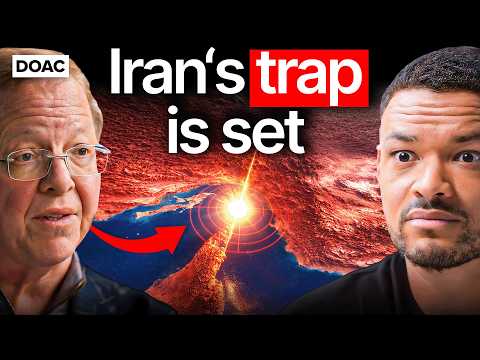
URGENT UPDATE - The Iran War Expert: The Most Dangerous Stage Begins Now
Robert Pape (guest), Steven Bartlett (host)
In this episode of The Diary of a CEO, featuring Robert Pape and Steven Bartlett, URGENT UPDATE - The Iran War Expert: The Most Dangerous Stage Begins Now explores pape warns Iran war escalation trap risks ground war, global shift Pape claims long-running war-game style modeling predicted that bombing can wreck facilities but cannot reliably eliminate Iran’s enriched uranium stockpile, making airstrikes strategically insufficient.
Pape warns Iran war escalation trap risks ground war, global shift
Pape claims long-running war-game style modeling predicted that bombing can wreck facilities but cannot reliably eliminate Iran’s enriched uranium stockpile, making airstrikes strategically insufficient.
He argues U.S. military action is strengthening Iran politically by fostering nationalism, undermining pro-democracy currents, and increasing public support for nuclear deterrence.
The episode frames an “escalation trap” in stages, warning the conflict is now at a fork between preparations for ground operations (especially around Hormuz/oil fields) and Iran emerging as a new global power center.
Pape contends Iran’s ability to disrupt the Strait of Hormuz creates geopolitical leverage over Asian allies and global oil prices, with spillover economic impacts (inflation, higher borrowing costs) for the U.S. and Europe.
He portrays U.S.-Israel dynamics as complicating diplomacy—describing Israel as a “spoiler”—and predicts NATO cohesion and willingness to follow U.S. leadership is eroding under the crisis.
Key Takeaways
Airpower can destroy facilities but not the ‘material’ that matters.
Pape’s core claim is that bombing enrichment sites (e. ...
Get the full analysis with uListen
Political reactions can outweigh tactical military success.
He argues bombing often galvanizes populations and regimes (Vietnam analogy), producing greater resolve and adaptation, so “successful” strikes can still yield strategic failure.
Get the full analysis with uListen
Iran’s buried arsenals create a persistent attrition problem in Hormuz.
Even if visible launchers are destroyed, deeply buried drones/missiles can keep threatening shipping and bases, enabling a selective blockade that is difficult to suppress by air/naval power alone.
Get the full analysis with uListen
The conflict’s ‘fork’ is ground war versus a stronger Iran.
He frames the next phase as either escalating into ground operations to secure Hormuz/oil/uranium, or accepting Iran’s rising leverage and likely nuclear breakout—both costly outcomes.
Get the full analysis with uListen
Threats of mass destruction harden Iranian unity and nuclear demand.
Pape treats Trump’s “civilization will die tonight” rhetoric as uniquely escalatory, arguing it persuades ordinary Iranians—including some opposition voices—that nuclear deterrence is necessary.
Get the full analysis with uListen
Watch force movements, not statements, to gauge escalation.
He advises tracking deployments (Marines, carriers, aircraft basing) as the most reliable indicator of impending ground operations, rather than volatile rhetoric or ceasefire announcements.
Get the full analysis with uListen
Oil leverage translates into alliance realignment and macroeconomic pain.
Because most Hormuz flows go to Asia and oil is globally priced, he argues Iran gains coercive power over India/Japan and can raise prices worldwide, potentially driving U. ...
Get the full analysis with uListen
A plausible diplomatic off-ramp requires restraining Israel, not just Iran.
Pape suggests an enforceable U. ...
Get the full analysis with uListen
Notable Quotes
““We’re not weakening Iran… we have strengthened Iran.””
— Robert Pape
““You can destroy the pan… you can’t get the gold.””
— Robert Pape
““Far more chaotic decision-making is happening in the White House than is happening in the government of Iran.””
— Robert Pape
““We are at a fork in the road… Either we go through with the ground war or Iran becomes… a fourth center of world power.””
— Robert Pape
““That is the most declared statement of genocidal intent we’ve ever seen from an American president.””
— Robert Pape
Questions Answered in This Episode
On the enriched-uranium problem: what specific intelligence or historical cases support the claim that bombing can’t reliably neutralize stored/enriched material in Iran?
Pape claims long-running war-game style modeling predicted that bombing can wreck facilities but cannot reliably eliminate Iran’s enriched uranium stockpile, making airstrikes strategically insufficient.
Get the full analysis with uListen AI
Your stages predict ground operations around Hormuz/oil fields—what concrete deployment signals (units, basing changes, logistics) would confirm stage three is imminent?
He argues U. ...
Get the full analysis with uListen AI
You call Israel a “diplomatic spoiler” citing killings of negotiators—what evidence best supports intent versus coincidence, and how should the U.S. respond without rupturing the alliance?
The episode frames an “escalation trap” in stages, warning the conflict is now at a fork between preparations for ground operations (especially around Hormuz/oil fields) and Iran emerging as a new global power center.
Get the full analysis with uListen AI
If Iran can selectively blockade Hormuz, what are the realistic military options short of invasion to reduce that leverage (minesweeping, coastal raids, cyber, special operations)?
Pape contends Iran’s ability to disrupt the Strait of Hormuz creates geopolitical leverage over Asian allies and global oil prices, with spillover economic impacts (inflation, higher borrowing costs) for the U. ...
Get the full analysis with uListen AI
You propose “military containment of Israel” via U.S. legislation cutting aid—how politically feasible is this in Congress, and what alternative enforcement mechanisms could exist?
He portrays U. ...
Get the full analysis with uListen AI
Transcript Preview
Iran has figured out that we can't beat them. We're not weakening Iran, we have strengthened Iran, and we can't stop their drone attacks. And what you're seeing is far more chaotic decision-making is happening in the White House than is happening in the government of Iran. And it's evidence Trump is losing power.
So when I look through the response to the last conversation, the audience had lots of different types of questions. Like, there's 90-odd million people stuck right in the heart of this that often don't really have a voice. What do you think happens next for them? And what is Israel's role in this?
Well, Israel's playing two roles here that have not helped us correctly assess the situation, and we'll talk about that.
And then what do you think happens with Europe?
NATO is, for all practical purposes, dead.
What happens next?
So for twenty-one years, I laid out what a hypothetical bombing campaign of Iran would look like. And when I was here last time, every single thing we talked about unfolded in the first several weeks of the war.
So when you did this twenty-one years of modeling these attacks, how did America come out of this situation?
So there was a consistent set of findings, and America can bomb them, attack them. We could even threaten to murder all ninety-two million of them. But the bottom line is, that is the real danger for us.
This is super interesting to me. My team give me this report to show me how many of you that watch this show subscribe, and some of you have told us, according to this, that you are unsubscribed from the channel randomly. So favor to ask all of you, please could you check right now if you've hit the subscribe button if you are a regular viewer of this show and you like what we do here. We're approaching quite a significant landmark on this show in terms of a subscriber number. So if there was one simple free thing that you could do to help us, my team, everyone here, to keep this show free, to keep it improving year over year and week over week, it is just to hit that subscribe button and to double-check if you've hit it. Only thing I'll ever ask of you. Do we have a deal? If you do it, I'll tell you what I'll do. I'll make sure every single week, every single month, we fight harder and harder and harder and harder to bring you the guests and conversations that you wanna hear. I've stayed true to that promise since the very beginning of The Diary of a CEO, and I will not let you down. Please help us. Really appreciate it. Let's get on with the show. [upbeat music] Professor Robert Pape. Good to see you again.
Great to see you again, Steven.
It's been four weeks since we sat down and talked about everything that was happening in the war, and it's all moved at light speed. You made some predictions then. S- many of them have come true already, and many of them are still unfolding. But I wanted to get you back to talk about what the hell is going on. And I think that's k- kind of how I started last conversation, but there's so much that's being said, and I get the sense that there's a truth that sits underneath there somewhere. Because when you look at what the Iranians are saying, when you look at what the Israelis are saying, when you look at what Trump and America are saying, and then you look at reality, at some level, I feel like we're not being told the truth. My first question to you, Professor, is who are you and who are you to speak on this subject matter?
Install uListen to search the full transcript and get AI-powered insights
Get Full TranscriptGet more from every podcast
AI summaries, searchable transcripts, and fact-checking. Free forever.
Add to Chrome