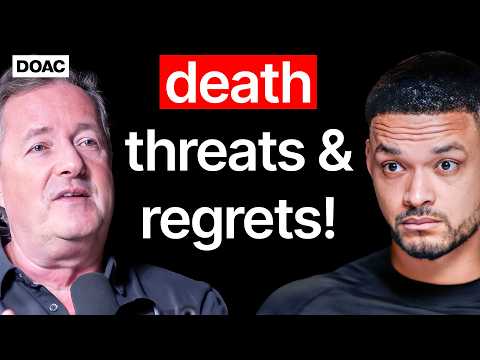
Piers Morgan: Dealing With Repeat Failure, Death Threats & Regrets | E137
Steven Bartlett (host), Piers Morgan (guest), Narrator, Narrator, Narrator
In this episode of The Diary of a CEO, featuring Steven Bartlett and Piers Morgan, Piers Morgan: Dealing With Repeat Failure, Death Threats & Regrets | E137 explores piers Morgan On Fame, Failure, Free Speech, Woke Wars, Resilience Piers Morgan discusses how early obsessions with news, attention, and fame shaped his career from tabloid editor to global TV host. He argues passionately for resilience, mental toughness, and personal responsibility, criticizing what he sees as the over-pathologizing of normal life struggles and the celebration of victimhood.
Piers Morgan On Fame, Failure, Free Speech, Woke Wars, Resilience
Piers Morgan discusses how early obsessions with news, attention, and fame shaped his career from tabloid editor to global TV host. He argues passionately for resilience, mental toughness, and personal responsibility, criticizing what he sees as the over-pathologizing of normal life struggles and the celebration of victimhood.
A major thread is his crusade against modern ‘woke’ culture and cancel culture, which he views as a new form of authoritarianism eroding free speech, common sense, and open debate. He details his high-profile clashes, including his exit from Good Morning Britain over Meghan Markle, and how he processes professional ‘failures’.
Morgan also reflects on parenting, bullying, media responsibility, and the psychological costs and benefits of notoriety for himself and his children. He positions his new show, Piers Morgan Uncensored, as an attempt to ‘cancel cancel culture’ and restore robust, pluralistic public discourse.
Key Takeaways
Separate ‘mental health’ from ‘mental illness’ and restore focus on resilience.
Morgan argues that society conflates normal emotional turbulence (stress, grief, breakups, exam pressure) with clinical mental illness. ...
Get the full analysis with uListen AI
Early adversity can forge adaptability and social range.
Being bullied at a comprehensive school for his double-barrelled name and then ‘protected’ when his tougher brother arrived taught him about standing up to bullies and the role of force in some conflicts. ...
Get the full analysis with uListen AI
Deliberate self-belief and risk-taking are central to building a prominent voice.
Morgan stresses ‘backing yourself’ (borrowing Kevin Pietersen’s mantra) and being willing to take shots, citing Wayne Gretzky’s line about missing 100% of the shots you don’t take. ...
Get the full analysis with uListen AI
Modern ‘woke’ culture, in his view, has mutated into censorious authoritarianism.
While he endorses the original ‘woke’ concern with racial and social justice, he argues contemporary wokism has become ‘a new form of fascism’ that dictates permissible jokes, opinions, and even vocabulary (e. ...
Get the full analysis with uListen AI
Public outrage ecosystems amplify extremes and erode nuance.
Morgan and Bartlett discuss how algorithms and tribalism create echo chambers where people are rewarded for more extreme positions and punished for nuance. ...
Get the full analysis with uListen AI
Treat career ‘disasters’ as transitions, not identity-defining failures.
Morgan reframes his high-profile exits—from The Mirror, CNN, and Good Morning Britain—not as catastrophes but as chapter endings that opened better opportunities. ...
Get the full analysis with uListen AI
Fame brings both privilege and collateral damage, especially for family.
He’s candid that his children get both perks (e. ...
Get the full analysis with uListen AI
Notable Quotes
“Opinions, to me, are the spice of life. If you don't have an opinion, there's something wrong with you.”
— Piers Morgan
“This generation in particular has lost the ability to look at mental strength and resilience and triumph over adversity and being tough in difficult times as badges of honor.”
— Piers Morgan
“Cancel culture's a virus as deadly over time as the coronavirus.”
— Piers Morgan
“One day you're the cock of the walk, the next a feather duster.”
— Piers Morgan
“The public wants someone to cancel cancel culture.”
— Piers Morgan
Questions Answered in This Episode
You argue we over-pathologize normal life struggles as ‘mental illness’. How would you practically redesign mental health services and public messaging so that people in genuine crisis are prioritized without discouraging others from speaking up early?
Piers Morgan discusses how early obsessions with news, attention, and fame shaped his career from tabloid editor to global TV host. ...
Get the full analysis with uListen AI
In the Meghan Markle episode, you emphasize the need for ‘evidence’ behind her claims. If she did sit down with you and provided credible corroboration, what would it take for you to revise your public stance—and would you do so publicly?
A major thread is his crusade against modern ‘woke’ culture and cancel culture, which he views as a new form of authoritarianism eroding free speech, common sense, and open debate. ...
Get the full analysis with uListen AI
You describe modern wokism as ‘a form of fascism’. Where do you personally draw the line between socially responsible regulation of speech (e.g., hate speech laws) and the kind of censorship you oppose, and who should enforce that line?
Morgan also reflects on parenting, bullying, media responsibility, and the psychological costs and benefits of notoriety for himself and his children. ...
Get the full analysis with uListen AI
You present your firings and public ‘bedoings’ as fuel rather than trauma. For someone without your platform or financial cushion, what concrete steps would you recommend to turn a humiliating career loss into an opportunity rather than a spiral?
Get the full analysis with uListen AI
You say you rarely feel anxiety and that your glass is always half full. Do you worry that this temperament might blind you to emotional realities experienced by less resilient people, and how do you guard against that blind spot when influencing millions through your platforms?
Get the full analysis with uListen AI
Transcript Preview
Could you do me a quick favor if you're listening to this? Please hit the Follow or Subscribe button. It helps more than you know, and we invite subscribers in every month to watch the show in person.
Opinions, to me, are the spice of life. If you don't have an opinion, there's something wrong with you. I'm Piers Morgan Uncensored. Show some damn respect. Why do you want to deport me? Am I allowed to respond yet? I'm a news junkie, and it started when I was six or seven. And then, as I got through my teens, I became very opinionated. I read a report last year that said 33 million people in Britain are mentally ill. No, they're not. It's crap. We're spending too much time encouraging a kind of wallowing in self-pity.
People will misunderstand the use of the word.
Yeah, but hang on, hang on.
The risk I see is being the judge of whether someone's feelings are worthy of the emotion.
I'm done with this. I left on a point of principle, and the principle was, I'm entitled to my opinion. Why should my sons be exposed to death threats simply for being my children? Cancel culture's a virus as deadly over time as the coronavirus. The public wants someone to cancel cancel culture. I want to stimulate debate and to get to some kind of truth.
Have you ever regretted anything you've said? So without further ado, I'm Steven Bartlett, and this is The Diary of a CEO: USA Edition. I hope nobody's listening, but if you are, then please keep this to yourself. (instrumental music) Piers.
Steven. (laughs)
This is quite, quite interesting. You're usually on the, uh, the other side of the table.
I already feel uncomfortable.
(laughs)
I've, I've watched your stuff. You're, you're forensic. You know, you go deep, and I'm like, "I don't know."
(laughs)
I don't really know why I'm doing it, other than at least one of my sons is a massive fan of yours and said, "Daddy, you gotta do this podcast. Everyone listens to this podcast. So whatever you're doing, it's working, so I'm here."
Mm-hmm. You make great kids. Well, thank you for being here. Um, the th- the thing ... I was think, sat up just thinking, where do I start with this conversation? And honestly, the, the, the p- the center point of my curiosity is how you came to be the person you are today. And I looked through your story, especially your early years-
Mm-hmm.
... the loss of your father, c- certain experiences you've had when you were younger. You're a self-aware guy. You're an honest man. What are the factors at that pre-teen age that went into making Piers Morgan the man that we all know as this media anomaly?
I'm a junkie. I'm a news junkie, and it started when I was six or seven, which is just weird. I've had four kids myself. The idea of being six or seven and being addicted to what's happening in the world, to news, to newspapers. I used to sit and read the Daily Mail. My parents used to get the mail. I used to read it from cover to cover when I was six or seven. So from a very early age, I had that kind of fascination and curiosity with what was happening, and I wanted to know what was happening and what to think about it. And then, as I got through my teens, I became very opinionated, and I used to regularly get thrown out of my local pub on a Saturday night for getting drunk and disorderly. Disorderly, they meant just too opinionated and too loud, so I'd argue with people, and then it would get out of hand, and then I'd be thrown out. I always got myself back in, but-
Install uListen to search the full transcript and get AI-powered insights
Get Full TranscriptGet more from every podcast
AI summaries, searchable transcripts, and fact-checking. Free forever.
Add to Chrome