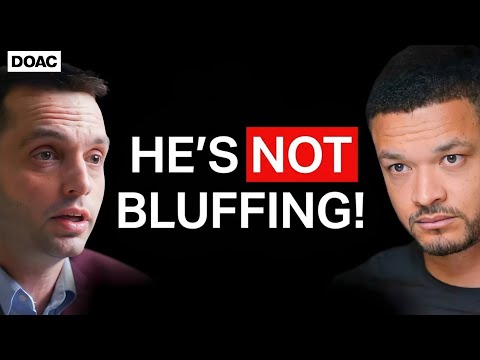
The Man Warning The West: Trump Is Changing The World Behind The Scenes
Steven Bartlett (host), Konstantin Kisin (guest), Steven Bartlett (host)
In this episode of The Diary of a CEO, featuring Steven Bartlett and Konstantin Kisin, The Man Warning The West: Trump Is Changing The World Behind The Scenes explores konstantin Kisin on a weakening West, Trump, and global disorder Konstantin Kisin frames today’s chaos—Ukraine, Iran, Taiwan tensions, and Trump’s aggressive posture—as the rapid disintegration of the post‑1945 (and post‑1991) order into a more dangerous, multipolar world.
Konstantin Kisin on a weakening West, Trump, and global disorder
Konstantin Kisin frames today’s chaos—Ukraine, Iran, Taiwan tensions, and Trump’s aggressive posture—as the rapid disintegration of the post‑1945 (and post‑1991) order into a more dangerous, multipolar world.
He argues “international law” and the “rules-based order” functioned as shared myths enforced mainly by US power, and that Western moral credibility and deterrence were eroded by Iraq/Afghanistan alongside Europe’s economic and military self-weakening.
A major throughline is UK/Europe decline: high welfare burdens, deindustrialization, expensive energy policies (especially “net zero”), demographic weakness masked by mass immigration, and a hostile culture toward entrepreneurs that pushes wealth-creators abroad.
The conversation also pivots to second-order effects: nuclear proliferation incentives if Ukraine isn’t properly supported, political extremism on both left and right, and AI/robotics potentially forcing radical redistribution if human labor becomes broadly obsolete.
Key Takeaways
The “rules-based order” depended on US-enforced power, not neutral law.
Kisin argues international law lacks a true enforcement mechanism; it worked largely because the dominant power could (and would) impose costs. ...
Get the full analysis with uListen AI
Western weakness is viewed as an invitation to aggression.
He frames Russia’s invasion of Ukraine and Hamas’s October 7 attack as “tests” triggered by perceived Western moral/military hesitation, rather than isolated surprises.
Get the full analysis with uListen AI
Nukes raise the stakes—and make proliferation rational for smaller states.
Bartlett’s observation that great powers pick on non-nuclear states leads to Kisin’s warning: insufficient support for Ukraine teaches others that only nuclear weapons guarantee security, accelerating proliferation risk.
Get the full analysis with uListen AI
Europe’s comfort model is strategically unsustainable.
Using the statistic “Europe is 12% of population, 25% of GDP, 60% of welfare spending,” Kisin argues Europe became complacent, underinvested in defense, and made energy/industrial choices that reduce resilience.
Get the full analysis with uListen AI
UK decline is economic first: weak growth, high taxes, and reduced capability.
He cites stagnant/declining GDP per capita, record peacetime tax burden, debt interest crowding out defense, and erosion of manufacturing (e. ...
Get the full analysis with uListen AI
Anti-entrepreneur culture plus high taxation shrinks the tax base.
Kisin and Bartlett emphasize that top taxpayers fund a large share of revenues (top 10% pay ~60% of income tax; top 1% ~30%), so policies that prompt founders to leave can create large fiscal holes.
Get the full analysis with uListen AI
Demography and immigration are being used to disguise per-capita stagnation.
He argues mass immigration can raise headline GDP while citizens get poorer per person, and that integration becomes harder at high inflow levels—fueling cultural fragmentation and political disillusionment.
Get the full analysis with uListen AI
AI may force redistribution not out of ideology, but stability.
If automation concentrates wealth while removing jobs at scale, Kisin contends some form of guaranteed income/redistribution becomes “unavoidable”—either voluntarily or through social conflict.
Get the full analysis with uListen AI
Notable Quotes
““What you’re seeing is the final collapse of the post‑World War II order… that entire framework… is disintegrating very rapidly.””
— Konstantin Kisin
““International law really was… a shared myth… there’s never been anything that could enforce that law other than the most powerful country in the world.””
— Konstantin Kisin
““We are not going to play by the fake rules anymore that no one else is playing by anyway.””
— Konstantin Kisin
““Britain’s GDP per capita is lower today than it was in 2006… per person, we have less money today than we did twenty years ago.””
— Konstantin Kisin
““If… the products of [robots’] labor only accrues to fifty people… redistribution… can happen voluntarily, or… at the end of bayonets.””
— Konstantin Kisin
Questions Answered in This Episode
You describe “international law” as mostly unenforceable—what concrete mechanisms (military, economic, institutional) could realistically restore deterrence without recreating a single hegemon?
Konstantin Kisin frames today’s chaos—Ukraine, Iran, Taiwan tensions, and Trump’s aggressive posture—as the rapid disintegration of the post‑1945 (and post‑1991) order into a more dangerous, multipolar world.
Get the full analysis with uListen AI
You argue Iraq/Afghanistan eroded Western moral credibility. What specific post‑2003 decisions most damaged deterrence, and what would “repair” look like in practice?
He argues “international law” and the “rules-based order” functioned as shared myths enforced mainly by US power, and that Western moral credibility and deterrence were eroded by Iraq/Afghanistan alongside Europe’s economic and military self-weakening.
Get the full analysis with uListen AI
On Ukraine: what level and type of support would have been sufficient to prevent the proliferation incentive you warn about, and is it still possible now?
A major throughline is UK/Europe decline: high welfare burdens, deindustrialization, expensive energy policies (especially “net zero”), demographic weakness masked by mass immigration, and a hostile culture toward entrepreneurs that pushes wealth-creators abroad.
Get the full analysis with uListen AI
You criticize Europe’s “net zero” approach as economic suicide. What energy strategy would you adopt that balances security, affordability, and emissions reduction—especially for the UK’s industrial base?
The conversation also pivots to second-order effects: nuclear proliferation incentives if Ukraine isn’t properly supported, political extremism on both left and right, and AI/robotics potentially forcing radical redistribution if human labor becomes broadly obsolete.
Get the full analysis with uListen AI
You claim mass immigration can make a country poorer per capita while GDP rises. Which metrics should governments be forced to report (and prioritize) to prevent this kind of statistical “masking”?
Get the full analysis with uListen AI
Transcript Preview
There's mention of Greenland being invaded by the United States. There's the situation in Iran. Trump has snatched Maduro from Venezuela. There's talk of China taking back Taiwan. What the hell is going on?
Well, what you're seeing is the West becoming weaker and emboldening our enemies, and the final collapse of a shared myth that we were living in a structured world where everything is done according to the rules. That is now gone, and Trump is acting in recognition of that reality, saying, "We are not going to play by the fake rules anymore that no one else is playing by anyway."
Is there a risk with this strategy?
Of course, and we can talk about the reasons for it. I think it's really important.
The floor is yours.
Konstantin Kisin is one of the sharpest voices in political commentary right now. He's here to unpack the current geopolitical landscape and what could be done to salvage the West before it's too late.
So Russia invading Ukraine was not an accident. It was a consequence of the fact that Putin felt this was the moment to test the waters. Can we now do the things we've always wanted to do? Because the West lost its focus and sense of purpose. So, for example, I don't know if you know this, Europe is twelve percent of the world's population, twenty-five percent of the world's GDP, and sixty percent of the world's welfare spending. Germany destroyed its nuclear facilities, thereby making itself reliant on Russian gas. And in Britain, we've destroyed our manufacturing, which is now produced elsewhere. And we've run down our armed forces because we have felt so safe and so comfortable because there's been no consequence. Well, the consequences are here. Per person, we have less money today than we did twenty years ago. We have the highest tax burden in peacetime history. We're driving out the entrepreneurs, and we've already seen a decline in our power in the world and our influence in the world. That's the big danger. But there is an opportunity to turn things around if we can make these big decisions.
But are you hopeful? [music] Listen, my, my team gave me a script that they asked me to read, but I'm just gonna ask you, um, in the nicest way I possibly can. Thank you, first and foremost, for choosing to subscribe to this channel. It is, um... It's been one of the most incredible, crazy years of my life. I never could have imagined. I had so many dreams in my life, but this was not one of them. And the very fact that these conversations have resonated with you, and you've given me so much feedback, is something I will always be appreciative of, and I almost carry a weight, a sort of burden of, uh, responsibility to pay you back. And the favor I would like to ask from you today is to subscribe to the channel, if you, um, would be so obliged. It's completely free to do that. Roughly about forty-seven percent of you that listen to this channel frequently currently don't subscribe to this channel. So if you're one of those people, please come and join us. Hit the subscribe button. It's the single free thing you can do to make this channel better, and every subscriber sort of pays into this show and allows us to do things bigger and better and to push ourselves even more. And I will not let you down if you hit the subscribe button, I promise you, and if I do, please do unsubscribe, but I promise I won't. Thank you. [music] Konstantin, there is so much going on in the world right now that it is incredibly confusing to somebody like me, who doesn't spend a lot of time thinking about geopolitics or the bigger picture. I'm very, very heads down, as I imagine a lot of people in my audience are. We kind of get on with our lives, but every time we look up at the news, there's Trump has snatched M- Maduro from Venezuela. There's the war with Russia and Ukraine. There's something going on with Iran. There's mention of Greenland being invaded by the United States. There's talk of China taking back Taiwan. I wanted to speak to you today to understand your perspective on the bigger picture here.
Install uListen to search the full transcript and get AI-powered insights
Get Full TranscriptGet more from every podcast
AI summaries, searchable transcripts, and fact-checking. Free forever.
Add to Chrome