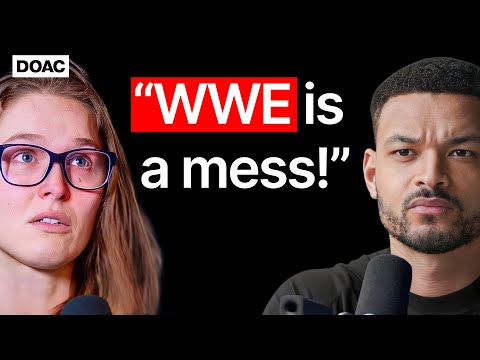
Ronda Rousey: I Kept This A Secret My Entire Career! WWE Is A Mess!
Ronda Rousey (guest), Steven Bartlett (host)
In this episode of The Diary of a CEO, featuring Ronda Rousey and Steven Bartlett, Ronda Rousey: I Kept This A Secret My Entire Career! WWE Is A Mess! explores ronda Rousey Reveals Hidden Injuries, Toxic Coaching, And True Peace Ronda Rousey traces her journey from a neurologically damaged, speech-delayed child to Olympic medalist, UFC megastar, and WWE headliner, revealing the unseen costs behind her success. She details childhood trauma, abusive coaching, chronic concussions she hid her entire career, eating disorders, and the emotional collapse after her first UFC loss. Rousey also exposes what she calls a “fundamentally sick” culture in elite combat sports and WWE, where athletes are treated as expendable contractors. Now semi-retired on a ranch with her husband and children, she has redefined success around family, writing, and restoring land rather than external validation and titles.
Ronda Rousey Reveals Hidden Injuries, Toxic Coaching, And True Peace
Ronda Rousey traces her journey from a neurologically damaged, speech-delayed child to Olympic medalist, UFC megastar, and WWE headliner, revealing the unseen costs behind her success. She details childhood trauma, abusive coaching, chronic concussions she hid her entire career, eating disorders, and the emotional collapse after her first UFC loss. Rousey also exposes what she calls a “fundamentally sick” culture in elite combat sports and WWE, where athletes are treated as expendable contractors. Now semi-retired on a ranch with her husband and children, she has redefined success around family, writing, and restoring land rather than external validation and titles.
Key Takeaways
Hidden neurological damage shaped her entire fighting style and career choices.
Rousey was born with the umbilical cord around her neck, resulting in apraxia and years of speech therapy. ...
Get the full analysis with uListen AI
Abusive coaching and power imbalances are normalized in elite sports—and systemically dangerous.
From judo through MMA, she describes a Bela-Karolyi-style culture where verbal and physical abuse are seen as tools of performance: a coach dislocated her jaw as a child, another grabbed her by the throat to make a point, and later coaches exerted invasive emotional control. ...
Get the full analysis with uListen AI
Chasing external validation and ‘mountain tops’ is emotionally unsustainable, even if it breeds greatness.
Rousey admits a deep drive for proof and respect—rooted in childhood loss and being the youngest sibling—pushed her to Olympic and UFC glory. ...
Get the full analysis with uListen AI
Her public downfall after Holly Holm was compounded by unspoken brain injury and social media cruelty.
Rousey reveals she fell down the stairs and knocked herself out a week before UFC 193, then entered the fight already compromised with a poor mouthguard. ...
Get the full analysis with uListen AI
WWE’s creative chaos and contractor model create needless risk and a sense of expendability.
She describes WWE as “a clusterfuck of a shit show,” where scripts are rewritten last-minute, stunts are often performed unrehearsed, and injuries occur because performers are thrown into dangerous spots with minimal preparation. ...
Get the full analysis with uListen AI
Personal relationships—especially her husband’s support—were crucial in preventing generational suicide patterns.
With both her father and grandfather having died by suicide, thoughts of ending her life surfaced almost immediately backstage after the Holm loss. ...
Get the full analysis with uListen AI
Fertility struggles, miscarriages, and IVF exposed a new layer of vulnerability and identity questions.
After two miscarriages—one shortly after a finger amputation on a TV set—Rousey went through four IVF cycles to create embryos, later giving birth to a daughter via the first transfer. ...
Get the full analysis with uListen AI
Notable Quotes
“I had to keep it a secret from everybody… I just thought that I could keep it going forever.”
— Ronda Rousey
“I literally fought until I couldn’t fight anymore… I just neurologically wasn’t capable of continuing to fight at that level.”
— Ronda Rousey
“I wanted to be so great that even an idiot couldn’t deny it… then I realized only people who are truly great can recognize greatness.”
— Ronda Rousey
“You would think it wouldn’t be an absolute clusterfuck of a shit show, and you would be wrong.”
— Ronda Rousey (on WWE)
“My happiness is every day with my family… there’s no amount of accomplishments you can add to your trophy shelf that will make you happy forever.”
— Ronda Rousey
Questions Answered in This Episode
You describe engineering a style built around instant finishes to protect your brain; if athletic commissions had fully understood your concussion history, how do you think your career—and the women’s division—would have unfolded differently?
Ronda Rousey traces her journey from a neurologically damaged, speech-delayed child to Olympic medalist, UFC megastar, and WWE headliner, revealing the unseen costs behind her success. ...
Get the full analysis with uListen AI
Looking back at specific incidents like having your jaw dislocated or being grabbed by the throat, what practical safeguards or oversight mechanisms would you want national teams and gyms to adopt to prevent similar coaching abuse today?
Get the full analysis with uListen AI
You assert that Vince McMahon still effectively runs WWE through loyal lieutenants—if Ari Emanuel invited you to design a reform plan, what concrete structural and cultural changes would you insist on before recommending anyone you care about sign there?
Get the full analysis with uListen AI
In moments when your self-destructive rumination flares up now, what exact tools or routines—mental, physical, or creative—have proven most effective at interrupting the spiral, and how could a young fighter realistically apply them in the middle of a career peak?
Get the full analysis with uListen AI
Given your experience with miscarriages and IVF, and the pressure on women to choose between peak athletic/career years and fertility, what system-level changes (in sports contracts, healthcare, or public policy) would make it genuinely feasible for female athletes to pursue both without such a heavy personal cost?
Get the full analysis with uListen AI
Transcript Preview
People don't know about this. (camera clicking) I had to keep it a secret. (instrumental music plays) Uh, it's really, really difficult. Presenting Rowdy Ronda Rousey.
Ronda, you were voted the best female athlete of all time. What was it that made you the person that sits in front of me today?
So, when I was a kid, it was tough. My dad, he ended up taking his life when I was eight. And in school, I got picked on a lot. I actually dropped out when I was 16 and moved away from home to train full time. But a lot of the coaches thought that being abusive to the athletes is what gave them the best results. My first coach dislocated my jaw. People don't know about this, but I would get concussions all the time, and every time you get a concussion, it's easier to get another one. So, by the time I got into MMA, I had to be able to finish the person off immediately. It was those experiences that made me the world champion at...
And you stacked up a bunch of records, including the fastest ever win-
Oh no! What a kick! Oh! ... fastest submission, fastest title defense- She's home!
But then that loss to Holly Holm.
And just like that! Yeah. My whole world turned upside down and I had to disappear for a while.
And, um, you decided to move on to the WWE. (camera clicking) You don't have nice things to say about it.
Vince McMahon just created a fundamentally sick environment, and I think he still is running the company to this day.
Why? Before this episode starts, I have a small favor to ask from you. Two months ago, 74% of people that watch this channel didn't subscribe. We're now down to 69%. My goal is 50%. So if you've ever liked any of the videos we've posted, if you like this channel, can you do me a quick favor and hit the subscribe button? It helps this channel more than you know. And the bigger the channel gets, as you've seen, the bigger the guests get. Thank you, and enjoy this episode. (instrumental music plays) Ronda, when I interview people, I often ask them to tell me the most sort of pertinent first event in their story that went on to shape who they are. And with you, from reading through your story, it's quite clear that the first potentially significant event happened as you were being born.
Yeah, I, uh, I was born with the, um, umbilical cord around my neck, and, uh, I was, like, a zero on the Apgar scale, which is like the health of a baby when they're born. I was blue, they thought I was dead. Um, had to... It took a while to revive me. And, um, I had, uh, some damage from that, um, some neurological damage which expressed itself as a motor speech disorder called apraxia, which is basically, I would have words formed in my head and try to say it, but there was a kinda disconnect between my brain and my mouth, and it would come out differently than how I said it. So, um, I ended up having to do many years of speech therapy to be able to get over it. And sometimes I, uh, I struggle a little bit, but, uh, um, I've, I've, you know, dealt with it well enough where people don't notice. But, uh, you know, doing things like pro wrestling promos and stuff, where everybody, like, will, uh, scrutinize you for, like, saying a single syllable or pre-, you know, p- p- not producing every single... not pronouncing every single word per- perfectly. Like if I just stuttered like I did just now or mispronounced something like I did just now in a wrestling promo, I would be, like, hung over it. And so, um, you know, there's little things like that that still express themselves to this day, but mostly it's not noticeable now.
Install uListen to search the full transcript and get AI-powered insights
Get Full TranscriptGet more from every podcast
AI summaries, searchable transcripts, and fact-checking. Free forever.
Add to Chrome