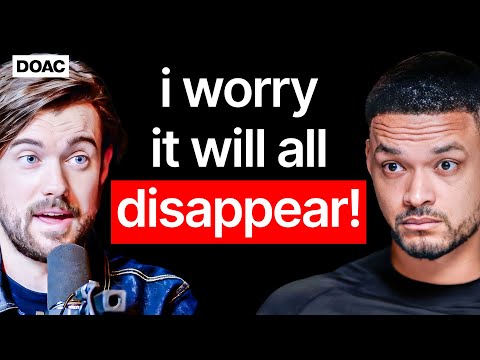
Jack Whitehall's Emotional Confession About His Dad, His Biggest Fear & His New Life!
Jack Whitehall (guest), Steven Bartlett (host), Narrator, Narrator
In this episode of The Diary of a CEO, featuring Jack Whitehall and Steven Bartlett, Jack Whitehall's Emotional Confession About His Dad, His Biggest Fear & His New Life! explores jack Whitehall Confronts Fear, Fatherhood, Fame And Finding Real Balance Jack Whitehall discusses how comedy became his way to connect with people, shaped by a childhood quest for his father's approval and early struggles with confidence and rejection.
Jack Whitehall Confronts Fear, Fatherhood, Fame And Finding Real Balance
Jack Whitehall discusses how comedy became his way to connect with people, shaped by a childhood quest for his father's approval and early struggles with confidence and rejection.
He reflects on being thrust into TV too young, developing his comedic voice, and the professional anxieties and imposter syndrome that persist despite his success.
A major thread is his unhealthy work-life balance and his hope that impending fatherhood will finally force a reprioritization toward presence, family, and what really matters.
In an emotional climax, Jack admits his deepest motivation for having a child now is to ensure his aging father can bond with his grandchild and witness more of Jack’s life and career milestones.
Key Takeaways
Comedy can be a powerful tool for connection rather than merely a mask for pain.
Jack rejects the simple 'sad clown' stereotype in his own case and frames humor as his lifelong way of connecting with others and offering escapism. ...
Get the full analysis with uListen AI
Early lack of approval and repeated rejection can fuel both drive and deep insecurity.
Growing up, Jack craved his father’s approval but 'definitely' didn’t get it, and he repeatedly failed to get school play roles and early acting jobs. ...
Get the full analysis with uListen AI
Finding an authentic voice is a long, sometimes embarrassing, process for performers.
Jack describes starting stand-up as a teenager, copying others, and even performing in a 'mockney' accent because he was scared audiences would reject his real, posh self. ...
Get the full analysis with uListen AI
Success amplifies anxiety and pressure, often making the work feel more fragile, not safer.
Early in his career, bombing in pubs hurt but carried little pressure; now a bad arena show, a misstep at the BRITs, or a bad review can spiral him for days. ...
Get the full analysis with uListen AI
Overwork and digital noise erode presence, especially in close relationships.
Jack openly admits to terrible work–life balance, filling every calendar gap with more projects and finding holidays uncomfortable. ...
Get the full analysis with uListen AI
Imminent fatherhood is forcing a re-evaluation of priorities and identity.
With his partner pregnant, Jack oscillates between excitement and overwhelm, aware that something in his life must give. ...
Get the full analysis with uListen AI
His relationship with his father remains a central emotional driver and measure of success.
Jack still measures himself against his dad’s reaction, cherishing praise and feeling stung by honest criticism. ...
Get the full analysis with uListen AI
Notable Quotes
“Growing up wanting my dad's approval and definitely not receiving it, it dented my confidence, but it also made me like I would one day make him proud.”
— Jack Whitehall
“So many times I'm just like, 'Why don't I just delete all social media from my phone?' That would be such a good thing for my mental wellbeing.”
— Jack Whitehall
“My problem was when I was trying to find my voice, I didn't even know who I was as a person back then.”
— Jack Whitehall
“What I'm struggling with most in my life is my work–life balance. I think I'm terrible at work–life balance and I always have been.”
— Jack Whitehall
“I wanted to have a baby because I wanted him to be around to know my child and to spend time with my kid. He's the most loving person ever.”
— Jack Whitehall
Questions Answered in This Episode
You’ve said you still haven’t deleted social media despite knowing it harms your mental wellbeing—what specific boundary or experiment would you realistically try for six months to test how life and creativity change without it?
Jack Whitehall discusses how comedy became his way to connect with people, shaped by a childhood quest for his father's approval and early struggles with confidence and rejection.
Get the full analysis with uListen AI
Looking back at being pushed so quickly onto TV before you’d found your voice, is there anything concrete you’d change about how new comics are discovered and developed today?
He reflects on being thrust into TV too young, developing his comedic voice, and the professional anxieties and imposter syndrome that persist despite his success.
Get the full analysis with uListen AI
You clearly admire how your dad wound down his career to be present as a father—have you discussed with him, in detail, what sacrifices he actually made and whether he’d advise you to do the same or choose differently?
A major thread is his unhealthy work-life balance and his hope that impending fatherhood will finally force a reprioritization toward presence, family, and what really matters.
Get the full analysis with uListen AI
You admit you’re great at 'selling' jokes even when the writing isn’t perfect—have you ever worried that your performance skills might be masking deeper creative risks you should be taking with the material itself?
In an emotional climax, Jack admits his deepest motivation for having a child now is to ensure his aging father can bond with his grandchild and witness more of Jack’s life and career milestones.
Get the full analysis with uListen AI
If your future child rejected the conventional path and wanted to pursue a highly unstable creative career, what, if anything, would you do differently from how your parents tried to steer you away from the arts?
Get the full analysis with uListen AI
Transcript Preview
He, he's the most loving person ever. I want him to have a relationship with my kid. I mean, that's why ... Oh, God I ... I said I wasn't gonna do this on this and (laughs) I'm, we- I'm we- I'm now getting emotional. Um. Jack Whitehall, ladies and gentlemen. (upbeat music)
Actor, writer, and award-winning comedian. You are in for a treat.
Oh God, that's tequila.
What is the reason why you're a comedian?
I use humor to connect with people and have always done so. Growing up wanting my dad's approval and definitely not receiving it, it dented my confidence, but it also made me like I would one day make him proud.
If people really knew you, what would they be most surprised about?
I do feel the pressure and I do feel the anxiety of it all. Worrying about stuff that is not worth worrying about, a bad review, rejection, online trolls. So many times I'm just like, "Why don't I just delete all social media from my phone?" That would be such a good thing for my mental wellbeing. I have a little bit more sensitivity than vulnerable than I tell people.
Do you doubt yourself?
Yes.
What impact does that have on you?
Overworking, not prioritizing family, and I'm not present when I should be present.
Roxy's pregnant now. How are you honestly feeling about it?
Now I'm regretting putting this on camera.
What you are doing is incredibly high-stakes art. Why are you smirking? (laughs)
Oh, Steven, I've got a punchline about ... of a tramp behind a wheelie bin. I mean, that's not hard. (laughs)
(laughs) Before this episode starts, I have a small favor to ask from you. Two months ago, 74% of people that watch this channel didn't subscribe. We're now down to 69%. My goal is 50%. So if you've ever liked any of the videos we've posted, if you like this channel, can you do me a quick favor and hit the subscribe button? It helps this channel more than you know, and the bigger the channel gets, as you've seen, the bigger the guests get. Thank you and enjoy this episode. Jack, I've sat here with so many incredible comedians, and it's funny because there's an ongoing stereotype with comedians that they get into comedy for a variety of different reasons. A lot of comedians have said to me, you know, comedians themselves are depressed in some way.
Mm-hmm.
Then I had Jimmy Carr say, say to me, "When you meet a comedian, you should ask him which of their parents are depressed." Um, and then I sat here with, um, one particular comedian who r- really didn't fit into any of those, um, stereotypes at all. What is the reason why you're a comedian, in your own words?
I think in the most reductive way, it's because I use humor to connect with people and have always done so. And so, I think I've always enjoyed, uh, making people laugh. And that's felt to me like a great way to connect with people, whether that be in real life or my audience when I'm up on stage. And I think there are, you know, lots of different reasons that people become comedians, and there is this kind of the sad clown trope, and that's definitely one that does exist. And I think there are people that use comedy for other reasons. But for me, uh, I don't think I fall into that category necessarily. I think I have always loved comedy and stand-up as an art form, because I just really enjoy making people happy and making people laugh and using comedy as escapism.
Install uListen to search the full transcript and get AI-powered insights
Get Full TranscriptGet more from every podcast
AI summaries, searchable transcripts, and fact-checking. Free forever.
Add to Chrome