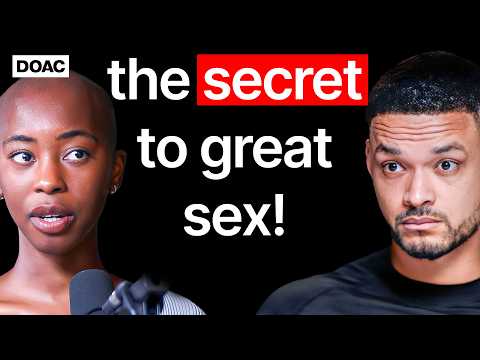
Victimhood & Self-sabotage Is Destroying The World In 2022: Africa Brooke | E160
Africa Brooke (guest), Steven Bartlett (host), Narrator
In this episode of The Diary of a CEO, featuring Africa Brooke and Steven Bartlett, Victimhood & Self-sabotage Is Destroying The World In 2022: Africa Brooke | E160 explores africa Brooke Challenges Victimhood, Redefines Healing, Sex, and Self-Responsibility Africa Brooke shares her journey from blackout drinking, compulsive lying, and self-sabotage to sobriety, self-awareness, and personal responsibility. Drawing on childhood trauma, cultural context from Zimbabwe, and her father’s alcoholism, she explains how destructive behaviors often masquerade as self-protection. She criticizes modern victimhood culture, binary politics, and the self-help industry’s promise of complete healing, arguing instead for nuance, emotional resilience, and identity shifts. The conversation also explores sexual shame, porn-influenced sex, tantric practice, and how communication and vulnerability transform intimacy and relationships.
Africa Brooke Challenges Victimhood, Redefines Healing, Sex, and Self-Responsibility
Africa Brooke shares her journey from blackout drinking, compulsive lying, and self-sabotage to sobriety, self-awareness, and personal responsibility. Drawing on childhood trauma, cultural context from Zimbabwe, and her father’s alcoholism, she explains how destructive behaviors often masquerade as self-protection. She criticizes modern victimhood culture, binary politics, and the self-help industry’s promise of complete healing, arguing instead for nuance, emotional resilience, and identity shifts. The conversation also explores sexual shame, porn-influenced sex, tantric practice, and how communication and vulnerability transform intimacy and relationships.
Key Takeaways
Self-sabotage is often a form of unconscious self-protection, not self-hatred.
Africa reframes self-sabotage (addiction, toxic relationships, procrastination) as an attempt to protect familiar identities like “I’m unlovable” or “I’m inadequate. ...
Get the full analysis with uListen AI
Breaking destructive cycles requires tolerating discomfort and identity limbo.
When Africa had stretches of sobriety, the lack of chaos felt unfamiliar and uncomfortable, pulling her back toward drinking. ...
Get the full analysis with uListen AI
Personal responsibility is a non-negotiable ingredient of real change.
Africa describes her final, lasting sobriety as beginning when she stopped externalizing blame (father, culture, racism, system) and asked, “What part did I have to play in this—and what now? ...
Get the full analysis with uListen AI
There is a vital difference between being a victim and adopting victimhood as identity.
Africa insists that genuine victimization is real and must be acknowledged, but warns against turning ‘victim’ into a permanent identity or brand. ...
Get the full analysis with uListen AI
Healing is not a destination and shouldn’t become your whole identity.
Africa criticizes the self-help industry for selling ‘healing’ as a final, cured state if you buy the right course, book, or practice. ...
Get the full analysis with uListen AI
Porn has quietly scripted most people’s sex lives—and it often kills real desire.
She and Steven both realized they’d learned sex from porn: focusing on performance, positions that suit the ‘camera,’ and orgasm as the main goal. ...
Get the full analysis with uListen AI
Nuance, honest dialogue, and identity-detached thinking are antidotes to culture wars.
Africa refuses to fully identify as left or right, describing herself as left-leaning but context-first and issue-specific. ...
Get the full analysis with uListen AI
Notable Quotes
“There is a very real difference between being a victim and making victimhood an identity.”
— Africa Brooke
“I ended up replicating pretty much the same drinking behavior that my dad had… from the age of 14 up until 24 I was a blackout drinker.”
— Africa Brooke
“The cost was that I never got to know myself… I got to know the version of me that I thought people wanted.”
— Africa Brooke
“I’m not oppressed. I don’t see my race as a burden… It’s actually my responsibility to claim my power as an individual who inhabits a Black body.”
— Africa Brooke
“Healing is being sold as a destination—sign up for this course, get this book, and then it’s done. That’s not real. Some of these things won’t go away completely, and that’s normal.”
— Africa Brooke
Questions Answered in This Episode
You described self-sabotage as often being self-protection: can you walk through, step by step, how someone might practically uncover the ‘reward’ they’re getting from a destructive behavior and then design an alternative that still meets that need?
Africa Brooke shares her journey from blackout drinking, compulsive lying, and self-sabotage to sobriety, self-awareness, and personal responsibility. ...
Get the full analysis with uListen AI
When you publicly stated, as a Black woman, that you’re ‘not oppressed,’ what were the most compelling criticisms you received from other Black people—and did any of them shift or refine your stance in any way?
Get the full analysis with uListen AI
You mentioned fear of success as a major block, especially around your dream festival; what concrete experiments or boundaries would you put in place to ensure success doesn’t replicate the chaos and instability of your drinking years?
Get the full analysis with uListen AI
In your work around sexual shame and tantric sex, what patterns do you most commonly see in heterosexual couples where she has ‘lost interest’ in sex, and what would a 30-day communication and practice plan for them realistically look like?
Get the full analysis with uListen AI
You’re critical of people making ‘healing’ their identity, yet you’re a coach and speaker in the self-help space—what guardrails do you use in your own business and branding to avoid incentivizing perpetual brokenness in your audience?
Get the full analysis with uListen AI
Transcript Preview
If I'm not drinking or snorting something, what the fuck do I actually enjoy doing? (instrumental music plays) You know, who am I?
Africa Brooke is a speaker, a podcast host, and she's helped hundreds of thousands of people see the world in a new light.
Thank you.
Legend.
Africa does not give a fuck, and that's why I love her.
If you're on the left, then you're the good person. If you're on the right, then you're the bad person. We're hanging out online where these platforms incentivize binary thinking; are you with us or are you against us? (instrumental music plays) There's only so much you can take. Most people didn't like when I said, that as a Black person I'm not oppressed, that there is a very real difference between being a victim and making victimhood an identity. Because if you don't think that you're worthy, that's always going to be the belief that you feed every single time.
What became your dark side?
(instrumental music plays) From the age of 14, I was a blackout drinker. That's when I started to see that I was behaving in the exact same way that my dad did. (sniffs)
Sex and sexuality.
Mm-hmm.
Can you talk to me about what you've learned about those topics that might benefit me?
Well...
Without further ado, I'm Steven Bartlett, and this is The Diary of a CEO. I hope nobody's listening, but if you are, then please keep this to yourself. (instrumental music plays) Africa.
Yes.
Let's... Uh, I mean if you've seen this podcast before, it's no surprise-
(laughs)
... where I'm going to start. But, um, I was reading about your story. I was reading about, um, where you grew up-
Yes.
... and where you were originally born. Give me your earliest, most relevant context. Give me the context of, um, where you came from and, and how that context-
Mm-hmm.
... shaped the person that sits here with me today.
Oh, that's good. So I'm Zimbabwean.
Mm-hmm.
I'm from Zimbabwe, and I think, uh, this accent always fools people into thinking (laughs) that I was born and raised here. But I was born in Zimbabwe, which is in the south of Africa. And I came to the UK when I was nine years old, so I remember my life back home in Zimbabwe quite clearly and vividly, actually. I don't remember it being hard apart from my experiences with my father. Even though he could be the most charming man, and he was such a beautiful man. He was the kinda person that walks into a room and you can feel that Maxwell has arrived. Just a very beautiful spirit. But when he was drunk, he could be very different, completely different. So I think the times that I can remember experiencing most of my sadness or frustration as a child was experiencing that side of my father, because he could be very abusive, and he was physically abusive to my mum and to myself and my siblings. But I don't even look at those things and think that I had a horrible childhood in Zimbabwe. I have so many wonderful, wonderful memories of being home, and I still call it home, you know. When people ask me where I'm from, I always say Zimbabwe before I say the UK or that I'm British. Um, yeah.
Install uListen to search the full transcript and get AI-powered insights
Get Full TranscriptGet more from every podcast
AI summaries, searchable transcripts, and fact-checking. Free forever.
Add to Chrome