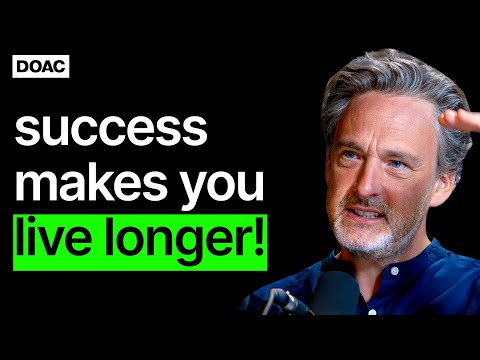
The More Successful You Are The Longer You'll Live! Will Storr
Will Storr (guest), Steven Bartlett (host), Narrator
In this episode of The Diary of a CEO, featuring Will Storr and Steven Bartlett, The More Successful You Are The Longer You'll Live! Will Storr explores status, Genes, And Self-Deception: Why Success Shapes How Long You Live Will Storr discusses how much of our personality and behavior is shaped by genes, early environment, and the invisible pursuit of status, challenging the self-help myth that we can be anything we want. He explains how perfectionism, individualism, and “self-esteem culture” have pushed Western societies toward anxiety, self-criticism, and suicidal ideation. Central to the conversation is Storr’s thesis that humans are status-seeking, storytelling animals, and that our position in hierarchies measurably affects health, longevity, and mental wellbeing. He also explores practical implications for parenting, personal growth, marketing, leadership, and how to play healthier “status games.”
Status, Genes, And Self-Deception: Why Success Shapes How Long You Live
Will Storr discusses how much of our personality and behavior is shaped by genes, early environment, and the invisible pursuit of status, challenging the self-help myth that we can be anything we want. He explains how perfectionism, individualism, and “self-esteem culture” have pushed Western societies toward anxiety, self-criticism, and suicidal ideation. Central to the conversation is Storr’s thesis that humans are status-seeking, storytelling animals, and that our position in hierarchies measurably affects health, longevity, and mental wellbeing. He also explores practical implications for parenting, personal growth, marketing, leadership, and how to play healthier “status games.”
Key Takeaways
Prioritize self-acceptance over self-love and the “you can be anything” myth.
Storr argues that telling children (or ourselves) we can be Beyoncé is both statistically false and psychologically harmful. ...
Get the full analysis with uListen AI
Change your environment rather than relying on sheer willpower.
Using the “lizard and iceberg” analogy, Storr emphasizes that behavior is heavily shaped by context; a lizard is miserable on an iceberg but thrives in the desert without changing its nature. ...
Get the full analysis with uListen AI
Understand that genes and personality create vulnerabilities, not destinies.
Most self-help ignores genetics, but Storr stresses that traits like neuroticism, addiction-proneness, and competitiveness are substantially heritable. ...
Get the full analysis with uListen AI
Use storytelling and ‘light figure’ positioning to persuade in business.
Humans think in story—not in stats—so effective marketing and leadership communication frames the audience as the hero and the company or leader as the “light figure” who helps them get what they want. ...
Get the full analysis with uListen AI
Recognize that status strongly affects health and longevity.
Citing Michael Marmot’s Whitehall Studies and social genomics research, Storr notes that people lower in workplace hierarchies have significantly higher mortality risk—even when lifestyle factors like smoking are equal. ...
Get the full analysis with uListen AI
Play better status games: favor success and virtue games over dominance.
Storr identifies three broad types of status games: dominance (aggression and coercion), success (competence and achievement), and virtue (morality and rule-following). ...
Get the full analysis with uListen AI
Use rivalry, not internal competition, to motivate teams and yourself.
Inside organizations, all-against-all competition (e. ...
Get the full analysis with uListen AI
Notable Quotes
“You shouldn’t raise your children to believe that they can be Beyoncé, because the chances are they can’t.”
— Will Storr
“That myth of you have full control over yourself as a human being, that’s the problem.”
— Will Storr
“The more status that you earn, the better everything else gets. That was true 10,000 years ago, it’s true today.”
— Will Storr
“If you take two smokers, the one higher up is less likely to die of a smoking-related disease than the one lower down.”
— Will Storr
“The only way out is art.”
— Will Storr
Questions Answered in This Episode
You argue that early damage to self-esteem can never be fully undone, only weakened. What kinds of interventions or life events have you seen most effectively reduce the power of those early scripts in your own life or in your research?
Will Storr discusses how much of our personality and behavior is shaped by genes, early environment, and the invisible pursuit of status, challenging the self-help myth that we can be anything we want. ...
Get the full analysis with uListen AI
If you were designing a school system from scratch that took genes, personality, and realistic limits seriously, how would you change the messages we give children compared to the self-esteem era you criticize?
Get the full analysis with uListen AI
You draw a clear line between healthy virtue games and destructive virtue-dominance games like cancel culture or totalitarian movements. Where do you think current social-justice activism sits on that spectrum, and what practical signs show it tipping into toxicity?
Get the full analysis with uListen AI
For someone running a small business who can’t afford big salaries, what are three concrete ways they can ‘spend’ status—through titles, rituals, or recognition—to dramatically improve morale and retention without extra cash?
Get the full analysis with uListen AI
Given the strong links between status loss, loneliness, and male suicide, what would a truly male-friendly mental health initiative look like in practice—beyond the usual advice to "open up"—and how might status games be used constructively within it?
Get the full analysis with uListen AI
Transcript Preview
You shouldn't raise your children to believe that they can be Beyoncé, because the chances are they can't. (bell ringing)
Will Storr is an award-winning author of six critically acclaimed books. His ideas are disruptive, challenging, and life-changing. And some of them will make you feel incredibly uncomfortable.
People don't like to talk about this stuff. The 99% of self-help books never mention genes. They, they want to promote the idea of, "Well, I can be whoever I want to be," but a huge amount of who we are is who we were born as. That myth of you have full control over yourself as a human being, that's the problem. It's not about embracing your flaws, it's about accepting your flaws. Our lives are full of status pursuit. The more status that you earn, the better everything else gets. But that was true 10,000 years ago, it's true today. The brain is highly attuned to where we sit in a pecking order. The lower we are down in that pecking order, the more unhealthy we became. If you take two smokers, the one higher up is less likely to die of a smoking-related disease than the one lower down.
That's mental.
It matters massively.
How do we advance in the status game?
There are kind of three general types of status games that we can play. First game is a-
Without further ado, I'm Steven Bartlett, and this is The Diary of a CEO. I hope nobody's listening, but if you are, then please keep this to yourself. (laid-back music) Will, first of all, thank you for being here. Um, take me right back then to your early years, 'cause I think wh- when I was reading through your different books here, throughout them you have glimpses of your own perspective, and it-
Mm-hmm.
... hints back to what I read about your, your early years.
Mm-hmm.
Um, so take me back, right back to the start, you know, before the age of, let's say, 12.
Mm-hmm. Okay, so, yeah, um, I was brought up in Tunbridge Wells in Kent, um, middle class family, very Catholic. Um, it was quite a Victorian, um, strict, superstitious religious upbringing. Not the happiest upbringing, I have to say.
Why?
Um, because my parents were very strict, my father was very strict especially, um, and, uh, they were very much in the grip of their ex- kind of, Catholic belief system, which I just didn't never, like, always baffled me even as a kid, just like, "What? How, how," you know? How can you believe this stuff? And I went to a Catholic school, so, s- so... A- and I was quite a, I don't know, I was probably a diff- if you were to ask them, they'd say I was a difficult child, um, because I was pushing against that all the time, you know? I thought it was crazy, I wasn't very good at authority and rules, so it was a bad fit, I would say. Um, and I think that's what's, you know, one of the things that, that's kind of driven my interests into adulthood. My, y- you know, my, my, my second book, The Heretics, was looking at why do otherwise smart people believe, end up believing these crazy things? 'Cause my parents are smart people, but, um, yeah, you know, they believe in heaven, hell, Satan, all of that stuff. I, I think that's how my childhood has informed my interests as an adult, trying to figure out how, how that happens.
Install uListen to search the full transcript and get AI-powered insights
Get Full TranscriptGet more from every podcast
AI summaries, searchable transcripts, and fact-checking. Free forever.
Add to Chrome