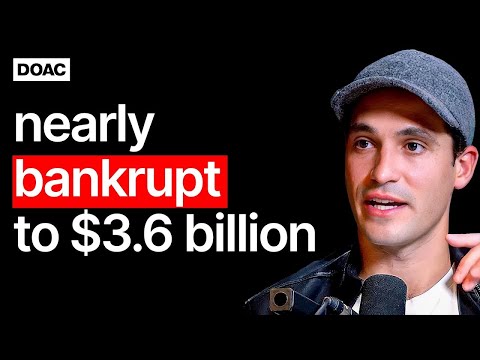
Whoop Founder: How I Built A $3.6 BILLION Company & BEAT Apple! Will Ahmed | E189
Will Ahmed (guest), Steven Bartlett (host)
In this episode of The Diary of a CEO, featuring Will Ahmed and Steven Bartlett, Whoop Founder: How I Built A $3.6 BILLION Company & BEAT Apple! Will Ahmed | E189 explores how Whoop Beat Giants: Focus, Recovery, And Relentless Founder Resilience Will Ahmed, founder and CEO of $3.6B health-tech company Whoop, explains how an obsessive curiosity about human performance led him from Harvard athlete to building what he argues is the most accurate health wearable on the market.
How Whoop Beat Giants: Focus, Recovery, And Relentless Founder Resilience
Will Ahmed, founder and CEO of $3.6B health-tech company Whoop, explains how an obsessive curiosity about human performance led him from Harvard athlete to building what he argues is the most accurate health wearable on the market.
He unpacks the science behind heart rate variability, sleep quality, and strain, and how continuous health monitoring can change behavior, prevent overtraining, and even flag illness like COVID before symptoms appear.
Ahmed also goes deep on founder psychology: panic attacks, chronic runway crises, separating personal identity from company performance, and how transcendental meditation, breathwork, and routines helped him build emotional resilience.
Throughout, he shows how ruthless focus, counterintuitive product decisions (no screen, no watch face, subscription model), and a first-principles approach allowed Whoop to thrive against competitors like Apple, Nike, Amazon, and others.
Key Takeaways
Use heart rate variability and recovery to intelligently modulate training load.
Ahmed explains that overtraining occurs when continued overreaching pushes the body into a depressed, run-down state that can last weeks or months. ...
Get the full analysis with uListen AI
Prioritize sleep quality, not just hours in bed.
Seven hours in bed is not seven hours of restorative sleep. ...
Get the full analysis with uListen AI
Develop deliberate tools to manage founder stress and decouple your identity from the company.
Ahmed describes tying his self-worth to Whoop’s daily performance: if Whoop had a bad day, he was having a bad day. ...
Get the full analysis with uListen AI
Ruthless focus and first-principles thinking can beat better-funded incumbents.
Whoop deliberately chose not to be a smartwatch—no time display, no apps, no calls—to avoid scope creep and to optimize 24/7 health monitoring accuracy and wearability. ...
Get the full analysis with uListen AI
Use customer problems as input, not their proposed solutions.
When Ahmed interviewed coaches and athletes, they asked for more exercise tech—GPS, video, stress analysis—yet their real pain points were injuries, availability, and being under- or over-prepared on key days. ...
Get the full analysis with uListen AI
Culture and incentives can hardwire health and data into how a company operates.
At Whoop, employees can opt into a “sleep bonus”: averaging 85% sleep performance over a month earns a $100 bonus. ...
Get the full analysis with uListen AI
Extreme runway pressure can be survivable—and transformative—if you learn to cope.
For 18 months, Whoop never had more than three months of cash runway and at one point was two days away from bankruptcy, pending a term sheet. ...
Get the full analysis with uListen AI
Notable Quotes
“Feelings are overrated. There are things happening in your body that you can't feel.”
— Will Ahmed
“The faster that I could separate those two identities, my own and Whoop, the easier it actually became to build a successful company.”
— Will Ahmed
“I think startups really only fail if the founders quit or you run out of money.”
— Will Ahmed
“True innovation often comes from a level of focus or discipline that's really uncomfortable.”
— Will Ahmed
“You can be very appreciative of where you are today and still entirely driven to get to the next milestone in your mind.”
— Will Ahmed
Questions Answered in This Episode
You’ve argued that steps are physiologically overrated compared to metrics like HRV and respiratory rate; what other popular fitness metrics do you think are misleading people about their actual health?
Will Ahmed, founder and CEO of $3. ...
Get the full analysis with uListen AI
When you were 48 hours from bankruptcy and drafting goodbye emails, what specific conversations or decisions in that 48-hour window most changed the trajectory of Whoop?
He unpacks the science behind heart rate variability, sleep quality, and strain, and how continuous health monitoring can change behavior, prevent overtraining, and even flag illness like COVID before symptoms appear.
Get the full analysis with uListen AI
You’ve stayed disciplined about not adding a screen or watch face; is there any feature users constantly request that you still refuse to build, and why are you so sure they’re wrong in the long term?
Ahmed also goes deep on founder psychology: panic attacks, chronic runway crises, separating personal identity from company performance, and how transcendental meditation, breathwork, and routines helped him build emotional resilience.
Get the full analysis with uListen AI
If you fully personalized Whoop around goals—fat loss, longevity, elite sport—how would the day-to-day experience differ for each user, and are there trade-offs between optimizing for performance vs. optimizing for lifespan?
Throughout, he shows how ruthless focus, counterintuitive product decisions (no screen, no watch face, subscription model), and a first-principles approach allowed Whoop to thrive against competitors like Apple, Nike, Amazon, and others.
Get the full analysis with uListen AI
Looking back at Amazon’s attempt to clone your product, what are the subtle design or data decisions they got most wrong that only become obvious when you live inside this problem for a decade?
Get the full analysis with uListen AI
Transcript Preview
So, two of our first 100 users were Lebron James and Michael Phelps. (dramatic music)
Fucking hell.
A $3.6 billion company... Wearable Health & Fitness Coach.
The founder of Whoop.
Will Ahmed. You know, Nike and Apple and a dozen other companies were entering the space, but, uh, when it comes to health monitoring, we're the best game in town. That really came from an insane level of focus in the beginning on what we were trying to solve. One of the reasons Whoop has been successful is there were a lot of counterintuitive decisions along that journey. One obvious one is that-
Interesting. I shall steal that.
It's worth emphasizing for your audience why that matters. So, there was a phase in building Whoop where it was so much about the next milestone that I was running almost exclusively on, like, a dopamine engine. If the company has a great day, you're feeling like a rocket ship, and if Whoop was failing, I was failing.
What's the personal toll on you in those moments that people don't see?
I was super stressed out, I was drinking too much, and I remember I was driving my car, and I'm on the highway, and all of a sudden, it's like your peripheral vision, like, starts narrowing on you, and you feel your fingers, and they're, like, numb. I actually drove myself to the hospital, and they do, um, you know, all these analysis on me, and, like, turns out I had a-
Before this episode begins, I just wanna say a huge thank you to all of our new subscribers. 74% of you that watch this channel didn't subscribe before, and we're now down to about 71%, so that helps us in a number of ways that are quite hard to explain, but simply, the bigger the channel gets, the bigger the guests get. So, if you haven't yet subscribed to The Diary of a CEO, if I could have any favors from you, if you've ever watched this show and enjoyed it, it's just to- to please hit the subscribe button. Without further ado, I'm Steven Bartlett, and this is The Diary of a CEO. I hope nobody's listening, but if you are, then please keep this to yourself. (upbeat music) Will, as you look back on your- your life and you connect the dots that led you to- to do what you've done now with Whoop and your professional life, um, what are those dots?
Well, I- I grew up on, uh, the North Shore of Long Island. Um, I was always into sports and exercise. I was a super active kid. Uh, my parents are very different. My dad's an Egyptian immigrant, uh, very street smart, charismatic, came to this country with very little, rose the ranks in finance over time. My mom, uh, very analytical, very book smart, and- and watching how they approached life, I think, was a fascinating way to grow up 'cause they had very different, uh, tool sets to solve problems. And, uh, I was always playing sports, I was always exercising, and that eventually led my way to- to Harvard, and, uh, and so I was a college athlete. I got, um, recruited to play squash at Harvard, and over the course of my time there, uh, got very fascinated by how I could better understand my body, how I could, uh, understand what it meant to train optimally, how I could prevent overtraining, which was a- a problem that I had, uh, how I could really, uh, understand the other 20 hours of the day when you weren't exercising. And so that took me down this rabbit hole of physiology research, which- which we can get into, but I read hundreds of medical papers while I was, uh, in school, and then ultimately wrote a paper myself around how to continuously measure the human body, and then over the course of my time, uh, at Harvard, built up the confidence to- to start a company, which was a fairly crazy thing, looking back on it. And for the last 10 years, I've been building this company called Whoop.
Install uListen to search the full transcript and get AI-powered insights
Get Full TranscriptGet more from every podcast
AI summaries, searchable transcripts, and fact-checking. Free forever.
Add to Chrome