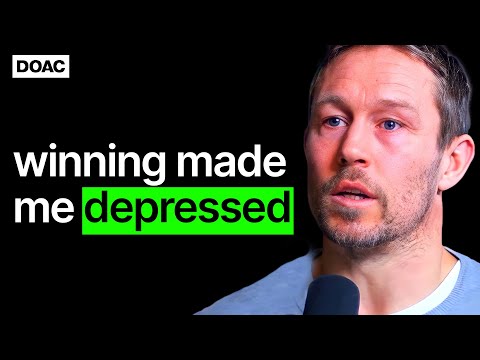
Jonny Wilkinson: Winning The World Cup Led To My Darkest Days | E131
Steven Bartlett (host), Jonny Wilkinson (guest)
In this episode of The Diary of a CEO, featuring Steven Bartlett and Jonny Wilkinson, Jonny Wilkinson: Winning The World Cup Led To My Darkest Days | E131 explores world Cup Glory, Inner Emptiness: Jonny Wilkinson Redefines Winning And Self Jonny Wilkinson unpacks how childhood fear, perfectionism, and an obsessive need to achieve drove him to World Cup glory while simultaneously eroding his mental health and sense of self.
World Cup Glory, Inner Emptiness: Jonny Wilkinson Redefines Winning And Self
Jonny Wilkinson unpacks how childhood fear, perfectionism, and an obsessive need to achieve drove him to World Cup glory while simultaneously eroding his mental health and sense of self.
He explains the difference between operating in a fear-based identity versus a present, creative “flow” state, and how chasing external validation locked him into cycles of anxiety, emptiness, and injury.
Now, his focus has shifted from being “the best ever” to becoming “all he can be,” emphasizing presence, health over fitness, inner work, and following genuine passion in small, practical ways.
Throughout, he offers a philosophical but grounded roadmap for rethinking purpose, handling success, dealing with depression and anxiety, and moving from survival mode into a more expansive, creative life.
Key Takeaways
Perfectionism and Fear Can Drive Success – But Also Deep Suffering
Wilkinson describes growing up with intense ball-sport talent alongside an “ever-present sense of doom. ...
Get the full analysis with uListen AI
Identity Built on Achievement Creates a Trap of Pressure and Humiliation
He explains how he built an identity around being the savior, warrior, and perfectionist. ...
Get the full analysis with uListen AI
Flow and Presence Eliminate Pressure – But You Can’t Force Them
At his best, especially as a teenager and in the 2003 World Cup final, Wilkinson was in a “zone” where inside intention and outside action felt almost instantaneous. ...
Get the full analysis with uListen AI
Winning the World Cup Intensified, Not Solved, His Inner Emptiness
The 2003 World Cup, which he’d treated as the ultimate life goal, delivered a sharp lesson: the promised permanent joy didn’t arrive. ...
Get the full analysis with uListen AI
Real Change Comes From Letting Go, Not Adding More
Wilkinson frames growth as an ongoing process of shedding what you’re holding onto—old ideas, defensive identities, and control—rather than acquiring more knowledge or techniques. ...
Get the full analysis with uListen AI
Shift from ‘Best Ever’ to ‘All I Can Be’ to Unlock Creativity
He outlines three stages of ambition: wanting to be the best ever (zero-sum, comparison-based, dependent on others’ opinions), wanting to be the best he can be (still constrained by old ideas of ‘my best’), and now wanting to be all he can be (focusing on his being rather than his doing). ...
Get the full analysis with uListen AI
Follow Your Highest Excitement in Small Ways to Transform Your Path
For people trapped in careers or identities they’ve outgrown, Wilkinson recommends a very practical approach: within your current constraints, choose the highest passion or excitement available in each moment (e. ...
Get the full analysis with uListen AI
Notable Quotes
“I thought there was gonna be joy here. I was convinced. There isn't.”
— Jonny Wilkinson
“When I'm in the now, your identity's gone. There's just doing.”
— Jonny Wilkinson
“Working on someone else really doesn't work for anyone, but working on yourself tends to work for everyone.”
— Jonny Wilkinson
“I spent my life being very fit but not really that healthy.”
— Jonny Wilkinson
“I can't find a place for regret… I can't have regret and surprise.”
— Jonny Wilkinson
Questions Answered in This Episode
You described the belief that ‘more suffering equals more access to the zone.’ If you could redesign an elite training environment to encourage flow without feeding the ‘fear machine,’ what specific structures or practices would you build in?
Jonny Wilkinson unpacks how childhood fear, perfectionism, and an obsessive need to achieve drove him to World Cup glory while simultaneously eroding his mental health and sense of self.
Get the full analysis with uListen AI
When you woke up after the World Cup win and felt that profound emptiness, what was the very first small decision you made that nudged you either toward deeper darkness or toward eventual insight?
He explains the difference between operating in a fear-based identity versus a present, creative “flow” state, and how chasing external validation locked him into cycles of anxiety, emptiness, and injury.
Get the full analysis with uListen AI
You spoke about two inner voices – one clinging to identity, one calling for freedom. In a moment of intense anxiety today, what does it look like, step-by-step, for you to side with the second voice in real time?
Now, his focus has shifted from being “the best ever” to becoming “all he can be,” emphasizing presence, health over fitness, inner work, and following genuine passion in small, practical ways.
Get the full analysis with uListen AI
You recommend following ‘your highest passion and excitement’ even inside constraints. How would you apply that principle to someone who is a parent of young children, in serious debt, and stuck in a job they actively dislike but can’t yet leave?
Throughout, he offers a philosophical but grounded roadmap for rethinking purpose, handling success, dealing with depression and anxiety, and moving from survival mode into a more expansive, creative life.
Get the full analysis with uListen AI
You’ve shifted from chasing peak fitness for performance to championing ‘life fitness’ and gut health. If you could rewrite professional rugby’s physical culture from academy level up, what would you remove, what would you add, and how do you think that would change both careers and mental health outcomes?
Get the full analysis with uListen AI
Transcript Preview
Could you do me a quick favor if you're listening to this? Please hit the follow or subscribe button. It helps more than you know. And we invite subscribers in every month to watch the show in person.
I had to achieve, I had to be perfect. I guess, ultimately take on the suffering. The player of the tournament, Jonny Wilkinson! A genuine sporting legend. How much pressure has this man been under this week? For me, it was do or die on the field, so therefore, where other people kind of called it quits and threw in the towel, I didn't have the choice. Here it is for Jonny! This'll go down in history.
Was your mental health better or worse after that moment?
When I was on the field in the zone, I was operating at a level I couldn't even understand. Waking up the next morning, you know, leaves you in the cold light of day. I thought there was gonna be joy here. I was convinced. There isn't. I spent my life being very fit but not really that healthy. Health is about what fitness can come out of, and unless you look after health, it's dangerous. People say, "I wish I made more of my life. Wish I'd enjoyed every moment." But that starts with health. Working on someone else really doesn't work for anyone, but working on yourself tends to work for everyone.
So without further ado, I'm Steven Bartlett, and this is The Diary of a CEO. I hope nobody's listening, but if you are, then please keep this to yourself. (instrumental music) Jonny, um, you went on to become one of the real greats in rugby, and I remember watching you in my living room as a very, very young kid on the screen-
(laughs)
... in awe, not just in that 2003 moment, but, but long before then. And when I think about, and when I sit here with guests that are athletes or successful entrepreneurs, whatever they might be, they sometimes, but not usually, can give me a sort of, uh, fairly accurate description of what happened in the earlier phases of life that would, would mold them to become that champion or that CEO that they later were. You're someone that is incredibly self-aware, so I was very much looking forward to asking you the same question, which is, when you reflect on the early s- stages of your life, what were the, like, defining, um, molding experiences, for better or for worse, that you would point at and say, "That's probably why, or at least that led to, in part, who I became later in life"?
Um, I think the best way of answering that would be to say that in my younger days, and very young, without any, any kind of triggering events, certainly not that I can, um, remember or ev- ever, ever sort of come into contact with, I had enormous passion and some kind of adeptness for ball skills. So, if I had a ball in my hand, things just made sense. I could work out... I could, I could, in my sort of head I could have a, a, some, some sort of target, some sort of goal, something to do with that ball, and I could, I could work it out. That was part of the intelligence I had was just, I could bring those things about relatively effortlessly, and I had a real passion for exploring that it still is the case with me. I still find myself, uh, playing basketball, and, and often so much of this I'll do on my own because it's my relationship with that inner capacity I have that interests me. Not to show what I can do, but it's that sense of, I guess, being at home, and that's where a huge amount of the revelations that I have in life come from, from that kind of relationship. However, there was also another relationship which, again, without triggering event, um, I grew up with an immense sense of doom and fear about everything. So I had this incredible sort of passion and inclination towards expressing myself with, with balls and skills, and, and, and in competition as well. But the competition side was a need that wasn't a desire. The, the, the achievement, um, all that stuff was obsessive, um, but from a negative perspective. Because I had this sense of doom surrounding everything, that was my disconnect, if you like. I saw other people handling situations that seemed so simple to them, but for me, insurmountable. And yet when they looked at me with regard to, "Ah," you know, with a ball in my hand, what they thought was impossible, for me just was relatively straightforward. And I think those two sides of my path meant that I had this constant, uh, drive to just find myself in a garden with a ball in my hand. That's ev- all, all hours of the day and night most of the time. It's all I talk about, all I talked about, all I spoke about, all I did. And yet on the other hand, I had this ever-present fear that I built this, if you like, defense mechanism, coping strategy, but ultimately identity around how to somehow survive that fear. And that, that, for me, that mechanism I put in place was I had to achieve, I had to be perfect, and I had to, I guess, ultimately take on the suffering and, and live that kind of martyr-savior/warrior archetype. And as such, I found myself really, really uncomfortable with when things were seemingly going well. It just, you know, I found that horrendously difficult to handle. As a result, I would revert to that defense mechanism of creating problems if there weren't. So I, I was constantly looking in a state of kind of survival for w-... where the next problem was, 'cause I was convinced with this ever-present sense of fear that there was a threat, and it was there. And so, yeah, those two paths essentially... weaved in and out with each other throughout my entire life. But there was no doubt that my ability on the field, at times, to be in that zone, was where I felt my genius. But at the same time, the other strength I had was that, for me, it was do or die on the field. So therefore, where other people kind of called it quits and threw in the towel, I didn't have the choice. You know, the fear didn't just drop off and let me just sit down for a bit, so I could go and go and go and go.
Install uListen to search the full transcript and get AI-powered insights
Get Full TranscriptGet more from every podcast
AI summaries, searchable transcripts, and fact-checking. Free forever.
Add to Chrome