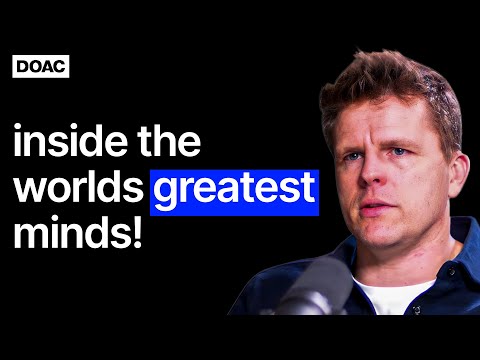
Lessons From 50 Of The Worlds Greatest Minds with Jake Humphrey | E59
Steven Bartlett (host), Jake Humphrey (guest)
In this episode of The Diary of a CEO, featuring Steven Bartlett and Jake Humphrey, Lessons From 50 Of The Worlds Greatest Minds with Jake Humphrey | E59 explores high Performers, Hidden Crumbs: Jake Humphrey Redefines Success And Happiness Jake Humphrey returns to reflect on lessons from interviewing dozens of elite performers across sport, business, and entertainment for his High Performance Podcast. He unpacks Matthew McConaughey’s idea of “don’t leave crumbs,” the danger of glorifying struggle, and why he’s shifting from obsessing over failure to doubling down on what works and makes him happy.
High Performers, Hidden Crumbs: Jake Humphrey Redefines Success And Happiness
Jake Humphrey returns to reflect on lessons from interviewing dozens of elite performers across sport, business, and entertainment for his High Performance Podcast. He unpacks Matthew McConaughey’s idea of “don’t leave crumbs,” the danger of glorifying struggle, and why he’s shifting from obsessing over failure to doubling down on what works and makes him happy.
The conversation ranges from anxiety, perfectionism, and criticism to passion, burnout, and how childhood wounds often fuel adult success. Jake and Steven also dissect modern comparison culture, invisible networking ‘karma’, and the practical realities of starting and growing a podcast or purpose‑driven business.
Throughout, Jake redefines high performance as “consistently, happily relentless” rather than stressed, sacrificial grind, emphasizing presence, self‑knowledge, and meaningful relationships over status or money. He closes by describing how hosting his podcast has fundamentally changed him, even mid‑career, and why he now sees it as both personal therapy and a legacy for his children.
Key Takeaways
Apply “don’t leave crumbs” to micro‑decisions, not just big goals.
McConaughey’s rule means making choices you won’t have to ‘clean up’ later—whether that’s an extra drink that ruins tomorrow, leaving prep to the last second, or not printing notes before an interview. ...
Get the full analysis with uListen AI
Shift from obsessing over failure to replicating what works.
Early in his career Jake fixated on mistakes, a mindset reinforced by David Coulthard’s “how does talking about the good stuff make the boat go faster? ...
Get the full analysis with uListen AI
Use emotional detachment and probabilities to handle crises rationally.
Steven describes treating life like a video game: he owns decisions but refuses to become the problem emotionally. ...
Get the full analysis with uListen AI
Name your anxieties and patterns so you can manage—not obey—them.
Jake has lifelong irrational fears of imminent disaster (with his mum, kids, phone calls, even lifts). ...
Get the full analysis with uListen AI
Redefine high performance as ‘consistently, happily relentless,’ not permanent struggle.
Interviews with people like Johnny Wilkinson shifted Jake’s view. ...
Get the full analysis with uListen AI
Design your life and work around passion to avoid burnout.
Jake’s observation: burnout rarely appears among his guests because nearly all are deeply passionate about what they do. ...
Get the full analysis with uListen AI
Relationships, reputation, and generosity compound through ‘invisible PR.’
Both stress how tiny interactions have outsized, hidden effects. ...
Get the full analysis with uListen AI
Notable Quotes
“The very flame of success should be happiness. What’s the point otherwise, man?”
— Jake Humphrey
“I thought the struggle was part of the hard work… That is so, so, so wrong.”
— Jake Humphrey
“Your biggest risk is you’ll just never start.”
— Steven Bartlett
“With real passion, I don’t think you suffer burnout… every day gets filled up again.”
— Jake Humphrey
“Sometimes you have to wait a long time in life for your dream opportunity… I didn’t realize you could change this much, this late.”
— Jake Humphrey
Questions Answered in This Episode
You’ve shifted from glorifying struggle to emphasizing ‘consistently, happily relentless’—how would you practically redesign a typical overworked high achiever’s week to reflect that new philosophy?
Jake Humphrey returns to reflect on lessons from interviewing dozens of elite performers across sport, business, and entertainment for his High Performance Podcast. ...
Get the full analysis with uListen AI
When you catch your catastrophic thinking kicking in (e.g., about your kids or a ‘we need to talk’ message), what exact self‑talk or micro‑actions have proven most effective at interrupting the spiral in real time?
The conversation ranges from anxiety, perfectionism, and criticism to passion, burnout, and how childhood wounds often fuel adult success. ...
Get the full analysis with uListen AI
Looking back at your early High Performance episodes, which specific questions or framing do you now regret because they might have unintentionally reinforced unhealthy hustle or sacrifice narratives?
Throughout, Jake redefines high performance as “consistently, happily relentless” rather than stressed, sacrificial grind, emphasizing presence, self‑knowledge, and meaningful relationships over status or money. ...
Get the full analysis with uListen AI
Coral Eyewear aims to be ‘planet positive’ rather than just ‘less bad’—what have been the hardest commercial compromises or trade‑offs you’ve had to make to stay genuinely sustainable rather than drifting into greenwashing?
Get the full analysis with uListen AI
You and Steven both see childhood wounds as powerful fuel for adult success; how do you distinguish between using that fuel productively and staying unconsciously trapped in a cycle of never‑enough achievement driven by old pain?
Get the full analysis with uListen AI
Transcript Preview
This week on the Diary of a CEO, we have a returning guest, Jake Humphreys. He is an entrepreneur. He is a TV presenter. He's also now a podcaster. And Jake has spent the last year on his podcast sitting down with some of the most high-performance people, some of the most accomplished people in their industries from acting, to business, to sports, you name it. And so because of that experience, because of all the insights he's gained over the last year since we last spoke, I wanted to sit down with him and compare notes. We have a lot of high-performance people on this podcast too. I wanted to understand the similarities. I wanted to pick into the minds of some of the guests and what he's learned from them. How are they the same? What makes them different? And that's what we're gonna talk about today. So without further ado, I'm Steven Bartlett and this is the Diary of a CEO. I hope nobody's listening, but if you are, then please keep this to yourself. (lively music) You've, um, you've had, what, 30 people on your podcast to date.
Yeah.
You've got a lot more coming up. One of the key questions that I, that I wanted to ask you, because it's, you know, something that I ask myself is, what are those, like, key lessons that you've learned? You've, you've interviewed, uh, you know, high-performance athletes, actors, authors, um, and really sort of high-performance pe- people-
Yeah.
... from all industries. What are the key lessons and the themes?
I think there is one key lesson that was summed up for me by Matthew McConaughey, the Oscar-winning actor who came on my pod recently, and his phrase is, "Don't leave crumbs." And what he means by that is, like when you're making a decision don't leave stuff behind. Don't make a bad decision now that later on you've got to go back and pick that crumb up and be regretful about it, and that's brilliant because sometimes when we talk on the podcast, we talk about really, like, big blue sky thinking. You know, like we talk to you about Social Chain, setting up Social Chain. Sometimes t- people that are listening in, that can seem, like, unreal almost, u- untouchable because it's this huge multimillion dollar business that you've created. But actually "don't leave crumbs" is about making the decisions for a big, big business like that and creating something amazing, but also, like, make sure that you don't have an extra drink in the evening in case it leaves you with a hangover tomorrow and you've got work to do. Or make sure you simply choose your clothes the night before so you're not doing it in a rush. And like I still leave crumbs all the time. Like I tell you, when we, uh, when we interviewed Matthew, like he's the first Hollywood actor we've had on the pod, so for me it was quite a big moment and I thought, "Right, I really want to be looking good for this." So I thought, "I'll have a shower and a shave before we do the interview." And I was having a shave in the bathroom. My wife was in the bath and she was gonna come down and, like, listen in the corner in my study 'cause she was like, she loves Dallas Buyers Club. She was excited. (laughs) And, uh, she... (laughs) I was having a shave and she goes, "It's 9:54." I was like, " (gasps) ," and I thought it was like 9:30 or something. We'd put the kids to bed. And then the next thing I know I'm running downstairs. I haven't done my hair properly. I'm on, I've got two Wi-Fis at home because our upload speed living in the countryside is horrendous. So I was then on the wrong Wi-Fi. I then looked for the script that I'd written for the questions for Matthew, couldn't find them, and I was like, "I was the last one in."
Install uListen to search the full transcript and get AI-powered insights
Get Full TranscriptGet more from every podcast
AI summaries, searchable transcripts, and fact-checking. Free forever.
Add to Chrome