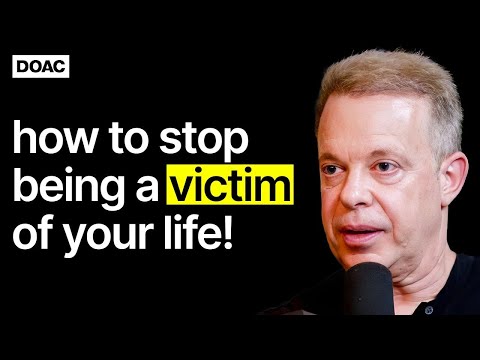
Dr Joe Dispenza: You MUST Do This Before 10am!
Dr Joe Dispenza (guest), Narrator, Steven Bartlett (host), Steven Bartlett (host)
In this episode of The Diary of a CEO, featuring Dr Joe Dispenza and Narrator, Dr Joe Dispenza: You MUST Do This Before 10am! explores rewire Your Morning Mind: Dr Joe Dispenza’s 10am Transformation Protocol Dr Joe Dispenza explains how most of our personality and behavior is subconscious programming by age 35, and how thought alone can both make us sick and heal us. He outlines a science-based method for change that combines new information, mental rehearsal, emotional regulation, and daily meditation—especially in the first hours after waking. Drawing on research from his week-long retreats, he cites rapid, measurable shifts in brain function, heart coherence, gene expression, and even serious health conditions. The conversation also explores addiction to negative emotions, the societal impact of chronic stress, and the need for a collective shift in consciousness.
Rewire Your Morning Mind: Dr Joe Dispenza’s 10am Transformation Protocol
Dr Joe Dispenza explains how most of our personality and behavior is subconscious programming by age 35, and how thought alone can both make us sick and heal us. He outlines a science-based method for change that combines new information, mental rehearsal, emotional regulation, and daily meditation—especially in the first hours after waking. Drawing on research from his week-long retreats, he cites rapid, measurable shifts in brain function, heart coherence, gene expression, and even serious health conditions. The conversation also explores addiction to negative emotions, the societal impact of chronic stress, and the need for a collective shift in consciousness.
Key Takeaways
Use the Morning “Window” to Rewrite Your Subconscious Programs
Right after waking, your brain waves move from delta/theta into alpha and low beta—exactly when the analytical mind relaxes and the subconscious is most suggestible. ...
Get the full analysis with uListen AI
Change Requires Becoming Conscious of “The Habit of Being Yourself”
By ~35, about 95% of who you are is automatic: recurrent thoughts, emotions, and reactions your body executes better than your conscious mind. ...
Get the full analysis with uListen AI
Mental Rehearsal Primes Your Brain and Body for New Behavior
The brain doesn’t clearly distinguish between a vividly imagined act and a physical one. ...
Get the full analysis with uListen AI
You May Be Addicted to the Emotion, Not the Behavior
Many self‑sabotaging habits are driven by an attachment to familiar states like guilt, anger, resentment, or unworthiness rather than to the sugar, pornography, or drama itself. ...
Get the full analysis with uListen AI
Combine Clear Intention with Elevated Emotion to “Signal” the Future
Information alone rarely produces lasting change; the nervous system shifts when thoughts and emotions align. ...
Get the full analysis with uListen AI
Meditation Can Produce Rapid, Measurable Biological Shifts
In his week‑long retreats, participants undergo pre‑ and post‑ measures: fMRI/EEG, heart‑rate variability, blood metabolomics (~2,882 metabolites), gene expression, and microbiome analyses. ...
Get the full analysis with uListen AI
True Responsibility Means Creating Your Life Rather Than Reacting to It
Dispenza distinguishes between having life ‘happen to you’ and consciously creating it. ...
Get the full analysis with uListen AI
Notable Quotes
“The greatest habit we have to break is the habit of being ourselves.”
— Dr Joe Dispenza
“People are reliving a miserable life they never even had just to excuse themselves from changing.”
— Dr Joe Dispenza
“You can’t wait for your wealth to feel success. You can’t wait for your new relationship to feel love.”
— Dr Joe Dispenza
“If your thoughts can make you sick, can your thoughts make you well?”
— Dr Joe Dispenza
“It’s so much more important to romance your future instead of romance your past.”
— Dr Joe Dispenza
Questions Answered in This Episode
You describe morning and evening as critical windows for reprogramming the subconscious; what would a realistic ‘minimum effective’ protocol look like for someone with children and a demanding job who can only spare 15 minutes before 8am?
Dr Joe Dispenza explains how most of our personality and behavior is subconscious programming by age 35, and how thought alone can both make us sick and heal us. ...
Get the full analysis with uListen AI
In your week-long retreats, you report dramatic changes in metabolites, gene expression, and microbiome profiles—what specific biomarkers show the largest and most consistent shifts, and how do you address critics who attribute these changes to placebo or regression to the mean?
Get the full analysis with uListen AI
You shared extreme healing cases like thyroid regrowth and multiple people standing up from wheelchairs; what are the most common *non‑responders* you see, and what patterns in their mindset or practice differentiate them from those who experience breakthroughs?
Get the full analysis with uListen AI
Given your view that we can be addicted to emotions like guilt or resentment, how should clinicians and therapists balance validating a client’s trauma with challenging their possible unconscious attachment to the suffering narrative?
Get the full analysis with uListen AI
You argue that small, highly coherent groups may influence larger social and physical systems; if mainstream institutions embraced that idea, how would you design a large-scale experiment (e.g., across cities or nations) to rigorously test the societal impact of coordinated heart–brain coherence practices?
Get the full analysis with uListen AI
Transcript Preview
Our research shows that your thoughts can make you sick. And the question is, if your thoughts can make you sick, can your thoughts make you well? That's absolutely possible, and it's easy to learn. So when you wake up in the morning...
Dr. Joe Dispenza.
Researcher and best-selling author.
One of the most sought-after speakers in the world.
All with the aim of helping people better understand and unlock the power of their mind. I'm concerned about human species. Why? 75 to 90% of every person that goes to a healthcare facility goes because of psychological or emotional stress, and it gets addictive to people. They need the bad relationship, the bad job in order to feel, and there's so much research to show that when they analyze their life within some disturbing emotion, we saw that they were actually making their brain worse. But 50% of that story isn't even the truth. People are reliving a miserable life they never even had just to excuse themselves from changing. You can't wait for your wealth to feel success. You can't wait for your new relationship to feel love.
Uh, 95% of who we are by the age of 35 is programmed.
Yeah. But there is a way to change, and so the model of change is breaking the habit of the old self and reinventing a new self. And if you teach people how to do that, in seven days, you can see very significant changes. So try this out as an experiment. First thing you have to do is-
Dr. Joe, you're someone that's constantly doing research and developing new ideas about where humans are and the way the universe is. What are the beliefs in your head that you're too scared to share?
Oh, boy. I, I have a very strong belief that-
Before this episode starts, I have a small favor to ask from you. Two months ago, 74% of people that watched this channel didn't subscribe. We're now down to 69%. My goal is 50%. So if you've ever liked any of the videos we've posted, if you like this channel, can you do me a quick favor and hit the subscribe button? It helps this channel more than you know, and the bigger the channel gets, as you've seen, the bigger the guests get. Thank you and enjoy this episode. (instrumental music) Dr. Joe, 95% of who we are by the age of 35 is programmed. When I read that in your work, it kind of hit me like a ton of bricks, because I just turned 30, and if what you're saying there is true, without realizing it, there's a puppet master that sits above me that's calling the shots in a way that I don't think I've realized. Is that true?
I think ah, if we define a habit as a redundant set of automatic, unconscious thoughts, behaviors, and emotions that's acquired through repetition. A habit is when you've done something so many times that your body now knows how to do it better than your conscious mind. Then it's programmed subconsciously. So then when the body knows how to do it better than the conscious mind, then for the most part, the greatest habit we have to break is the habit of being ourselves, right? So there's a principle in neuroscience that says that nerve cells that fire together wire together.
Install uListen to search the full transcript and get AI-powered insights
Get Full TranscriptGet more from every podcast
AI summaries, searchable transcripts, and fact-checking. Free forever.
Add to Chrome