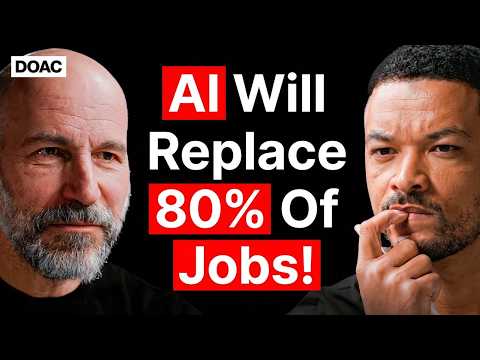
Uber CEO: At Uber, If You Don’t Perform, You’re Out! Uber Was Losing $3b A Year
Dara Khosrowshahi (guest), Steven Bartlett (host)
In this episode of The Diary of a CEO, featuring Dara Khosrowshahi and Steven Bartlett, Uber CEO: At Uber, If You Don’t Perform, You’re Out! Uber Was Losing $3b A Year explores dara Khosrowshahi on relentless performance, transparency, and AI disruption Dara Khosrowshahi traces his drive and risk tolerance to fleeing Iran after the 1978 revolution, watching his family lose everything, and later rebuilding in the U.S.
Dara Khosrowshahi on relentless performance, transparency, and AI disruption
Dara Khosrowshahi traces his drive and risk tolerance to fleeing Iran after the 1978 revolution, watching his family lose everything, and later rebuilding in the U.S.
He describes leadership as an engineering problem: set the right goals, build fast feedback loops, and create a culture where truth travels quickly—even if it scares people off.
Khosrowshahi contrasts coasting cultures with “embracing the grind,” arguing that hard work is a learned (and compounding) advantage, and that transparency is a practical tool for better decisions.
He outlines Uber’s AI-first foundation (pricing, routing, matching) and warns that AI/autonomy could disrupt 70–80% of intellectual work in ~10 years and physical work in ~15–20, raising unresolved societal questions about retraining, meaning, and unemployment.
Key Takeaways
Radical honesty is a decision-quality tool, not a personality trait.
Khosrowshahi argues CEOs fail more from bad data than bad judgment; by telling the truth first, leaders earn truth back and reduce filtering up the chain.
Get the full analysis with uListen AI
Build “source-level” information channels to beat organizational filtering.
He emulates Barry Diller’s habit of going directly to the people closest to the work (often engineers) to preserve fidelity and surface problems early.
Get the full analysis with uListen AI
Hard work compounds and can outperform raw talent over time.
He treats effort as a skill—focus, discipline, repetition after failure—and insists on a culture where people expect demanding standards and direct feedback.
Get the full analysis with uListen AI
Turnarounds require speed because decline can be exponential too.
In tech, once momentum turns negative, recovery is brutally hard; he pushed rapid action at Expedia when the “technology engine was broken,” even if it scared people.
Get the full analysis with uListen AI
Transitions reward leaders who think in exponentials, not straight lines.
He describes the opportunity as the gap between linear forecasts and “hockey-stick” reality—why IAC often ‘overpaid’ by contemporaneous standards for eventual winners.
Get the full analysis with uListen AI
Company values can be useful—or weaponized—depending on execution.
Uber’s old “toe-stepping” (truth-telling) could become permission to be a jerk; he later prioritized distinctive, behavior-shaping values like “Go get it” and “Great minds don’t think alike,” anchored by “Do the right thing, period.”},{
Get the full analysis with uListen AI
AI will reshape work faster than societies can comfortably retrain.
He expects AI to replace much intellectual labor within ~10 years and physical labor later, and says the missing capability is a scalable ‘retraining machine’—plus a solution for meaning, not just money.
Get the full analysis with uListen AI
Notable Quotes
““You come to Uber, you're gonna work your ass off, and if you're not performing, we're gonna let you know.””
— Dara Khosrowshahi
““The most important skill in life is the skill of working hard… I’m not gonna let anyone outwork me.””
— Dara Khosrowshahi
““They won, we lost. Next.””
— Dara Khosrowshahi (quoting Barry Diller’s style)
““Before you go out and try to change the world, let the world change you first.””
— Dara Khosrowshahi
““When a company who’s a verb tells you to run it, you just say yes.””
— Dara Khosrowshahi (relaying his father’s advice)
Questions Answered in This Episode
You say transparency may “scare people away.” What are the specific mechanisms you use to deliver hard truths without crossing into fear-based management?
Dara Khosrowshahi traces his drive and risk tolerance to fleeing Iran after the 1978 revolution, watching his family lose everything, and later rebuilding in the U.S.
Get the full analysis with uListen AI
At Uber you emphasize “work hard” but also “flexibility.” What does an elite-performing week look like in practice for different roles (engineering, ops, product)?
He describes leadership as an engineering problem: set the right goals, build fast feedback loops, and create a culture where truth travels quickly—even if it scares people off.
Get the full analysis with uListen AI
You said you’ve never seen a non-hard-worker become an exceptionally hard worker. What hiring signals or interview questions best predict “embrace the grind”?
Khosrowshahi contrasts coasting cultures with “embracing the grind,” arguing that hard work is a learned (and compounding) advantage, and that transparency is a practical tool for better decisions.
Get the full analysis with uListen AI
How do you prevent goal-setting systems from being gamed, especially when teams are optimizing local metrics (diffs, conversion, NPS) that can conflict?
He outlines Uber’s AI-first foundation (pricing, routing, matching) and warns that AI/autonomy could disrupt 70–80% of intellectual work in ~10 years and physical work in ~15–20, raising unresolved societal questions about retraining, meaning, and unemployment.
Get the full analysis with uListen AI
On exponential transitions: what are your repeatable indicators that a market is about to hockey-stick—before it’s obvious?
Get the full analysis with uListen AI
Transcript Preview
You come to Uber, you're gonna work your ass off, and if you're not performing, we're gonna let you know.
But do you ever worry that they might not be able to deal with the truth?
Then they can leave, because the most important skill in life is the skill of working hard. And when you see the top athletes, Ronaldo, Michael Jordan, of course they're talented, but the thing that's different about them is they work their asses off, and that's a learned skill. That's not something you're born with. You may be smarter, more talented, et cetera, but I'm not gonna let anyone outwork me.
And with that mentality, when you joined Uber, Uber was losing three billion per year. Now it generates eight point five billion in free cash flow every year. But it seems that you were forged in such a way that you were gonna be relentless.
Yeah, and it really started with being born in Iran. With the Islamic Revolution in 1978, we were not safe there. And I remember at one point we had these revolutionary guards come into the backyard, and bullets went through our living room. So my family came to the US to rebuild their lives.
You were what, eight, nine years old?
Yeah, and it really destroyed my dad. [voice breaking] Sorry, he... [exhales] It's tough for me to talk about it.
All right.
Sorry. All right, let me try again. Seeing that has put me on a road where I just wanted to make my family proud. So I studied bioelectrical engineering, and then my first job was investment banking, and I got to see the process of big companies being built, and then I had the opportunity to take over Expedia.
And in your twelve years as CEO, Expedia's sales increased from two point one billion to eight point eight billion, and you were the highest paid CEO of a US tech company.
And I left it all behind to go to Uber.
And I wanna get into practical company building, how you would get that company to work hard and create a culture of continuous improvement and all that stuff. But there's an alien that's arrived amongst us, which is AI. Now, driving, I think, is one of the biggest employers in the world, like, as a profession.
I mean, we've got nine and a half million drivers and couriers on our platform.
Those drivers, couriers that you have, will be out of work. Being honest about the situation, what do the nine million people do? [dramatic sound effect] Guys, I've got a quick favor to ask you. We're approaching a significant subscriber milestone on this show, and roughly sixty-nine percent of you that listen and love this show haven't yet subscribed for whatever reason. If there was ever a time for you to do us a favor, if we've ever done anything for you, given you value in any way, it is simply hitting that Subscribe button, and it means so much to myself but also to my team, 'cause when we hit these milestones, we go away as a team and celebrate. And it's the thing, the simple, free, easy thing you can do to help make this show a little bit better every single week. So that's a favor I would ask you, and, um, if you do hit the Subscribe button, I won't let you down, and we'll continue to find small ways to make this whole production better. Thank you so much for being part of this journey. It means the world, and, uh, yeah, let's do this. [upbeat music] Dara, you lead one of the most consequential, interesting, talked-about companies of my generation. It's worth hundreds of billions of dollars last time I checked, and it's, uh, it's a company that I use every single day.
Install uListen to search the full transcript and get AI-powered insights
Get Full TranscriptGet more from every podcast
AI summaries, searchable transcripts, and fact-checking. Free forever.
Add to Chrome