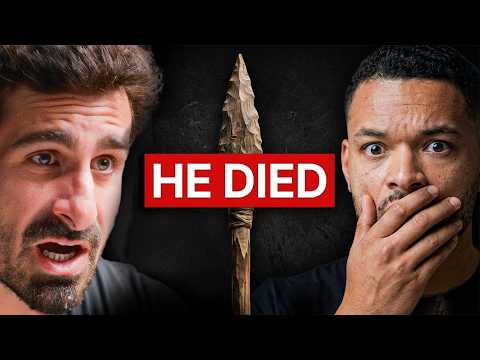
I Met An Uncontacted Tribe: They Killed My Friend! (VIDEO PROOF)
Paul Rosolie (guest), Steven Bartlett (host), Steven Bartlett (host), Steven Bartlett (host)
In this episode of The Diary of a CEO, featuring Paul Rosolie and Steven Bartlett, I Met An Uncontacted Tribe: They Killed My Friend! (VIDEO PROOF) explores amazon conservationist shares first contact footage, purpose lessons, and danger Paul Rosolie, a longtime Amazon conservationist and co-founder of Junglekeepers, describes how witnessing logging and deforestation turned his teenage thirst for adventure into a mission to protect an Amazon watershed and support indigenous-led protection.
Amazon conservationist shares first contact footage, purpose lessons, and danger
Paul Rosolie, a longtime Amazon conservationist and co-founder of Junglekeepers, describes how witnessing logging and deforestation turned his teenage thirst for adventure into a mission to protect an Amazon watershed and support indigenous-led protection.
A centerpiece of the episode is his account—and rare video—of first contact with a nomadic uncontacted group (often labeled Mashco-Piro), highlighting fear on both sides, requests for food/rope, and their core plea: how to distinguish “good guys” from “bad guys” amid violence from traffickers, loggers, and miners.
The conversation broadens into modern life: how disconnection from nature and constant screen exposure affect mental health, why doing hard things builds resilience, and what “meaning” looks like when life is reduced to survival fundamentals.
Rosolie also discusses a notorious Discovery Channel project (“Eaten Alive”) that derailed his career, Jane Goodall’s pivotal mentorship, ayahuasca, indigenous medicine, and a direct call to support rainforest protection via junglekeepers.org.
Key Takeaways
The Amazon’s importance is routinely underestimated because people miss the scale.
Rosolie frames the rainforest as a planet-shaping system holding vast freshwater and driving atmospheric cycles; he argues ecosystem collapse is a shared global problem and a “last generation” moment for repair.
Get the full analysis with uListen AI
Adventure can mature into meaning when it becomes responsibility.
He describes starting as an 18-year-old seeking wilderness, then shifting after watching ancient forest burned—turning exploration into a lifelong commitment to stop “bulldozers and chainsaws.”
Get the full analysis with uListen AI
First contact is not a trophy—it's an ethical emergency.
The tribe’s appearance is presented as driven by pressure (deforestation, violence). ...
Get the full analysis with uListen AI
Violence from uncontacted groups is often defensive, shaped by historical and ongoing threat.
He recounts multiple arrow attacks (including a friend nearly killed the day after the filmed encounter) and argues their aggression tracks the reality of being hunted, shot at, or boxed in.
Get the full analysis with uListen AI
Conservation can succeed by aligning livelihoods with protection, not extraction.
Junglekeepers’ model converts loggers/miners into paid rangers and funds protection directly through donors—aiming to secure hundreds of thousands of acres and potentially a national park.
Get the full analysis with uListen AI
Media shortcuts can destroy credibility and set movements back.
He says Discovery reframed his work into the stunt-focused “Eaten Alive,” angering audiences, scientists, and animal advocates, costing him years professionally—an example of narrative control risk.
Get the full analysis with uListen AI
Resilience is trained through voluntary hardship and real-world feedback loops.
He links wilderness living to clearer “what’s real” boundaries and echoes the idea that doing what you don’t want to do builds capacity—contrasting it with screen-mediated comfort and anxiety.
Get the full analysis with uListen AI
Notable Quotes
“If our ecosystems collapse, life on Earth is not possible, and we are the last generation in history that's going to have a chance to restore those ecosystems.”
— Paul Rosolie
“Every day the ground is like last night's newspaper. It tells you what happened.”
— Paul Rosolie
“They had one other question: 'How do we tell the bad guys from the good guys?'”
— Paul Rosolie
“They've never heard of a spoon or the wheel or Jesus.”
— Paul Rosolie
“I got Hollywooded hard. I got lied to, and I got taken for a ride.”
— Paul Rosolie
Questions Answered in This Episode
On the “one-fifth of oxygen” claim: what’s the most accurate way to describe the Amazon’s role in Earth’s oxygen and climate cycles without overstating it?
Paul Rosolie, a longtime Amazon conservationist and co-founder of Junglekeepers, describes how witnessing logging and deforestation turned his teenage thirst for adventure into a mission to protect an Amazon watershed and support indigenous-led protection.
Get the full analysis with uListen AI
What specific safeguards did you and the anthropologist use during the river encounter to reduce escalation—and what would you do differently today?
A centerpiece of the episode is his account—and rare video—of first contact with a nomadic uncontacted group (often labeled Mashco-Piro), highlighting fear on both sides, requests for food/rope, and their core plea: how to distinguish “good guys” from “bad guys” amid violence from traffickers, loggers, and miners.
Get the full analysis with uListen AI
You mentioned releasing only part of the footage. What ethical criteria determine what can/can’t be shown, and who participates in that decision?
The conversation broadens into modern life: how disconnection from nature and constant screen exposure affect mental health, why doing hard things builds resilience, and what “meaning” looks like when life is reduced to survival fundamentals.
Get the full analysis with uListen AI
When the tribe asked, “How do we tell the bad guys from the good guys?”, what concrete signals (objects, behaviors, routines) could realistically help them distinguish threats?
Rosolie also discusses a notorious Discovery Channel project (“Eaten Alive”) that derailed his career, Jane Goodall’s pivotal mentorship, ayahuasca, indigenous medicine, and a direct call to support rainforest protection via junglekeepers.org.
Get the full analysis with uListen AI
You describe the women raiding crops while the men negotiated. What does that imply about their food scarcity, social organization, and risk calculus?
Get the full analysis with uListen AI
Transcript Preview
This Burmese python wants to know what is inside The Diary Of A CEO.
Oh, my God!
It's beautiful. Now, what are you feeling right now?
Wondering why the [beep] I do this for a living.
Have you ever done a podcast- [laughing] - with a ten-foot snake across the table before?
No, this is my first.
Awesome. I'm gonna bring out the next friend.
Don't bring it over here.
Just don't move. [upbeat music]
Paul, what have you spent the last twenty years of your life doing?
Living out of a backpack in the Amazon rainforest, barefoot with a machete, to help the indigenous people save the Amazon. Whatever it takes. Which means crocodile bites, snake bites, very rare diseases, hunted by the narco traffickers. Like the picture of that guy, that scar is because he was shot in the head by a seven-foot arrow while he was trying to make peaceful contact with the uncontacted tribes. And this is actually a very important story.
I think I have a video of this.
Yeah, this is world-first footage. So a tribe isolated so deep in the jungle that they've never heard of a spoon, or the wheel, or Jesus, was coming out to make contact. So we do a two-day boat journey in one night through the worst thunderstorm I've ever seen. They were scared. We were scared, 'cause these tribes kill people all the time. And they had one question: "How do we tell the bad guys from the good guys?" You see, these people are being hunted by traffickers, and gold miners, and loggers, and boxed in by deforestation. But if our oceans and rainforests are vanishing, life on Earth is not possible. Now, it's not too late, but we're the last generation that can save it.
Paul, young kids are growing up attached to screens, and loneliness is at an all-time high. Is there anything that you learned in those fifteen years that a Westerner like me would find useful?
A hundred percent. So let's start with purpose. [upbeat music]
Listen, my, my team gave me a script that they asked me to read, but I'm just gonna ask you, um, in the nicest way I possibly can: Thank you, first and foremost, for choosing to subscribe to this channel. It is, um, it's been one of the most incredible, crazy years of my life. I never could have imagined... I had so many dreams in my life, but this was not one of them. And the very fact that these conversations have resonated with you, and you've given me so much feedback, is something I will always be appreciative of, and I almost carry a weight, a sort of burden of, uh, responsibility to pay you back. And the favor I would like to ask from you today is to subscribe to the channel, if you, um, would be so obliged. It's completely free to do that. Roughly about forty-seven percent of you that listen to this channel frequently currently don't subscribe to this channel. So if you're one of those people, please come and join us. Hit the subscribe button. It's the single free thing you can do to make this channel better, and every subscriber sort of pays into this show and allows us to do things bigger and better and to push ourselves even more. And I will not let you down if you hit the subscribe button, I promise you. And if I do, please do unsubscribe. But I promise I won't. Thank you. [upbeat music] Paul, you live an extraordinary life, a very atypical, extraordinary life. What have you spent the last twenty years of your life doing?
Install uListen to search the full transcript and get AI-powered insights
Get Full TranscriptGet more from every podcast
AI summaries, searchable transcripts, and fact-checking. Free forever.
Add to Chrome