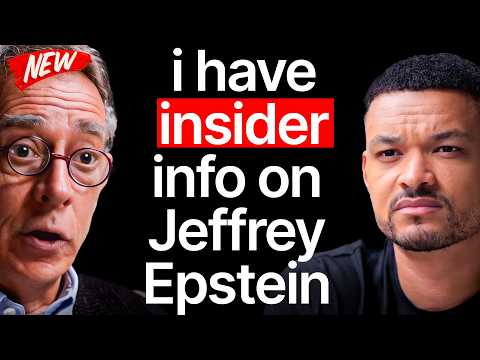
Top Intelligence Advisor: "Epstein Was A Front." They Can See Everything, Even Your Messages!
Gavin de Becker (guest), Steven Bartlett (host), Steven Bartlett (host)
In this episode of The Diary of a CEO, featuring Gavin de Becker and Steven Bartlett, Top Intelligence Advisor: "Epstein Was A Front." They Can See Everything, Even Your Messages! explores security expert warns privacy is dead, urges intuition amid distrust Gavin de Becker, a leading protective security advisor, explains how modern protection work spans physical threats, reputation attacks, and cyber intrusion—arguing that true phone confidentiality is effectively impossible against state actors.
Security expert warns privacy is dead, urges intuition amid distrust
Gavin de Becker, a leading protective security advisor, explains how modern protection work spans physical threats, reputation attacks, and cyber intrusion—arguing that true phone confidentiality is effectively impossible against state actors.
Using the Bezos phone-hack/Enquirer extortion episode, he details how geopolitical incentives and advanced spyware (e.g., no-click exploits) enable kompromat, leverage, and influence operations.
He claims Jeffrey Epstein functioned as an intelligence-linked “construct” running a blackmail operation—likely benefiting Israel—citing patterns (cameras/audio, unusual legal deal terms, Maxwell family ties) and reasons governments resist transparency.
The conversation broadens into institutional distrust, empire decline and division-by-fear, AI’s erosion of “reality,” and de Becker’s practical philosophy: trust intuition, prioritize contribution, and live “downstream” rather than forcing outcomes.
Key Takeaways
Assassination prevention is broader than bodyguards.
De Becker frames his company’s mission as preventing “tissue damage,” encompassing physical protection, threat assessment, armored transport, home hardening, and reputation/psychological threat management.
Get the full analysis with uListen AI
If a government targets your phone, privacy is not reliably defendable.
He argues that even secure devices are temporary solutions because exploit development is continuous; “confidentiality of your phone” cannot be guaranteed against state-level capabilities.
Get the full analysis with uListen AI
Kompromat often works best when the blackmailer plays rescuer.
Rather than overt threats, a manipulator can present the problem (“a recording exists; she’s underage”) and then offer to “handle it,” creating long-term control through fear and dependency.
Get the full analysis with uListen AI
The Bezos episode illustrates how power, media, and geopolitics intersect.
He links alleged Saudi interest to Bezos’ ownership of The Washington Post, Khashoggi fallout, business competition, and negotiating leverage—showing how personal devices become national-security battlegrounds.
Get the full analysis with uListen AI
Epstein is portrayed as a manufactured access vehicle, not merely a wealthy criminal.
De Becker claims Epstein’s public persona (billionaire access, assets, lifestyle) was a “construct,” pointing to suspicious funding arrangements and the operational use of cameras/audio to create leverage.
Get the full analysis with uListen AI
Government transparency is constrained by alliances and institutional self-protection.
He suggests redactions and reluctance stem from “national security” and the implications of an allied intelligence operation; the public may only get partial truth, late.
Get the full analysis with uListen AI
Intuition is protective signal-processing—people fail by ignoring it, not lacking it.
He emphasizes that intuition is “knowing without knowing why,” and the key training is honoring it (e. ...
Get the full analysis with uListen AI
Decentralization improves accountability; scale breeds bureaucracy and abuse.
He favors “subsidiarity” (local governance) and warns large institutions optimize for process over people; he describes using daily employee pulse questions (CARE) to restore feedback loops as organizations scale.
Get the full analysis with uListen AI
Notable Quotes
“Meetings were not, 'How shall we tell the public?' But, 'What shall we tell the public?'”
— Gavin de Becker
“There is absolutely no protection viable for the confidentiality of your phone if a government wants you.”
— Gavin de Becker
“What he was is a construct. He's a created construct.”
— Gavin de Becker
“Division is the fuel of power.”
— Gavin de Becker
“The ending embedded in the beginning.”
— Gavin de Becker
Questions Answered in This Episode
On phones: Are there any realistic behaviors or setups that meaningfully reduce risk (segmented devices, threat-modeling, air-gaps), even if nothing is perfect?
Gavin de Becker, a leading protective security advisor, explains how modern protection work spans physical threats, reputation attacks, and cyber intrusion—arguing that true phone confidentiality is effectively impossible against state actors.
Get the full analysis with uListen AI
On Bezos: What specific indicators made you confident there was hacking/foreign influence versus an insider leak or tabloid fabrication?
Using the Bezos phone-hack/Enquirer extortion episode, he details how geopolitical incentives and advanced spyware (e. ...
Get the full analysis with uListen AI
On Epstein: Which pieces of evidence do you consider strongest for an intelligence link, and what would you accept as disconfirming evidence?
He claims Jeffrey Epstein functioned as an intelligence-linked “construct” running a blackmail operation—likely benefiting Israel—citing patterns (cameras/audio, unusual legal deal terms, Maxwell family ties) and reasons governments resist transparency.
Get the full analysis with uListen AI
On the cameras: Who would operationally store, move, and exploit that volume of footage—and how could it disappear after law enforcement photographed it?
The conversation broadens into institutional distrust, empire decline and division-by-fear, AI’s erosion of “reality,” and de Becker’s practical philosophy: trust intuition, prioritize contribution, and live “downstream” rather than forcing outcomes.
Get the full analysis with uListen AI
On the Florida plea deal: How common are “unnamed co-conspirators” clauses, and what institutional incentives could produce that outcome without intelligence involvement?
Get the full analysis with uListen AI
Transcript Preview
I have inside information on Jeffrey Epstein and why the US government is reluctant to be more transparent. And I know this because when I was working in government, meetings were not, "How shall we tell the public?" But, "What shall we tell the public?" So often the best we can get in our skepticism is to know that we are not being told the truth.
I think people need to know the truth.
So put on your seatbelt, I'm gonna tell you everything, and all senior people in the US government know everything that you and I have discussed here today.
So you've been behind the scenes with some of the most successful, richest, most powerful people on planet Earth. But what is it you do, Gavin?
So I do protective coverage, you know, any of the ways that wealthy or prominent people might be targeted. For example, the Saudi Arabian government obtained a system which can get into your phone, used it on Jeff Bezos. So our work was to figure out how it happened.
Why would a government want to hack the founder of Amazon's phone?
So I'll tell you in a second, but we're all not as careful as we could be in terms of what we say, what we text, and there is absolutely no protection viable for the confidentiality of your phone. Do you have any skepticism about that?
I just have a lot of ignorance to how this whole world works.
Lucky you. But all power centers in human history lie. There are some examples of this where we'll start telling the truth about something, but years later, things like cancer-causing asbestos in baby powder, a hundred thousand people dying from heart attacks from opioids, and we'll see it with mass vaccinations.
So what advice would you give about how to navigate in the world we're living in today to avoid risk, threat?
I've got some core truths. So first of all...
Guys, I've got a quick favor to ask you. We're approaching a significant subscriber milestone on this show, and roughly sixty-nine percent of you that listen and love this show haven't yet subscribed for whatever reason. If there was ever a time for you to do us a favor, if we've ever done anything for you, given you value in any way, it is simply hitting that subscribe button. And it means so much to myself but also to my team, 'cause when we hit these milestones, we go away as a team and celebrate. And it's the thing, the simple free easy thing you can do to help make this show a little bit better every single week. So that's a favor I would ask you, and, um, if you do hit the subscribe button, I won't let you down, and we'll continue to find small ways to make this whole production better. Thank you so much for being part of this journey. It means the world and, uh, yeah, let's do this. [upbeat music] Gavin, we have a mutual friend, and that mutual friend actually sent me a voice note late last night. Here is what the voice note says.
Install uListen to search the full transcript and get AI-powered insights
Get Full TranscriptGet more from every podcast
AI summaries, searchable transcripts, and fact-checking. Free forever.
Add to Chrome