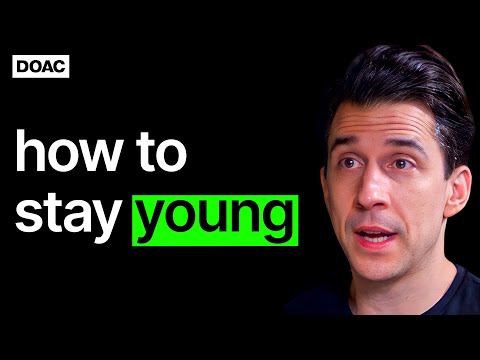
Russell Kane: How To Build Confidence & Stay Young | E79
Steven Bartlett (host), Russell Kane (guest), Narrator, Steven Bartlett (host)
In this episode of The Diary of a CEO, featuring Steven Bartlett and Russell Kane, Russell Kane: How To Build Confidence & Stay Young | E79 explores russell Kane: Biohacking, Brutal Honesty, and Rethinking Success, Love, Luck Comedian Russell Kane joins Steven Bartlett to unpack how his tough working‑class upbringing, overbearing father, and late academic breakthrough shaped his drive, confidence and outlook on life. He explains how self-awareness, cognitive objectivity, and an addiction-like love for stand-up comedy transformed his career from ad copywriter to award-winning comic. Kane dives deeply into biohacking, aging, nutrition, and hair loss, outlining his routines and supplements while stressing personal experimentation and responsibility. The conversation also tackles cancel culture, luck, meritocracy, relationships, sex, and religion, arguing for nuance, personal responsibility, and societal systems that better surface hidden talent.
Russell Kane: Biohacking, Brutal Honesty, and Rethinking Success, Love, Luck
Comedian Russell Kane joins Steven Bartlett to unpack how his tough working‑class upbringing, overbearing father, and late academic breakthrough shaped his drive, confidence and outlook on life. He explains how self-awareness, cognitive objectivity, and an addiction-like love for stand-up comedy transformed his career from ad copywriter to award-winning comic. Kane dives deeply into biohacking, aging, nutrition, and hair loss, outlining his routines and supplements while stressing personal experimentation and responsibility. The conversation also tackles cancel culture, luck, meritocracy, relationships, sex, and religion, arguing for nuance, personal responsibility, and societal systems that better surface hidden talent.
Key Takeaways
You can break generational patterns, but only if you cultivate insight into yourself.
Kane describes his father as a powerful, negative, overbearing presence who lived in constant upward comparison and self-pity. ...
Get the full analysis with uListen AI
Self-awareness is a practiced skill: learn to criticise your own 'work' as a separate object.
Kane argues that the path to real self-awareness runs through objectivity: treating your work, routines, and even relationships as 'things' you can examine and critique. ...
Get the full analysis with uListen AI
Most people underestimate how much hard, boring practice underpins visible 'talent'.
When aspiring comics ask to open for him, Kane lays out the real timeline: three years unpaid, multiple gigs a week, five years to make small money, around eight to nine years before being good enough to support on tour. ...
Get the full analysis with uListen AI
Luck favors the observant and proactive; 'lucky' people manufacture more opportunities.
Citing research (Richard Wiseman’s work on luck), Kane describes an experiment where 'lucky' and 'unlucky' people are given a newspaper; on page two a big headline says they can stop and claim the prize. ...
Get the full analysis with uListen AI
Working extremely hard is sustainable only if you love the work and feel in control.
Kane contrasts his own punishing schedule (late filming, minimal sleep, early podcast, constant touring) with people grinding in jobs they hate. ...
Get the full analysis with uListen AI
Biohacking can extend 'healthspan', but basics—fasting, carbs, and sleep—are the foundation.
To maintain his energy and youthful appearance for a high-intensity stage act, Kane uses intermittent fasting (often skipping breakfast, having long gaps between meals) and a relatively low-carbohydrate diet to improve cellular processes like autophagy and insulin control. ...
Get the full analysis with uListen AI
Long-term relationships survive male and female desire by talking honestly about sex and temptation.
Kane is explicit that many relationships fail not because love ends, but because unspoken sexual boredom or curiosity festers into cheating. ...
Get the full analysis with uListen AI
Notable Quotes
“I felt sometimes a bit like a bonsai – fully grown but small.”
— Russell Kane
“Genetics is not destiny. If identical twins can end up different heights, you’re not destined to be your dad.”
— Russell Kane
“Most people that are absolutely excellent at something have done a lot of boring, repetitive practice that would be boring to the person asking the question.”
— Russell Kane
“The solution isn’t giving someone a million‑pound‑a‑year job; it’s getting them to switch the light bulb on in themselves.”
— Russell Kane
“It’s not that eating too much makes you overweight; being overweight makes you eat too much.”
— Russell Kane
Questions Answered in This Episode
You’ve described your dad’s constant negativity and upward comparison as a 'script' you worked hard not to absorb; what specific daily habits or mental reframes helped you rewrite that script when it tried to resurface?
Comedian Russell Kane joins Steven Bartlett to unpack how his tough working‑class upbringing, overbearing father, and late academic breakthrough shaped his drive, confidence and outlook on life. ...
Get the full analysis with uListen AI
In your stand‑up career, you turned something that almost wrecked your life into a sustainable vocation; if you had to design a 12‑month 'stand‑up apprenticeship' for someone serious, what would the concrete weekly schedule and milestones look like?
Get the full analysis with uListen AI
You argue that obesity often causes overeating rather than the other way around; if you were tasked with designing NHS policy on obesity with that framing in mind, what practical changes would you make to treatment and public messaging?
Get the full analysis with uListen AI
You advocate couples openly discussing sexual boredom and fantasy to prevent cheating; what step‑by‑step conversation structure would you recommend to someone who’s terrified their partner will react with anger or shame?
Get the full analysis with uListen AI
On cancel culture, you’re trying to hold both nuance and accountability; if 'Evil Genius' became a global TV format, how would you handle a living guest whose current behaviour is actively harmful but whose work is culturally important?
Get the full analysis with uListen AI
Transcript Preview
(music plays) Russell Kane, he's known as a multi-award-winning comedian, presenter, actor, author, and script writer. But man, this guy is so much more.
I started doing all this biohacking to survive on less sleep, to not lose your hair, or to slow down the aging process. It fucked my life in the proper sense. Everything fell apart. Like a junkie. How can I get more of that? My relationship with my girlfriend fell apart. My bills started to not be paid. I started to look thin. It's the closest thing to a drug addiction that I've ever experienced.
Russell Kane. He's known as a multi-award winning comedian, presenter, actor, author, and script writer. But man, this guy is so much more. He's genuinely, deeply intellectually curious, something that honestly surprised me. And this sounds like it might be e- offensive or a weird thing to say, but I'm gonna say it anyway. I didn't realize how smart this guy is. Remarkably self-aware and on, to top it all off, brutally honest. He says it how it is. He has an ability to point out things that I think most of us muggles miss, and he's also genuinely just a really nice and hilarious human being. Today, you won't hear many jokes. This is the more serious side of Russell Kane, and a side of him that I did not know and would not have guessed before speaking to him. So without further ado, I'm Steven Bartlett, and this is The Diary of a CEO. I hope nobody's listening, but if you are, then please keep this to yourself. Russell.
Hello.
On- (laughs) one of the things I read when I was, um, reading about your story was a quote.
Mm-hmm.
Um, and I'm gonna read the quote to you. You said, "I remained a boy while he was alive, even when I was 18, and I needed to be a man to tell these stories." What were you talking about when you said that?
Um, well, I don't think that's true of just me. I think any boy or probably girl who has a reasonably overbearing and dominant father, you sort of remain a, a child. Now that I'm a, a father myself, I can see that's true. So when my daughter Mina is 40, she's still gonna be my, my baby, so that's the positive side of it.
Mm-hmm.
The negative side of it is if it's quite an overbearing, masculine energy, y- the, you sort... I felt sometimes a bit like a bonsai, like I kept nearly growing and then the roots were trimmed. So I was fully grown but small.
Mm.
So if my dad was in the room, you know, I was instantly s- childlike, I would say, in- inside. So just a very dominating figure and I think that would've been the same had my dad not dropped down dead from a heart attack years ago. I think that would've been the same when I'd been 40, 50, 60. If my dad had been a n- 90-year-old shouting in the corner, I probably still would've been like that.
Install uListen to search the full transcript and get AI-powered insights
Get Full TranscriptGet more from every podcast
AI summaries, searchable transcripts, and fact-checking. Free forever.
Add to Chrome