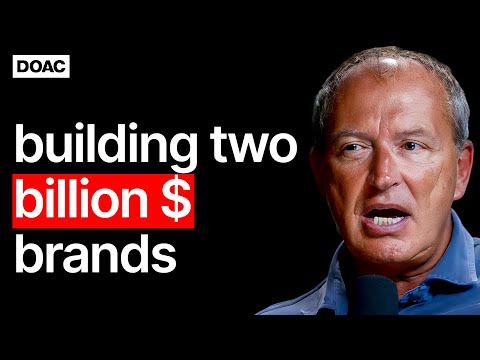
Pret & Itsu Founder: How I Built TWO Billion Dollar Brands At The Same Time!: Julian Metcalfe | E173
Julian Metcalfe (guest), Steven Bartlett (host)
In this episode of The Diary of a CEO, featuring Julian Metcalfe and Steven Bartlett, Pret & Itsu Founder: How I Built TWO Billion Dollar Brands At The Same Time!: Julian Metcalfe | E173 explores julian Metcalfe: Turning Pain, Obsession And Truth Into Billion-Dollar Brands Julian Metcalfe, founder of Pret A Manger and itsu, explains how childhood loneliness, distrust of authority, and a deep love of food and people shaped two multi‑billion‑dollar brands.
Julian Metcalfe: Turning Pain, Obsession And Truth Into Billion-Dollar Brands
Julian Metcalfe, founder of Pret A Manger and itsu, explains how childhood loneliness, distrust of authority, and a deep love of food and people shaped two multi‑billion‑dollar brands.
He argues that long‑term success comes from obsessive focus on product quality, culture, transparency and genuine affection for staff and customers, not financial engineering or short‑term ambition.
The conversation ranges from his mother’s suicide and cold schooling, to radical hiring practices, generosity‑based ‘loyalty’, and selling Pret while building itsu into an affordable, nutritious food platform.
Metcalfe is candid about his inadequacies and trade‑offs, insisting that embracing failure, naivety, and emotional truth is essential to creating anything genuinely new and valuable.
Key Takeaways
Deep emotional wounds can fuel drive, but they are not a prerequisite for success.
Metcalfe links his loneliness, lack of affection, and bad experiences with authority to his later distrust of institutions and compulsion to forge his own path. ...
Get the full analysis with uListen AI
Transparency and truth inside a company are more valuable than any tactic.
He argues most businesses lack internal transparency because people protect their status, pay and insecurities. ...
Get the full analysis with uListen AI
Culture and relationships drive the numbers, not the other way around.
Metcalfe largely ignores spreadsheets in favor of obsessing over food quality, staff pride, and customer relationships. ...
Get the full analysis with uListen AI
Empowering frontline staff radically improves performance and ownership.
Pret allowed shop teams to vote on whether trial employees were hired, and introduced ‘Buddy Days’ where office staff worked in stores. ...
Get the full analysis with uListen AI
Naivety and willingness to fail are core innovation tools.
Metcalfe insists he “had no idea” what he was doing with Pret and still regularly casts himself into ‘never‑never land’ with itsu. ...
Get the full analysis with uListen AI
Generosity can be a long‑term economic strategy, even if you can’t prove it on a spreadsheet.
Instead of a points card, Pret staff could give multiple free items daily to anyone they chose, logging them via a ‘Joy of Pret’ button. ...
Get the full analysis with uListen AI
Founders pay a relational price for extreme commitment, and need to accept and manage that trade‑off.
He admits that his relentless focus on creating and building comes at the expense of time and emotional energy for loved ones. ...
Get the full analysis with uListen AI
Notable Quotes
“To create something new, you’ve got to put yourself in slightly uncharted territory.”
— Julian Metcalfe
“I love failure. I fail every day. I don’t care about it, I just get on with it.”
— Julian Metcalfe
“Transparency and people being open and honest and building trust is by far the most important characteristic ever… Transparency is everything.”
— Julian Metcalfe
“I’m far more interested in the relationships with the customer and the staff and the product. The numbers just look after themselves.”
— Julian Metcalfe
“Very ambitious people are a pain in the ass… I take a 30‑year view to everything I do.”
— Julian Metcalfe
Questions Answered in This Episode
You’ve said Pret’s ‘Joy of Pret’ giveaways worked despite zero numerical proof. If you had to design a minimal measurement framework today, what would you track to preserve the spirit while satisfying a data‑driven investor?
Julian Metcalfe, founder of Pret A Manger and itsu, explains how childhood loneliness, distrust of authority, and a deep love of food and people shaped two multi‑billion‑dollar brands.
Get the full analysis with uListen AI
You’re wary of ‘very ambitious’ managers because of their short‑termism. How do you differentiate between healthy ambition and destructive ambition when interviewing or promoting leaders at itsu?
He argues that long‑term success comes from obsessive focus on product quality, culture, transparency and genuine affection for staff and customers, not financial engineering or short‑term ambition.
Get the full analysis with uListen AI
Looking back at the Natasha’s Law tragedy from your current vantage point, is there anything cultural or systemic you would unequivocally change about how fast‑growing food chains approach allergen risk and labelling?
The conversation ranges from his mother’s suicide and cold schooling, to radical hiring practices, generosity‑based ‘loyalty’, and selling Pret while building itsu into an affordable, nutritious food platform.
Get the full analysis with uListen AI
You framed your obsessive work as inevitably costing time and nurture for loved ones. If one of your children adopted your exact work style, would you advise them to copy you, or would you recommend a different balance?
Metcalfe is candid about his inadequacies and trade‑offs, insisting that embracing failure, naivety, and emotional truth is essential to creating anything genuinely new and valuable.
Get the full analysis with uListen AI
Both Pret and itsu were born from you ‘swimming upstream’ against industry norms. If you were 30 again and starting a brand‑new food concept today, which current norms would you most want to swim against, and why?
Get the full analysis with uListen AI
Transcript Preview
I love failure. (instrumental music) I fail every day. I don't care about it, just get on with it. (instrumental music) You had Pret, and now you've got itsu. You are absolutely an entrepreneur at heart. As all the fish are going in one way, you suddenly look round and you think, "Damn it, I'm gonna go the other way."
When you look back at Pret, a business you ended up selling for two billion.
I have no idea what I was doing. It wasn't planned. Endless moments of magic, moments of bizarre creativity and confidence.
What was motivating you then?
I wanted to make a difference. I suddenly found myself with this responsibility to open a restaurant. From that start, we built 76 of them. We started developing it so it could become the future.
The absence of both parents.
He was quite distant, my father. My mother committed suicide when I was seven, that created a loneliness. To create something new, you've gotta put yourself in slightly unchartered territory.
Business isn't just business to you, is it? It's not just about the money.
No, and it shouldn't be to anyone. I'm far more interested in the relationships with the customer and the staff and the product. I was obsessed by that. Obsessed. It's incredible what people can do if people don't trust them, people don't nurture them, 'cause they're too busy being selfish, nurturing themselves.
What's the worst crisis you've ever had in your business?
I daren't even wanna go into it.
I wanna hear it. So, without further ado, I'm Steven Bartlett, and this is The Diary of a CEO. I hope nobody's listening, but if you are, then please keep this to yourself. Julian?
Yeah.
"I was exposed to a number of hardships as a child." You said that. What did you mean?
I love the way you start off with a real killer. Um, I can't remember who I said that to. Um, and I was expe-... Well, listen, I- I'm not, I'm not alone, by the way. Other, a great many people watching this or listening to this were exposed to hardships far greater than mine. But the death of my mother when I was seven, she, my mother committed suicide on Boxing Day, uh, so I was left... And my parents were divorced. So we, we lived, uh, the three of us, my brother, sister, and I, lived with our mum, but that was a difficult thing, that was, uh, uh, uh, that created a loneliness.
Did you, did you realize that at the time? Did you realize the impact that incident ha- had had on you growing up?
Probably not. No, I think I, that, you don't, when you're lonely, you don't really, aged eight or nine or 12, you don't really know you're lonely, you just, you don't feel whole, I suppose. You don't feel completely whole. Other people seemed to be jollier than I was at that age, that's for sure.
Install uListen to search the full transcript and get AI-powered insights
Get Full TranscriptGet more from every podcast
AI summaries, searchable transcripts, and fact-checking. Free forever.
Add to Chrome