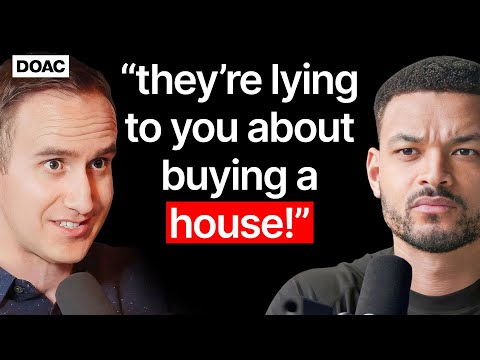
The Savings Expert: “Do Not Buy A House!” Do THIS Instead! - Morgan Housel
Morgan Housel (guest), Steven Bartlett (host)
In this episode of The Diary of a CEO, featuring Morgan Housel and Steven Bartlett, The Savings Expert: “Do Not Buy A House!” Do THIS Instead! - Morgan Housel explores stop Chasing Rich, Start Buying Freedom: Morgan Housel’s Money Playbook Morgan Housel argues that true wealth is not flashy spending but unspent money that buys you independence, time, and autonomy. Drawing on stories from his family, Warren Buffett, a janitor-turned-millionaire, and his own brush with death, he shows that endurance, low expectations, and emotional control matter more than IQ or stock‑picking genius.
Stop Chasing Rich, Start Buying Freedom: Morgan Housel’s Money Playbook
Morgan Housel argues that true wealth is not flashy spending but unspent money that buys you independence, time, and autonomy. Drawing on stories from his family, Warren Buffett, a janitor-turned-millionaire, and his own brush with death, he shows that endurance, low expectations, and emotional control matter more than IQ or stock‑picking genius.
He explains why saving aggressively, using simple index funds and dollar‑cost averaging, and holding for decades will almost certainly beat most active investors. At the same time, he warns about moving goalposts, social comparison, and trying to predict markets or economic crises—risk is mostly what you don’t see.
The conversation ranges from poverty and lottery tickets to parenting, housing, careers, and billionaires’ psychology, repeatedly returning to one theme: money is a tool to live a life true to yourself, not a scoreboard. Housel avoids prescriptive rules, instead using vivid stories to force listeners to define “enough,” confront their expectations, and design a financial life built around freedom rather than status.
Key Takeaways
Redefine wealth as hidden savings that buy your future freedom.
Housel distinguishes being rich (having money to spend on visible things) from being wealthy (money you don’t spend and may never spend). ...
Get the full analysis with uListen AI
Your expectations matter more for happiness than your income level.
If expectations rise faster than income, you’ll feel poor at any level—even as a billionaire. ...
Get the full analysis with uListen AI
Endurance and simplicity beat genius stock-picking over a lifetime.
Housel’s own portfolio is “painfully simple”: one bank account, a house, lots of cash, and broad index funds. ...
Get the full analysis with uListen AI
Stop trying to predict markets; invest in buffers and preparedness instead.
The biggest economic shocks—Pearl Harbor, 9/11, the 2008 crisis, COVID—were not in forecasts or models. ...
Get the full analysis with uListen AI
Status-seeking is financially toxic; almost no one cares about your stuff.
As a valet in LA, Housel realized he never admired drivers of luxury cars—he only imagined himself in their place. ...
Get the full analysis with uListen AI
Treat home ownership as a lifestyle decision, not a wealth strategy.
Historically, inflation‑adjusted home prices in the U. ...
Get the full analysis with uListen AI
Use big shocks and discomfort as catalysts to redesign your life and risk profile.
His friends’ deaths in an avalanche taught Housel how fragile life is and how much outcomes hinge on tiny, random decisions. ...
Get the full analysis with uListen AI
Notable Quotes
“Every bit of savings that you have is a piece of your future that you own.”
— Morgan Housel
“If your expectations rise faster than your income, you’re never gonna be happy with your money.”
— Morgan Housel
“If you have endurance and you’re investing, you’re gonna be filthy rich.”
— Morgan Housel
“Risk is what’s left over when you think you’ve thought of everything.”
— Morgan Housel
“If you’re buying a house because you think it’s gonna be a good financial investment, stop. Run for your life.”
— Morgan Housel
Questions Answered in This Episode
You draw a hard line between being rich and being wealthy. How should someone concretely audit their current lifestyle to see if their spending is eroding the autonomy they say they want?
Morgan Housel argues that true wealth is not flashy spending but unspent money that buys you independence, time, and autonomy. ...
Get the full analysis with uListen AI
If a listener is already heavily invested in property as an ‘investment,’ what specific steps would you recommend for rebalancing toward the kind of simple, resilient portfolio you advocate?
He explains why saving aggressively, using simple index funds and dollar‑cost averaging, and holding for decades will almost certainly beat most active investors. ...
Get the full analysis with uListen AI
You argue that risk is mostly what we don’t see, yet you still choose to be on a corporate board and hold a single stock. How do you decide when concentrated risk is justified versus when it’s just overconfidence?
The conversation ranges from poverty and lottery tickets to parenting, housing, careers, and billionaires’ psychology, repeatedly returning to one theme: money is a tool to live a life true to yourself, not a scoreboard. ...
Get the full analysis with uListen AI
For parents with substantial means, what practical guardrails would you put in place around helping children financially so they benefit from optionality without losing the hunger that drove your own career?
Get the full analysis with uListen AI
If most societal and personal breakthroughs follow from crises and discomfort, how can someone deliberately build constructive stress into a comfortable life without needing a dramatic failure or tragedy to force change?
Get the full analysis with uListen AI
Transcript Preview
If you're buying a house because you (beep) , d- don't do it. Run for your life.
Mr. Morgan Housel. He's the author of The Psychology of Money, one of the best-selling business books of this decade.
He can help anyone build wealth and change their life. The world is split between people who don't know how to start making money and people who don't know when to stop making money. And if you are stuck in a low-income job, you feel like you don't have the opportunity to generate wealth, but once you realize that opportunities are available for everybody, you can choose where you wanna live, what job you want, when you retire, because you can be rich.
Prove it.
People like Ronald Read, and he was a janitor.
What does it take to amass Mr. Read's $8 million fortune?
He has a fascinating story of somebody who became rich despite not having the skills that you normally associated with wealthy people. Then there's Warren Buffett, who's worth $100 billion, but the real secret to their success? Investing. My parents are a great example of this. We were very poor, no financial background, and they have, like, minimal financial interest, but now they'd probably be in the top 3% of professional investors. If you wanna do well with money, you don't need to be a genius. If you have endurance and you're investing, you're gonna be filthy rich. But when most people say, "I wanna be a millionaire," what they actually mean is, "I wanna spend a million dollars. I want some nice clothes, a bigger house, the nicer car." Ask yourself, what is your relationship with money? If your expectations rise faster than your income, you're never gonna be happy with your money. That's the problem.
So if I have 100 pounds, what's the first thing that I should do?
I keep it as painfully simple as I can. So...
Ladies and gentlemen, you're about to meet the man whose book changed my entire life as it relates to money and finance. About four or five years ago, my brother, who's a investment banker, said, "Steve, there's one book I need you to read about wealth, investing, and money, and finance," and he passed me a book called The Psychology of Money. That book changed my fortunes. It is the reason I've been a successful investor, and it's the reason I've been able to hold onto my wealth and build it. It's this man, and that's the reason why you need to stay tuned and listen to this episode. (upbeat music) Morgan, you wrote what I would consider to be the greatest book on money and finance ever written. I say that because I remember when I came into money when I was, uh, 25, 20, no, 27, 27, 28 years old, and my brother turned to me and said, "There's one thing I ask of you." He said, "You have to read this book called The Psychology of Money. It will stop you losing all of the money you've just earned from your career." And it changed my life. I've talked about it for years and years ever since, and that's why I was so keen to have this conversation with you, because I really believe if people choose to listen to this conversation, it stands the chance of changing those two. So let's begin. Why? Of all the things that you could do with your life, Morgan, why are you writing books about the subject matter that you explore? What is the reason?
Install uListen to search the full transcript and get AI-powered insights
Get Full TranscriptGet more from every podcast
AI summaries, searchable transcripts, and fact-checking. Free forever.
Add to Chrome